How to Write a Good Newsletter

We used to make zines with typed and photocopied pages. Those were the old days, before desktop publishing, computers and the whole concept of publishing on the Internet. Now, people are creating email newsletters to promote their online services and businesses. In between are the old, real newsletters which can still be created, written, planned, published and distributed to make money in the real (offline) world.

Consider making money with a real newsletter, in real print (not on the Internet).

Consider how many online newsletters you have actually read lately compared to the actual print newsletter which you pick up while you are out somewhere and likely read during some of your offline down time. I read the same print newsletter every month. It’s distributed through the family restaurant where I like to have a leisurely breakfast out a few times a month. I watch for the latest newsletter there. It’s sponsored by local businesses (it makes money by publishing their ads) and the content is light and simple. If the same content were on a website I would pass it by. But, when I’m just sitting there, enjoying a slow pace, that newsletter gets read and I enjoy it.

The print newsletter is not dead, it’s just a little rusty, dusty and over looked.

Make money writing a print newsletter you can distribute in your local community. Once you have a basic product (the newsletter) get paid advertising to make money from it all.

Open Source (Free) Graphics Editors

Desktop Publishing Software

The Business Plan

Start by looking at what sort of newsletter already exists in your area. You can get ideas from them and decide how you will compete with them. What could you bring that would get new readers, bring new information and attract local businesses to advertise in your newsletter?

Talk to local businesses and see who would be interested in in advertising and what kind of money they would consider fair and reasonable. It would be a good plan to approach them with a mock up of your print newsletter and a distribution plan. This way you will be ready to answer (at least some of) their questions.

Printing and Distributing the Newsletter

You need to find a local printer. Try offering free ad space in exchange for a discount on the cost of printing the newsletter. But, don’t choose a printer based on price alone. You want someone who can print the newsletter on time, without printing errors. One thing you can do is ask about left over paper stock from other jobs they have printed. You could get a bargain on paper someone else ordered and then didn’t use.

Printers can fold and/ or staple newsletters for you but that is an extra cost. Consider doing your own folding – at least until you are making money and can afford to spend on a few nice extras.

Is your newsletter being distributed in store fronts or mailed out? Options for distribution need to be considered based on cost, effectiveness and how well you can track the issues you put out versus how many were read by people. You need to know this for your advertisers. They want to know their ads are being seen.

Passive distribution means you leave your newsletter in public areas where people will pick it up. Active distribution means you have to know who you are sending your newsletter to, you will need to create and build up a mailing list of subscribers. If you use active distribution you can also consider having paying subscribers versus free subscriptions. People might pay for a subscription to a print newsletter if the content were valuable to them in particular. A general sort of newsletter isn’t likely to find a lot of people interested in paid subscriptions.

Read More

How to Write a Christmas Newsletter

Publishing a Hyper Local Print Newsletter

Small publishing and distributing a print newsletter with ads, to make some money. Could you do it? Would you do it? Is a small community newsletter/ newspaper a good idea for a home based business, for you?

Articlesbase: What Does it take to Publish a Community Magazine?

Newspapers Canada FAQ

Chron: How do Free Community Papers Make Money?

AZCentral: How do Free Community Papers Make Money?

eHow: How to Create Fliers for Free – a bit of desktop publishing using non-traditional software.

How to Publish a Small Newspaper

Tools Needed to Start a Newspaper Business

How to Start a Newspaper

How to Make Money with a Local Newspaper

How to Start a Small Newspaper Business

How to Start a Writer Blog: 8 Helpful Tips | WritersDigest.com

5. Ask Commenters to Contribute

This is very, very important. Whenever you make a list of things, end it by asking readers what you left out. This makes the inevitable “You left out xyz awesome thing!” comment a happy collaboration rather than an indictment of the blogger’s intelligence. I can’t tell you how many times people have commented: “I can’t believe you didn’t include [some obscure nerd thing], furthermore [you are an idiot] and [should be fired].” But when I invite people to contribute, they do so gladly.

Such a simple lesson. Worth so much. Do it. Also, you’ll often get people giving you links that lead to new posts down the road.

6. The Past: There’s Always More of It

Credit to John Hodgman for the headline here.

When I started blogging, I sat down and wrote a long list of interesting trivia: topics I knew something about, interesting historical tidbits, lots of computer nerd stuff. Literally a big long bulleted list, in a file on my desktop. I then proceeded to write a blog post for every single one of those items. When I ran out, I panicked. What would happen? How would I keep coming up with a new thing every day forever? I had run out of interesting stuff!

When it’s your job to find and highlight one interesting thing every day, you quickly become a specialist at spotting interesting things. If you have any human interaction, and you keep your eyes and ears open, you will constantly encounter topics. You just need to notice them, then write about them. Go to the post office and listen to people talking in the line, look around the room, look at what’s for sale — something about that experience is almost certainly bloggable. (Forever Stamps, anyone?) So my job as a blog writer changed when I ran out of ideas in my back catalog — I became a finder of interesting things, and worked to become good at briefly describing those things. The finding skill can be harder; you need to develop a clear sense not just of what’s interesting to you, but what’s interesting to your audience, and also what can be briefly described.

via How to Start a Writer Blog: 8 Helpful Tips | WritersDigest.com.

WordPress Plugins for Writers

I got the idea to make a post about WordPress plugins for writers. I use a few which help me and thought I’d share them. But, I found something interesting when I started looking around to see what other writers like to use. Almost every plugin written about as being “for writers” was for SEO in blogging. Almost none of the plugins reviewed as “for writers” were about writing. Does anyone else think that’s kind of a sad reflection on writing?
Here are the plugins I use which help me with actual writing online (not blog promoting – but blog writing).

  • Custom About Author – Add your social media links and a blurb about yourself to the end of each of your posts.
  • Dashboard: Scheduled Posts – This adds a feature to your WordPress desktop where you can store and view posts you have marked as scheduled/ saved as drafts to be finished later. I use this a lot!
  • Sideblog WordPress Plugin – Run a side blog (in your sidebar) for short posts like quotes and notes.
  • Drop Caps – I used this for awhile but didn’t stick with it. Fun for awhile, but not essential. It does work and was simple to set up.

The following are plugins I have not used myself but they sound interesting. Some of them I will download and try.

  • NetBlog – Connect posts and external resources (websites, pdf, doc, data). Use Captions, Footnotes, Bibliography. Netblog is highly customizable.
  • WP-Typography – Improve your web typography with: hyphenation, space control, intelligent character replacement, and CSS hooks.
  • In-Series – I was thinking to use this to connect posts that I didn’t write as a series originally. I use related posts but this might be a way to hand-pick posts and turn them into a series.
  • Graceful Pull-Quotes – Allows you to make pull-quotes without duplicating content. If the plugin is disabled the pull-quotes disappear seamlessly.
  • Table of Contents Creator – Table of Contents Creator automatically generates a highly customizable dynamic site wide table of contents that is always up-to-date.
  • WP Table of Contents – Add a table of contents to your post. This would be lovely for people who write long posts.
  • Add to All – Add content to your header, footer, etc and keep it even if you change blog themes.
  • Front-end Editor – Edit your typos without going back into the Admin screen.
  • FD Word Statistics – Shows word and sentence counts plus a readability analysis of the post currently being edited using three different readability measurements.

Just for fun – not about writing.

  • Quiz – An alternative to word verification, give commenters a question to answer instead.


What Writing Related Life Hack do you Use?

Curvy Girl Guide asked: “We want to know what items make your life easier. Not counting your phone what life hacks do you use?”

I thought about it for a while and then wrote:

My old TV tray. I use it to sort out the mail in the morning. I use it to sort through stuff that would otherwise clutter my home office desk. I can bring my mini laptop to it and work on small stuff or catch up with family. I like not having to be in the home office for personal computer time. At night I will sometimes set my coffee on the TV tray while I make dinner in the kitchen, keeps it out of my way and yet within reach. I even eat on the TV tray some nights. It’s almost a mini home office, but far more casual and I don’t get crumbs on my desktop computer!

The old TV tray is kind of neat really. I use it more than I realized. It’s just simple, a small flat tray with legs that fold underneath it and then the top falls down to the side. Mine is wood, a secondhand/ thrift store find. I spray painted it with silver colour a few years ago. It could use another round of paint as the wear and tear are showing. But, it’s sturdy and reliable. Not something I’d want to use my desktop computer on but it’s perfect for the mini laptop and whatever accessories (like my scanner or the digital camera) I want to use with it.

Five Manifestos for Life | Brain Pickings

Five Manifestos for Life | Brain Pickings.

Five Manifestos for Life

by Kirstin Butler

How a numbered list can start a personal revolution.

Some days everyone needs a little extra encouragement. The words or lines or colors don’t want to come, or worse, we don’t even want to sit down to create. That’s when we turn to these inspiring manifestos, any one of which is guaranteed to give our uncooperative creativity a sharp kick in the pants. Here are five of our favorite contemporary manifestos that nudge ideas out of your head and into the hands of the world.

RIGHT BRAIN TERRAIN

We’ve long been fans of the amazing work of Frederick Terral, the creative visionary behind design studio Right Brain Terrain. His “Alternative Motivational Posters” have in fact adorned our walls and desktop wallpapers for some time. But the love affair really began at the words behind his whole operation:
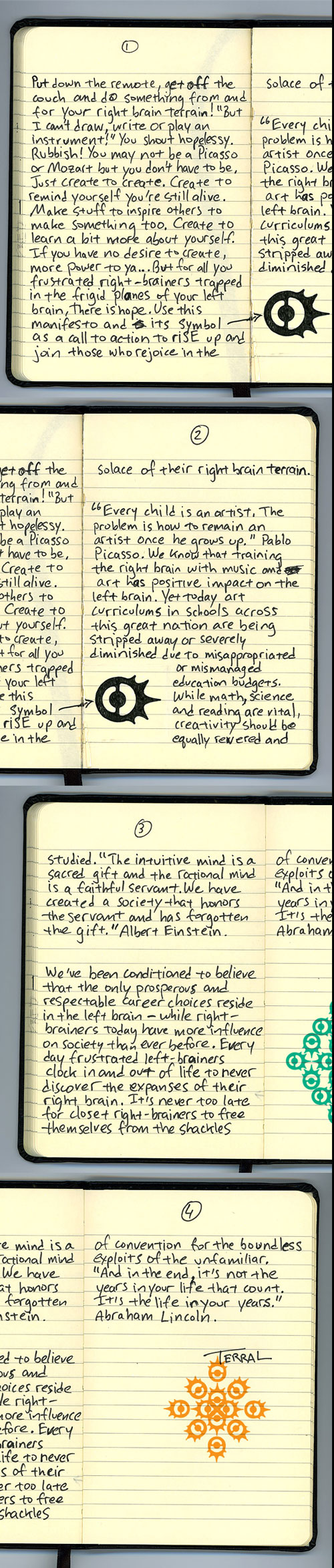
You may not be a Picasso or Mozart but you don’t have to be. Just create to create. Create to remind yourself you’re still alive. Make stuff to inspire others to make something too. Create to learn a bit more about yourself.”

We can’t imagine more sound advice. And charming, too: Terral’s manifestoappears online in its original form as scanned notebook pages, complete with sketches. Happily you can support all things Right Brain Terrain, and surround yourself with life-affirming statements, by purchasing limited edition prints from the studio’s gorgeous selection online.

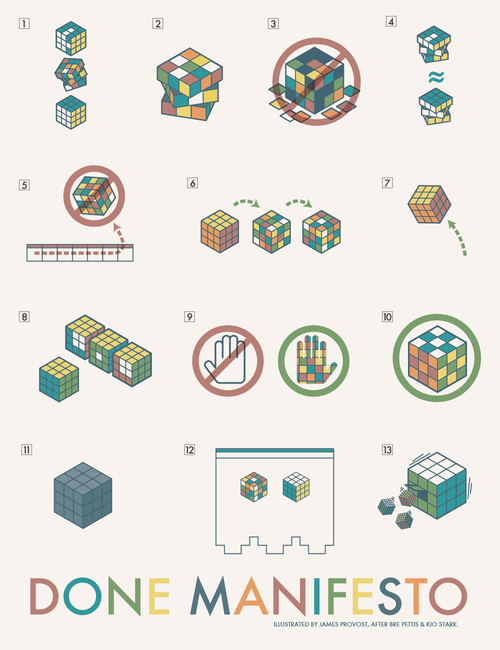
THE CULT OF DONE MANIFESTO

Guidelines to get you from Point A to finished product, The Cult of Done Manifesto was written by tech guru Bre Pettis (of MakerBot fame) in collaboration with writer Kio Stark in 20 minutes, “because we only had 20 minutes to get it done.” Following that same parameter, their manifesto consists of 20 truisms borrowed from hacker culture. To wit, number four on the list:

Pretending you know what you’re doing is almost the same as knowing what you are doing, so just accept that you know what you’re doing even if you don’t and do it.”

With iteration at the heart of its process, The Cult of Done Manifesto will banish your inner perfectionist (and its evil twin, procrastination).

HOLSTEE

We first featured the Holstee manifestoover a year ago, and our fondness for their sustainable social enterprise has only grown since then. Whether you’re raising a family or venture funds for your new business, rallying cries for creativity don’t get much stronger than this:
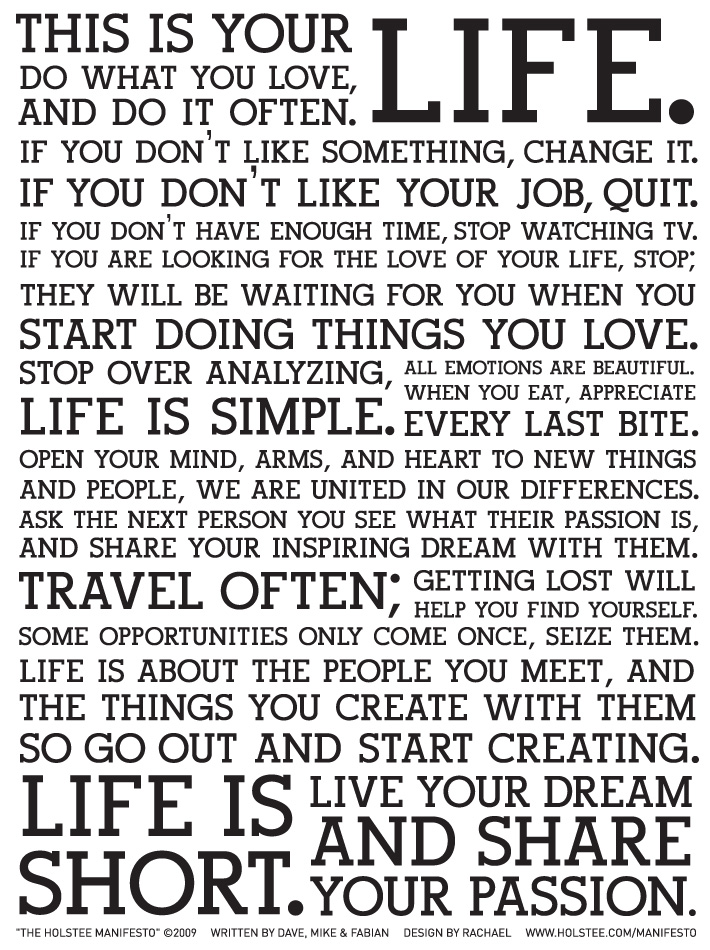
This is your life. Do what you love, and do it often. If you don’t like something, change it. If you don’t like your job, quit. If you don’t have enough time, stop watching TV. If you are looking for the love of your life, stop; they will be waiting for you when you start doing things you love.”

You can buy these bracing words in postercard, and even bib form, so that every time your baby throws a cup of peas on the ground you’re reminded of the things that matter most in life.

WORK IS NOT A JOB

It’s no coincidence that three out of the five manifestos featured here come from design-y entrepreneurial ventures, since as a discipline design takes a “fail forward” approach to creativity. Our number-four favorite was written by Catharina Bruns, the German-born designer and illustrator behind Work Is Not A Job. Bruns’s raison d’être is effecting “a paradigm shift in how people approach ‘work’ not as your 9-5 job but how you individually contribute to the world.”

Empower yourself and realise the importance of contributing to the world by living your talent. Work on what you love. You are responsible for the talent that has been entrusted to you.”

In addition to design-for-hire, Work Is Not A Job also offers products, from hoodies to fine-art prints, to keep you inspired on the daily.

DO THE WORK

We’re over the moon that author Steven Pressfield has a new release out this month. Part of Seth Godin’s e-publishing experiment The Domino Project (which we featured earlier this year), Do the Work is intended as a companion guide to Pressfield’s earlier text – and one of our all-time favorites on the creative process – The War of Art. Where that book was almost Zen-like in tone, containing koans about art and life that have had us returning to it for years, Do the Work focuses on practical methods and tools. Still, Pressfield doesn’t pull any punches, getting right to the point about what’s at stake in whether or not we create.

There is an enemy. There is an intelligent, active, malign force working against us. Step one is to recognize this. This recognition alone is enormously powerful. It saved my life, and it will save yours.”

Even better, Do the Work is free(!) until April 20th, so do yourself an enormous favor and snag a copy now.

Whatever you do, we hope this list of manifestos helps you manifest your passion; and if you have other favorite creative directives leave us a link in the comments. Now go forth and create!

Kirstin Butler is writing an adaptation of Gogol for the Google era called Dead SULs, but when not doing the work spends far, far too much time on  Twitter. She currently lives in Cambridge, MA.