Just Rob Campbell on the site currently. The original link and photo were from 2008. Rob continues digging, finding and collecting old bottles (in his recent posts) and other Toronto based old treasures.
Dumpdiggers chronicles the adventures of low tech treasure hunters Rob Campbell (that’s me) and Tim Braithwaite as we research and recover antiques from forgotten historical sites.
Edward Donnelly, from California, in the US, posts photographs of address plates from buildings. How often do you pass by these house numbers and not even think twice about them? But, some are unique, old and interesting. Address Photography Do you have a house number visible on your home? Numbers should be easy to read, big in size, and a contrasting colour to the background they are affixed to. Placing house numbers on your mail box isn’t enough. These days not everyone has a mailbox and they tend to be smaller numbers, not so easy to read from the street. I have large house numbers over the garage and another set at the front door of the house. No credit to me, the numbers where here when we bought the house. One of those little things people usually don’t think of when they move into a new house. But, a nice thing to give your home some extra character and a practical item too.
Using clear house numbers is important! It makes life easier for your guests, for your postman, and for emergency service workers who might need to find you. The rules for displaying house numbers vary, depending on where you live. However, the following recommendations will ensure that your house number is placed where it can be seen by emergency responders, postal services, courier companies, and so on.
Placement :
The house number should be visible from the road or street in front of the property. As such, the house number sign should be placed on the side of the house that faces the road.
If the house is too far from the road, the house number should be displayed on the mailbox.
There’s a chance that you or someone else may park their vehicle in front of the mailbox; in this case, it’s suitable to paint your house number on your driveway. The number should be painted on the side of the driveway that faces the moving traffic.
If your mailbox isn’t in front of your house or near your driveway, post a house number sign in your yard.
The house number, whether displayed on the house, mailbox, or curb, should be unobstructed by objects such as tree limbs, bushes, debris, or decorations.
A house number sign should be placed in close proximity to the porch light so it can be seen at night. When that isn’t possible, invest in reflective house address signs.
Color :
Overglow can be blinding, and makes it difficult for anyone to see your house number.
The color of the numbers should be in sharp contrast to their background. Certain colors on reflective address number signs may glow too much under headlights, which can overshadow the number on the sign. This is a major cause of concern for emergency personnel.
White numbers on a black background is an ideal combination of colors when displaying the number on the house, mailbox, or curb.
Brass or bronze numbers should be avoided – they don’t offer optimum visibility at night.
When posting your address number or a sign on the mailbox, don’t use the same colors as the mailbox. Stickers with shiny silver numbers on a black background should be avoided, as well.
You can also mount a sign above or below your mailbox.
Design:
Use Arabic numerals. Writing numbers in words should be avoided.
Most local governments recommend displaying numbers horizontally.
While the color of the numbers and the background should contrast with each other, the alignment of the two should be the same. Avoid vertical signs with numbers aligned horizontally (and vice versa).
Just Rob Campbell on the site currently. The original link and photo were from 2008. Rob continues digging, finding and collecting old bottles (in his recent posts) and other Toronto based old treasures.
Dumpdiggers chronicles the adventures of low tech treasure hunters Rob Campbell (that’s me) and Tim Braithwaite as we research and recover antiques from forgotten historical sites.
I found this map for sale in an Etsy shop, civicatlas. With shipping, it would cost over $50 to have a print copy. Sure, it would be a nice size but more than I can spend. If you have the resources I recommend getting it for any Toronto history explorers. As you can see, there are excellent images of old architecture, likely gone or very different looking now.
To see more of it myself, I searched online and found it Historical Maps of Toronto, with a link to the source for the full map at the University of Toronto. Here are screenshots, to give you a preview. I would like to have this covering an entire wall of my house. But, I will settle for keeping it as wallpaper for my desktop computer. Meanwhile, I did download the full file and I can see what it would cost to get it printed. Possibly a local business where the photographer reprints and fixes old photographs, might be just the place.
The Smog Free Bicycle concept (courtesy Studio Roosegaarde)
A smog-eating bike may soon be cruising through the Beijing streets. Last month the Dutch design firm Studio Roosegaarde announced that it is partnering with Ofo, a Chinese bike sharing program, to develop the Smog Free Bicycle. Daan Roosegaarde, who leads the studio, stated: “Beijing used to be an iconic bicycle city. We want to bring back the bicycle as a cultural icon of China and as the next step towards smog free cities.”
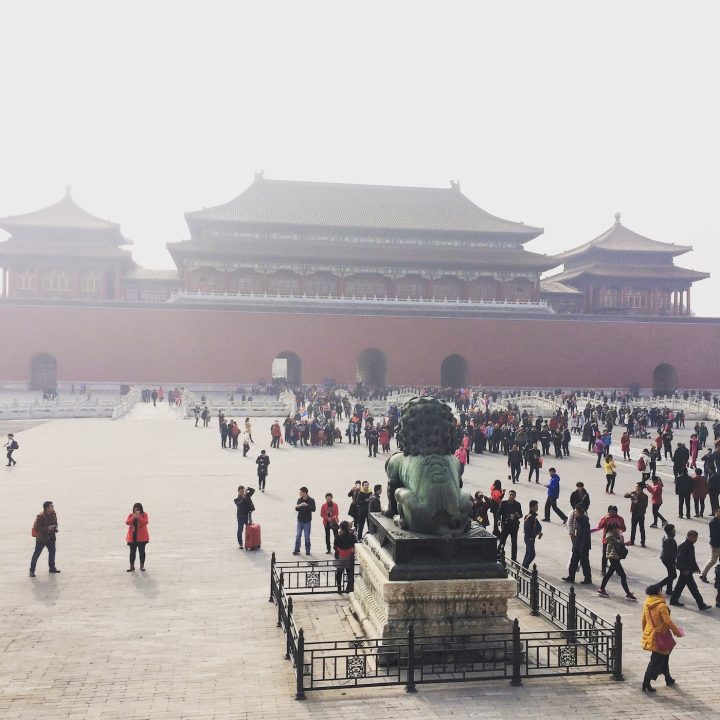
Beijing has an air pollution crisis, and the bike proposal joins other environmental initiatives like a Chinese government-led mass tree planting. According to the release from Studio Roosegaarde, details about the Smog Free Bicycle’s implementation will be released this fall. Roosegaarde was inspired by a recent workshop at the M Woods museum in Beijing. It featured artist Matt Hope, who previously created a “Breathing Bike,” a much more DIY contraption with an air cleaning system involving an IKEA trash can and fighter-pilot mask.
Smog Free Bicycle concept map (courtesy Studio Roosegaarde)
The Smog Free Bicycle is the latest from Roosegaarde’s ongoing Smog Free Project. It follows the installation of a Smog Free Tower in Rotterdam in 2015, reported for Hyperallergic by Claire Voon, that was billed as the “largest smog vacuum cleaner in the world.” Using positive ionization to pull particulate matter from the air, these particles are then compressed into cubes for jewelry. In 2016, another Smog Free Tower was installed in Beijing.
The bicycle would potentially use a similar technology to inhale pollution, then release the cleaned air around the rider. Yet bike sharing programs in China have faced their own hurdles. The Guardian reported in January that hundreds of cycles-for-hire were being abandoned by riders in huge piles around Shenzhen.
Other recent designs such as the CityTree by the Berlin-based Green City Solutions that has a wall of air-cleaning moss for concrete-heavy urban zones, and Air Ink by Graviky Labs in India that transforms smog into inks, similarly are aimed at small-scale interventions that could influence larger thinking on greener cities. Perhaps it’s better to view projects like the Smog Free Bicycle as statements rather than solutions. Bikes are, by their peddle-powered nature, smog free, and the social impact design may be successful in encouraging more people to ride.
Smog at the Forbidden City in Beijing (photo by the author for Hyperallergic)

 Just Rob Campbell on the site currently. The original link and photo were from 2008. Rob continues digging, finding and collecting old bottles (in his recent posts) and other Toronto based old treasures.