Centennial, Port Union History
This includes a bit about the Johns Manville plant and an aerial photo of it. Must have been taken quite awhile ago. My brother would go there and find marbles, not really marbles but glass balls the size of marbles. Most of them had a blue tint. I don't know what they were used for, if I knew before I've forgotten. Later I attended Sir Oliver Mowat High School which was almost across the road on Lawrence Avenue East from the high school. I don't remember when Johns Manville was completely shut down. I don't think it was still in operation (not sure though) when I was in high school.
We didn't think asbestos was a big problem then. I still wonder how bad it really is when so many old houses were made with asbestos (roof and walls). I was surprised to learn Johns Manville is a US company. I never looked into it all those years we lived near it, I assumed it was a local thing, or at least Ontario. I wonder if they have already built a new subdivision or condominiums over the old site. I wouldn't be surprised, though people had claimed it could not be used for anything for a hundred years. (It hasn't been 100 years because I'm certainly not that old yet).
I never knew the full story about Thomas Adams. But we played at Adams Park often. We watched Victoria and Canada Day fireworks there. Had birthdays there (my brother especially because his birthday is in June). It had a fancy entrance with flowers and landscaping. But, I don't think we ever came through that way. There was another entrance, I forget just where now, but it was closer to the park with the sliding bridge, swings, and other recreation. My sisters and brother played soccer there too, practices and games.
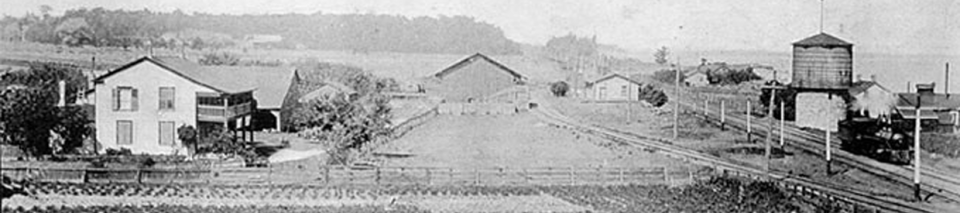 Centennial Community and Recreation Association - Centennial/ Port Union History
In 1808, an American immigrant named Thomas Adams became the first settler in the area. He was a successful businessman and built the first schoolhouse.
In 1847 following the building of a wharf, Port Union entered a golden age of growth as a shipping port. Arrival of the The Grand Trunk Railway in 1856 boosted the area as a shipping and rail hub. Port Union was born. First Peoples
A branch of the Anishinabe who settled along the north shore of Lake Ontario were known as Mississaugas. The territory of the Mississaugas in the Toronto region stretched from Long Point on Lake Erie to the Rouge River at the southeastern edges of what is now Toronto. Now referred to as Mississaugas of the New Credit, it’s believed they had seasonal camps at the mouth of the Rouge River.
1808 Tommy Adams first settler An early settler was American Tommy Adams, referred to as Uncle Tommy Adams or the American Dutchman. Adams built the first schoolhouse in the area in 1836, a cottage of planks which stood on Kingston Road. Many of the first frame houses in the neighbourhood were also erected by him. In 1967 Adams Park was opened and is named in recognition of Thomas Adams..
1849 William Helliwell launched Port Union shipping Scarborough’s lakefront connections to trade and transportation reached it’s zenith when the Scarborough and Pickering Wharf Company was established in 1847 near the mouth of the Rouge by local farmer and entrepreneur William Helliwell along with partners Daniel Knowles and Will Hetherington.
1852 Andrew Annis Family
Andrew Annis purchased 100 acres of land from Tommy Adams in Port Union at the corner of Lawrence and Port Union Road in 1852 He built the stone house that was to become the family social center for years to come. The home was affectinately called “The Manor”. The house eventually became a branch of the Bank of Montreal and stood near the east end of what is now the local plaza.
1856 The Grand Trunk Railway The Grand Trunk Railway was built along the shore of Lake Ontario and Port Union became a major commercial centre with both rail and shipping options. Hetherington built a hotel nearby and other businesses such as a blacksmith and cooper (barrel making) were established.
1860 Thomas Laskey Hotel A second hotel was built near the railway station and operated by Thomas Laskey. It later became a private residence and was located where the Port Union Commons washrooms are located today.
1865 Post Office The railway and shipping businesses at Port Union peaked in 1865 with a permanent population of over 100 residents and as many as 300 on any given business day. The growing community was granted its own post office, which survived until 1934.
1890 Morrish Store This was the finest store in the district when it was built in 1890 and owned by William J. Morrish. The Morrish building at Meadowvale and Old Kingston Road provided space for living, sales and storage. The business included hardware, dry goods, boots, shoes, farm machinery and groceries with flour, sugar, tea and salt being a small part of the business.
1895 Wharf Company closes A massive storm severely damaged the wharf and with shipping losing more of its business to the railway, the Wharf Company closed and the community gradually declined over the next fifty years.
1921 Watson’s Orchard Until recently, the property southwest of Centennial Road and Lawson Road was known as Watson’s Orchard. It was originally a 50-acre parcel of land bought by John Cecil Watson and his wife Beatrice Alberta Acheson in 1921 from The Stanley Piano Company.
1948 Johns-Manville Asbestos Plant Johns-Manville took advantage of the railway access and built its massive plant overlooking the lake and employing hundreds of local residents. It was later closed due to health issues with its asbestos production.
1967 – How Centennial got it’s names The community was built on the former Annis farm and since much of the planning and construction took place in 1967, the community was named in honour of the 100th anniversary of Canada’s Confederation. The Charlottetown Conference gave the community, street and school its name. Other street names recognize several of Canada’s 1867 Fathers of Confederation: D’Arcy McGee, Samuel Tilley, J.C. Chapais, Ambrose Shea, Hector Langevin, Thomas Haviland, J. Cockburn, Charles Tupper, J. McCulley. Oliver Mowat was also recognized in the naming of the Collegiate Institute.
2006 – Port Union Waterfront Trail opens Phase one opened in September 2006. The second and final phase opened in November 2012. You can access the Centennial portion of the trail by the pedestrian underpass at the Port Union Village Common at the southern end of Port Union Road. From 1849 to 1895 this was the location of the wharf built by the Scarborough, Pickering and Markham Wharf Company to facilitate Lake Ontario shipping.
In 1967, the CCRA in association with the local community opened Adams Park on Lawson Road. The plague inscription reads as follows: In commemmeration of “Uncle Tommy Adams” or American Dutchman” who came to Canada in 1808 from Vermont United States and settled in this vicinity. He built a loghouse over looking the lake and replaced it later with a brick dwelling. This house was struck by lightning in about the year 1832 when his son William was killed.
Thomas Adams was a carpenter and captain of an American sailing vessel during the war of 1812. He was driven for refuge into Highland Creek. There fearing his cargo of guns, brass kettles and ammunition might be seized he threw everything overboard and tradition adds “the drowned cargo is still supposed to be lying at the bottom of the creek”.
Old Tommy Adams, a man of diversified trades, was the pioneer flax grower in 1825. It was scutched, heckled and spun here by primitive methods being used chiefly for ships.
About 1834 Thomas Adams in partnership with John Allen, built a sailing vessel at the mouth of Highland Creek. They named her the “Mary Ann” and it was engaged for many years in local trade and proved of great service to the farmers ashes, grains and shingles away and bringing back flour, salt, lime etc.
Adams built the first schoolhouse in the area in 1836, a cottage of planks which stood on Kingston Road. Many of the first frame houses in the neighbourhood were also erected by him.
Port Union Wharf
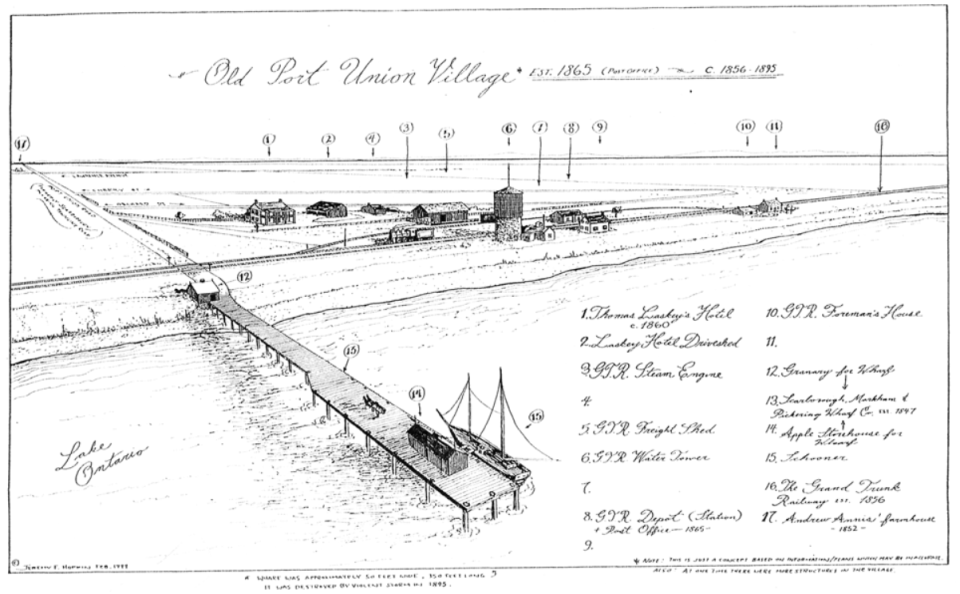 Drawing of Port Union Village and wharf (c. 1856-1895). Illustration:Jeremy Hopkin, courtesy Scarborough Archives
The mouths of the Highland Creek and Rouge Rivers were a hub of shipbuilding activity during the early 1820s to late 1840s. Schooners such as the Duke of York (1820), the fastest ship on the lake in her day, the Wood Duck (1822), which was a 25-ton schooner, along with the Mary Ann and the Highland Chief were built at the mouth of the Highland Creek. The steamer Canada, a 250-ton ship built at the mouth of the Rouge during the winter of 1825-1826, along with the Charlotte of Pickering (1843) and the last locally built ship, the Caledonia (1851). During this time, both the Highland Creek and Rouge Rivers were navigable for vessels of up to 100 tons. They were able to travel two kilometres inland.
Many of these ships formed what was called the Highland Rangers (a name given to the local ships of the Highlands of Scarborough) and plied the waters of Lake Ontario, shipping cargo to Toronto, Port Hope and Cobourg, also trading across the lake to Oswego and other ports of call along the New York shoreline.
With the construction of the Grand Trunk Railway bridges over the rivers during the mid-1850s, the Highland Creek and the Rouge River were all but closed to ships much larger than a rowboat.
There was no natural harbour along our shoreline like Frenchman’s Bay, yet there was enough potential trade to warrant some kind of port. Local businessmen formed the Scarborough, Pickering and Markham Wharf Company. During 1847, a suitable location on the shoreline between Scarborough and Pickering was agreed on. The first section of wooden cribs was constructed and loaded with stone. Newer sections were built, floated into position, and they too were filled with stone. Eventually, the wharf extended 350 feet into the lake with a width of 50 feet. The wharf ran south-east and was located completely within Pickering Township. A storage shed was constructed on the shoreline with a smaller shed on the end of the pier for the storage of apples and other perishables awaiting shipment. The water at the lake end of the pier was a good 12 feet in depth and allowed for vessels large enough to carry the cargos of the three townships, such as cord wood, potash, grain, shingles and tanbark.
There were also schooners used for “stone hooking.” These shallow draft ships would collect stones from the shallows and ship them to Toronto to be used at various construction sites. A 1942 Toronto Telegram newspaper article mentions “Capt. John Williams seeing the Highland Chief, a schooner, loading fieldstone at Port Union. It had been dumped over the bank by landowners during the clearing of their fields.” During the 1880s, steamers would stop at the Port Union wharf in the summer to take people on moonlight dance excursions. There was also much passenger traffic to numerous ports of call throughout the Great Lakes.
The end of the Scarborough, Pickering and Markham Wharf Company came in the form of a fierce storm during the winter of 1895. The pier was damaged beyond repair. With the railway, which came through 40 years earlier, shipping by water proved too slow and expensive as a way of transporting goods to Ontario markets. The wharf company ceased operations and the pier was left to the ravages of the lake.
Scarborough’s lakefront connections to trade and transportation reached it’s zenith when the Scarborough and Pickering Wharf Company was established in 1847 near the mouth of the Rouge by local farmer and entrepreneur William Helliwell along with partners Daniel Knowles and Will Hetherington.
Helliwell’s father, Thomas, after emigrating from Yorkshire, England, began a brewery and distillery on the banks of the Don River in 1820. This area became known as Todmorden Mills, and the brewery operation continued until the building was destroyed by fire in 1847. Helliwell then moved to the Highland Creek Valley where in 1849/50 capitalized on the active trade already taking place and built a wharf at the bottom of present day Lawrence and Port Union and storehouses at the shore that moved goods from the three townships directly on to the ships.
The little village of Port Union grew up around the wharf and storehouses near the edge of the lake. Sometimes lined up all the way up to the Kingston Road, farmers stood with their teams, waiting their turns to load their goods, among which was grain, potash and apples into the storehouses and then on to markets beyond.
By the early 1850’s Port Union was booming. Will Hetherington opened the Union Hotel, which catered to the influx of farmers waiting to offload their goods near the wharf. During those years Hetherington and Helliwell also joined forces to build the Caledonia, probably on the beach near Port Union. It and the Northerner (1856) were among the last of the schooners built at the Scarborough shore.
Port Union Train Station
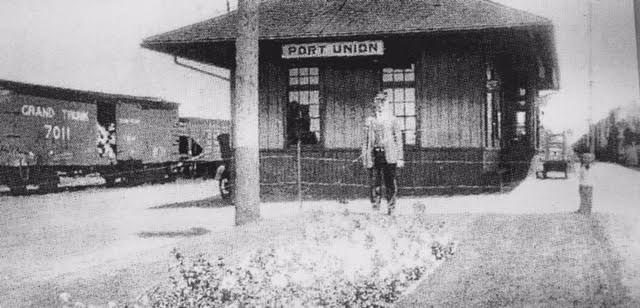 The Port Union train station (c. 1905) was located on part of the current Port Union Village Common. Photo, courtesy Scarborough Archives
On November 10, 1852, the Grand Trunk Railway was incorporated. Plans were immediately announced to build a rail line between the cities of Montreal and Toronto. Railway construction commenced during 1853, with the final phase completed for the August 1856 opening of the line.
The Port Union station was constructed along with a number of workers’ houses. The actual train station was on the north side of the tracks, along with large sheds for storage of goods awaiting shipment or pick-up by customers. “Coal-cars” would be parked on the siding and customers would bring their wagons at an arranged time to remove the amount of coal they had purchased from various businesses such as the W.J. Morrish store. South of the tracks was the Station Agent’s house and a house for the tender of the water-tank. Another shed contained the steam engine used to pump lake water into the storage tower which was used to refill the train’s boiler. Also, for the station water supply and a “town-pump”. Wooden cribbing ran from the pump shed into the lake to protect the intake pipe from winter ice. Further east was the GTR Foreman’s house. At this time Port Union had a population of approximately 30 people, mainly workers employed by the GTR. On June 1st 1865 a post office was opened in the station.
Because of the steep gradient from Port Union to Scarboro Junction, a Shunting engine was on hand at the station siding. This was used to help push trains up the grade between the two stations.
On June 6, 1919, the Canadian National Railway was formed and by 1920 the Grand Trunk Railway declared bankruptcy and was amalgamated into the new CNR. At one time, the station was staffed 24 hours a day with the Station Agent during the day and Telegraph Operators during the evening and nights. All train clearances to allow freight and passenger trains to proceed both east and west bound had to go through this station. The crew on a train could pick up telegraphed messages as they steamed through the station using a net to retrieve telegrams extended on a long Y-shaped pole.
During the 1950’s, with increased truck traffic and the opening of the 401 highway, Port Union lost its importance to the community.
The year 1967 brought a new style of transportation to the masses: the Government of Ontario brought in the “GO” train service. The Rouge Hill station was the first Government of Ontario Rail Commuter Station built. It opened on May 23, 1967, just a few hundred metres east of the old Port Union station.
It is sad that the 120-year history of the area could not have been incorporated as a new PORT UNION GO station. The station was demolished in 1973. The land was eventually expropriate in 1997 and the rail siding removed in 1998 along with the demolition of the Lasky Hotel that had been gutted by fire, five years earlier.
Laskey Hotel
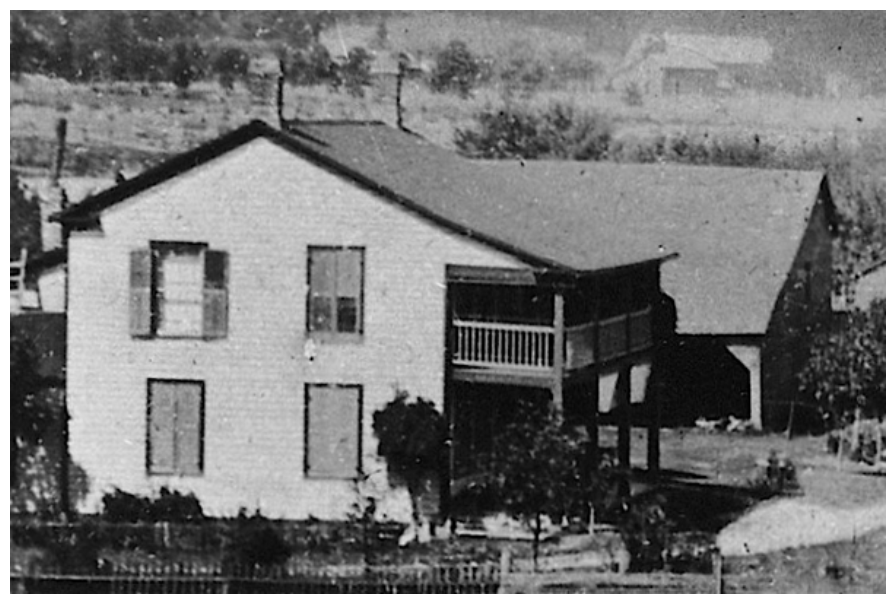 The Laskey Hotel , circa 1859/60 was located at the southeast end of Port Union Road on Orchard Street (later called Duthie Street) and on part of the current Port Union Village Common. Photo: Scarborough Archives
With the opening of the Grand Trunk Railway in 1856, the area we know as Port Union expanded as a reliable transportation point for travellers and local farmers wishing to ship their goods to the city markets.
Mr. Thomas J. Laskey came to the Highland Creek area and resided on Lot 5 Conc. 1 in the mid-1800s to operate a cooperage, constructing barrels for the shipment of apples and various other goods. Thomas was 34 years old at this time and his wife Martha was 28. They prospered and soon purchased a newly constructed 1859/60 hotel building from a Mr. Isaac Stoner, “while it was fresh from the painters’ brushes.” He named his new business venture the Laskey Hotel.
This was the second hotel in Port Union at the time, as the Union Hotel had been built by Mr. Will Hetherington approximately 10 years earlier. It should be noted that Hetherington’s hotel was located on the west side of Port Union Road (Scarborough) while the Laskey was on the east side of Port Union Road (Pickering).
At this time the population of Port Union had grown to approximately 100 residents. Yet with the Scarborough, Markham and Pickering Wharf Company plying the shipping trade and the railroad station tending to the needs of the farmers and travelling public, there could be up to 300 people in the small community on a business day.
The Laskey Hotel was located at the southeast end of Port Union Road on Orchard Street (later called Duthie Street). The building was constructed in the Georgian style of architecture with full-width verandahs on both the first and second floors. The first floor of the hotel had a large kitchen, dining room and bar. The second floor had six bedrooms, caring for the needs of up to 12 travellers at any one time, and a ballroom that was located at the rear of the building directly over the kitchen.
Many social activities would take place in the Laskey Hotel, such as political meetings, church socials and community dances followed by moonlight cruises from the nearby wharf. Thomas’s daughter, Jane, was married in the building in 1891 and following the service and dinner, the newlyweds were followed to the Port Union train station by well-wishing friends showering the customary rice and “old shoes.”
Like many hotel keepers, Mr. Laskey had his share of violations with the law. During 1864 he was charged with such offences as selling liquor on a Sunday, a $5 fine; gambling on premises, a $2 fine; raffling and gambling on premises, a $20 fine. Pretty basic activities by today’s standards.
Although it is unknown as to when the hotel ceased operation, it seems logical that with the loss of the wharf during an 1895 storm and the resulting lack of lake traffic, the hotel had outgrown its importance to the area. As late as 1942 the building was still in the Laskey family, being owned by Mr. Secor Johnston, grandson of Thomas.
In 1974, the area from Port Union Road east to the Rouge River (known as The West Rouge) was annexed into Scarborough. Council passed by-law No.18297: “A By-Law to designate the Laskey Hotel as being of historical and architectural value.” Unfortunately, as is so often the case, the unattended building was destroyed in a suspicious fire on December 29, 1993, and was eventually demolished in 1998.
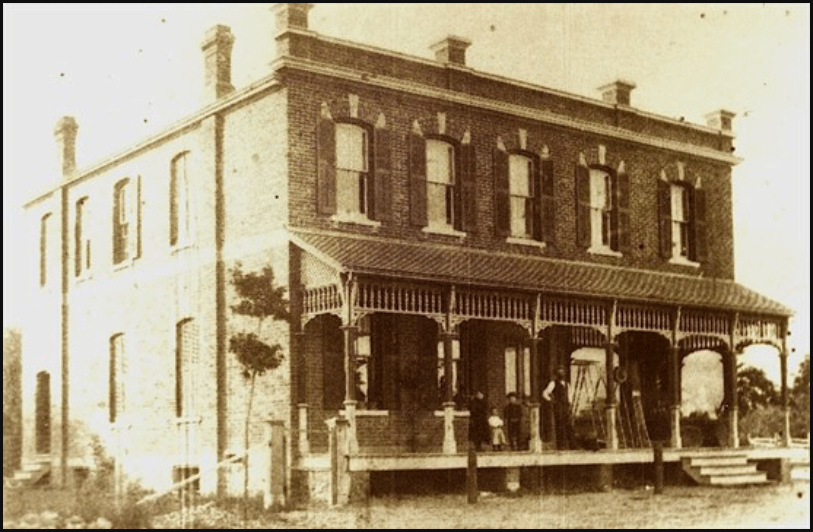
At the corner of Meadowvale and Old Kingston Road is a beautiful old building. This was the finest store in the district when it was built in 1890 and owned by William J. Morrish. William was the first surviving son of John Morrish, who was born in Ohio. At the time, Highland Creek was a farming community and the Morrish building provided space for living, sales and storage. The Morrish business included hardware, dry goods, boots, shoes, farm machinery and groceries with flour, sugar, tea and salt being a small part of the business.
By 1914, William Morrish installed a fuel pump when the automobile started to replace the horse as a means of transport. This was the only pump between Toronto and Whitby. Gas was 17 cents a gallon. The retailer profited by 3 cents.
William turned the business over to his sons, Roy and Charles. William Morrish died in 1924. Roy left to open his own business and Stuart and Florence with their 3 children moved in and ran the store until 1967.
During the depression merchants found it difficult since they often had to wait for two months for money and cash flow was difficult.
Rationing of sugar, tea, butter coffee and meat came after the war in 1939 and Sundays were spent sticking hundreds of ration stamps to gummed sheets.
Until recently, the Cameron Watson orchard was southwest of Centennial Road and Lawson Road was known as Watson’s Orchard. It was originally a 50-acre parcel of land bought by John Cecil Watson and his wife Beatrice Alberta Acheson in 1921 from The Stanley Piano Company. The Watsons called their property Cherrydale Farm. It was here that John Cameron Watson was born on November 24, 1922, and where he tended to his beloved orchard until his death in 2004.
Farming is always at the mercy of the elements and the Watsons certainly had their share of hard times. The severe winter of 1933 took a devastating toll on the farm’s apple trees. Since the orchards had to be replanted, the family needed to diversify their crops until the new trees could bear fruit. Root vegetables, such as cabbage, along with rhubarb, strawberries, currants and raspberries were cultivated as a quick crop.
During the late 1940s, a contract was obtained from Dominion Stores Ltd. for Watson to supply apples, which gave financial security for the orchard. Countless hundreds of local kids found their first employment with Mrs. Watson, known by all as Granny. Rumour has it that “Granny” would demand the berry boxes be filled to overflowing, then in the lower level of the barn take her knife and level the boxes off using the “extra” berries to fill more boxes. A reasonable thing, considering the millions of berries that never made it to the barn, but we assume the kids thought they were delicious.
The Watsons operated an apple stall at the St. Lawrence Market every Saturday, beginning in 1922, the same year Cameron was born. From the time he was an infant being carried in a wicker basket until his declining health forced him to retire in 1997, you could find him every Saturday in the north corner of the market.
Cameron had a full-time work-hand named Ross Regele, who was employed by the Watsons for more than 47 years. Some may remember Ross living in a tiny trailer on site even though he was offered accommodation in the Watson family home.
Cameron and Ross would arrive at the St. Lawrence Market at 3 a.m. to ready their display for the Saturday crowds that came to purchase produce and goods from the many vendors.
Cameron built a new house facing Acheson Blvd. for his mother and himself. She was to live on the main floor and Cameron in the lower level walkout. With the death of “Granny” Watson in 1970, the main floor of the house was never used. Cameron was forced to sell off a major part of the orchard to cover estate taxes. He kept four acres where his home and orchard buildings were located. This he continued to tend until 2004.
The property has since been sold to a developer and new houses have replaced the orchard. Although many large trees had to be removed, there is a silver lining, as the tiny Centennial Creek that flows through the property will remain in its natural state and protected from further alterations.
The Watsons played an important role in the lives of so many people in the area. In their memory, Acheson Blvd. was named many years ago for Cameron’s mother and the newly created roadway through the old orchard grounds has been named Cameron Watson Crescent.
Johns-Mansville before 1992
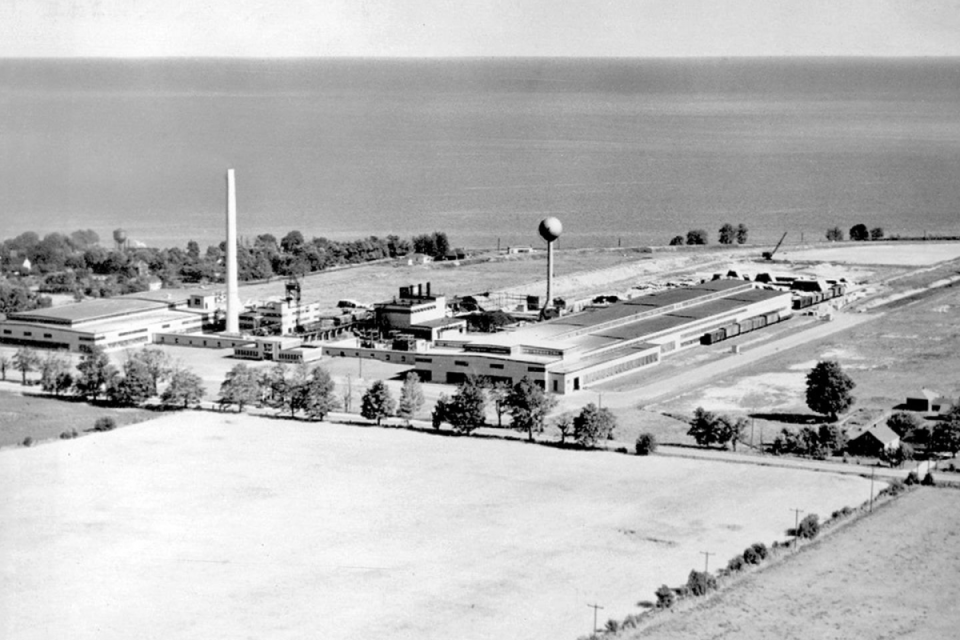
The Johns-Manville plant used to be located west of Port Union Rd. south of Lawrence.
In May 1948, big industry came to Port Union on the historic Dixon farm land. For a relatively poor township, this was good news at the time. The company employed 350 people and created much needed tax dollars. When people complained of the linseed oil smell from the rock wool manufacturing process, a new 200 foot poured concrete smoke stack was built in 1949 to replace the 50 foot metal one. At the time, environment protection was a concern to Johns-Manville. The one million gallons of water used daily in manufacturing was returned to the lake purer than when they took it in. What Johns-Manville did was environmentally acceptable and within the limits of the legislation at the time they conducted their operations. They also exceeded government standards due to sophisticated emission and dust control procedures.
In the 1960’s, Johns-Manville manufactured and stored transite pipe was at this facility. Transite is the name trademarked by Johns-Manville and was the only manufacturer who could use the term.
Transite Pipe is made with asbestos and concrete and is commonly used as water main pipe. Many industrial complexes and city sewer systems have this pipe to this day. The transite pipe plant was the first of its kind in Canada and the facility held seven transite pipe production plants. Over 600,000 miles of transite pipe was installed in the 1960s with much of it having been made at the Port Union Johns-Manville pipe plant. The pipe plant continued to operate until Johns-Manville declared bankruptcy in 1982.
The Johns-Manville Port Union plant site was also used as an asbestos disposal site when the company built a dike system into the wetlands at the mouth of Highland Creek where it meets Centennial Creek. Former Johns-Manville employees have reported using bulldozers to push pipe fragments and other asbestos debris into Lake Ontario when the asbestos disposal site was full. The Ministry of the Environment approved, as part of the decommissioning plan related to this site, that all remaining asbestos waste would be placed in the settling ponds and capped with clay. The site has been designated as a waste disposal site.
John Dempsey, CCRA President and representing Centennial residents addressed City of Toronto council. He requested identification of a process that is private and/or public that will ensure the early and safe demolition of the existing industrial building on the Manson property located on Port Union Road and Lawrence Avenue East in Scarborough, and also to address the issues of site remediation and future land use.
The CCRA monitored the cleanup of asbestos waste on the Johns-Manville site which is now considered remediated. It is now a residential community called Port Union Village.