Posts tagged with “web art”
Posted on . Filed in . Tagged with , , .

How to Become a Pixel Artist

Pixel art is an image drawn pixel-by-pixel using a limited color palette and usually primitive/ retro computer graphics tools. Microsoft Paint, a bitmap graphics editor, was a popular software for creating 2D sprites and pixel art.

Pixel art was used for 2D games. It's retro now. 3D games took over and there weren't many 2D games around any more. MapleStory is one which still uses pixel art. Computer icons and those tiny smiley graphics are also still created using pixel art.

Like ASCII art, pixel art is coming back into usefulness now that there are small applications (for mobile phones, etc.) which need simple art files and illustrations.

I've begun making pixel art. Mine is the size of icons. I've used some of my pixel art as favicons for my sites. It's interesting to work with pixels. You need a fairly steady hand, or the patience to go back over your work and remove tiny extra lines and pixels one by one. Most of the graphics software make it easy to fill in your colour. To make the more detailed art you need to pay attention to shadowing and light. Just as photographers and other graphic artists do.

Pixel art used for icons is much simpler. It's flat. You can use two basic colours, one for the outline to give it shape inside the basic outline and the other just to give it colour rather than leaving it black and white.

I'd like to do the more detailed pixel art. I've been working my way up to it. I'm not ready to share my early creations, they are a bit discouraging while I figure out the process and how to make the light and shadows work to give my graphics depth rather than just looking odd and warped.

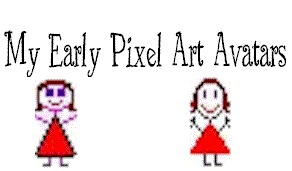
My Pixel Art Avatars in Real Size and Enlarged

Posted on . Filed in . Tagged with , , .

Visual Poetry: Concrete Poetry and Calligrams

Concrete poetry is a form of text art, like ASCII art and typewriter art. It's also poetry, the genre known as visual poetry. Concrete poetry uses words and drawings to illustrate a poem. The words are in the image. The text itself forms a visible picture on the page, like a silhouette.

Calligram seems to be another word for concrete poetry. If there is a distinction between them I'm not sure what it is. Maybe calligrams are more about graphic art based visual poetry and concrete poetry is more text based. However they began the line between the two has become blurred.

You know concrete poetry when you see it because the word has become the art, the illustration and the picture holds the words inside it.

Sometimes the poem is written in a shape which can be read in different ways but still make sense. For example, a circle which can be read in any direction.

Concrete poets use use typography: fonts, shape, texture, colour, and sometimes animation to form text art into prose.

Concrete Poetry/ Calligram History

Simmias of Rhodes, a 4th century scholar and poet, created poems written in shapes relevant to the subject.

In the Middle Ages when Monks used concrete poetry to illuminate their written text.

Guillaume Apollinaire (Picasso's friend) composed several calligrams.

How to Critique of Calligrams/ Concrete Poetry

Is it easy to identify the picture with the text?

Is the image relevant to the poem?

Does the image add something (humour, deeper meaning, comprehension) to the poem?

Can the poem stand on it's own as just a poem?

Does the text help form the image, does the text actually add something to the image?

Are there alternative ways of reading the poem?

Try Creating your own Concrete Poem

Get a general idea of something you could write about. Pick a topic or idea which creates images and thoughts in your mind right away.

Draw a sketch (like an outline) of the idea. Even if you want to work with ASCII art or typewriter art you sitll need a basic sketch to start with). Imagine yourself as a cartoonist who just has one panel, one image, to tell the story or explain the idea.

Write your poem, get the words at the end of each line to rhyme. Keep it short and keep it simple for your first try visual poetry work. Aim for a total of four rhyming lines.

Take your poem and fit it into your sketch. How do the words add to the sketch? Once you get this far you might change your mind about the sketch and draw it differently or start all over fresh, with a different vision for the image you use with your words.

Go from there and turn your sketch into text art and then type in your words. This adds another challenge as you will have limits imposed by the typewriter or word processing text itself. A hand drawn concrete poem can be moved in any way your hand chooses to draw it. If you create ASCII art, you will (hopefully) enjoy the challenge of concrete poetry and ASCII art.

Concrete Poetry: Artists and Links

Posted on . Filed in . Tagged with , .

ANSI Art isn’t Really Dead

It’s surprising that ANSI art isn’t far more popular than it is. Instead, only a small group of old gamers, artists and musicians seem to know about it at all. Many people confuse ANSI art with ASCII art when they see it. ANSI art uses all of the keyboard characters including those you can’t see on the computer keyboard itself. You can access these extra keyboard characters with the right extra codes and the alt keys.

I don’t make ANSI art myself. I like the puzzle of dealing with plain text. But I do admire all the colour of ANSI art.

It used to aggravate me when people would post text art and claim it was ASCII art when anyone could plainly see there were all kinds of keyboard characters in there, above and beyond the limits of ASCII characters. Now, I’ve become a little more understanding and I see how there is confusion about ANSI art versus ASCII art.

So let me make it clear. ANSI art uses everything you can get out of your keyboard. ASCII art only uses the standard keyboard characters – if you can’t type it without hitting more than just the shift key, it is not ASCII art.

I hope that helps to clear the whole ANSI/ ASCII thing up.

Get to Know ANSI Art

ANSI art is a computer art form that was used on BBSes (Bulletin Board Systems) in the 1980’s. Like ASCII art, but it is constructed from a larger set of 256 letters, numbers, and symbols. ANSI art (extended ASCII) also contains special ANSI escape sequences that colour text with the 16 foreground and 8 background colours offered by ANSI.SYS.

Some ANSI artists create animations, commonly referred to as ANSImations. ANSI art and text files which incorporate ANSI codes carry the .ANS file extension. ANSI art was used for games like MUDs (multi user dungeons), computer hackers, crackers and demoscene (which was about sound music, ANSI art, creativity and competition). ANSI artists released their finished artwork in files which they call packs.

ANSI art is considerably more flexible than ASCII art. The particular character set it uses contains symbols intended for drawing, such as box-drawing, shading, mathematical symbols, card suits, characters used in languages other than standard English, and block characters that dither foreground and background colour. With clever use of the shading characters, ANSI artists could mix two colours and create more shades from them.

The popularity of ANSI art encouraged the creation ANSI editors, some are still maintained today. The decline of BBSes and DOS made it difficult to view ANSI animations. So ANSI art has lost popularity and become retro, geeky or old fashioned and out dated.

Try Creating Your Own ANSI Art

ANSI art is pretty exceptional. Do you feel inspired to give it a try?

There are still a few software programs which will help you create graphics/ images/ pictures with ANSI art. Explore the links I’ve added here, read the reviews and suggestions from the ANSI artists and then pick which ever software gives you the best tutorial on how to get started and where to go from there.

Posted on . Filed in . Tagged with , , .

Text Art to Get your Fingers Typing

Text art includes: ASCII art, ANSI art, typographic art, typewriter art, emoticons and Twitter art. They are all based on keyboard characters, more or less.

Text art includes more than ASCII art. But, ASCII art will come up first and be the largest part of the search results when you look up text art online.

The Text Mode blog on Tumblr has a mix of text art forms and techniques. It’s worth looking through the current posts and the archives too. There’s also a Pinterest account.

On Flickr I found a Text group with all kinds of art involving text. Another group for Text as Art.

What is Text Art?

ASCII Art

ASCII artists use the standard keyboard characters (if you have to use more than the shift key to type them they are not ASCII art characters) to create pictures (images/ graphics). This means artists who use more than the standard ASCII art characters are creating ANSI art.

ANSI Art

Artists have more flexibility with ANSI art because there are a variety of extended characters and colours which give far more options than ASCII art. It’s funny how ASCII art is still hanging around and is better known than ANSI art.

Typewriter Art

Typewriter art is easy to understand. Take away the computer keyboard and put an old fashioned typewriter down in front of yourself instead. Use the typewriter ribbon to add more effects to the art you create. You can smudge the ink, for instance. You can also hold the paper as you type and move it where you want to type, exactly. This means you can type one character halfway over another – easily done with the old typewriter.

Twitter Text Art

Twitter text art is a version of ANSI art. But, like Japanese ASCII art, it is dependent on which computer, software and operating system you are using. Not all keyboards, systems and languages work alike. These differences bring variety to ASCII/ ANSI text art and this difference is also use for creating text art which works on Twitter.

Emoticons/ Smileys

Emoticons are another simple form of text art, easily explained. You may have seen them as smileys/ smilies. Text art created to show expression and mood in the flat communication of email and online forums and chats. The basic emoticon, with the nose in the middle. Confused or don’t see the face? Then tip your head to the left and use some imagination.

Typographic Text Art

Last of all are the typographic text art. These can have a variety of styles. But, they are all formed from text (assorted fonts) and created in a graphics program, like Gimp. Typographic art is the closest thing to being a cross over between ASCII/ ANSI art and typewriter art. If more artists got into this and really thought about how far it can be taken we would have some very creative and unique graphic arts text art.

Posted on . Filed in . Tagged with , .

You Can Have Designer Tweets with Twitter Text Art

Unicode Twitter Text Art to Create and then Post on Twitter

I began noticing Twitter text art in 2010. I thought it was nice… but most of it was patterns and designs and I wasn’t too interested. A few months later I found there were people making pictures as well. That was more interesting. As an ASCII text artist I like seeing how text can be used to create new art. So I researched this new art and found artists, more art and some information about how it all works.

It’s different from ASCII art. It doesn’t use the standard ASCII art characters, it includes ANSI art characters. Plus using Twitter makes the artists work within the 140 character limit and the spacing has to fit with how Twitter works too. You don’t have limitless width or height.

fsymbols - Small Simple Text Art