Posts tagged with “visual arts”
Posted on . Filed in . Tagged with , , , , , , , .

Weird Web October and Inktober

Weird Web October is a challenge to try and make a website every day of October, based on the theme for each day, inspired by Inktober. It’s open to you and everyone! #weirdweboctober

My name is Jay Zuerndorfer and I decided to organize Weird Web October after talking about the idea with fellow attendees of the 2024 XOXO festival.

Jake Parker created Inktober in 2009 as a challenge to improve his inking skills and develop positive drawing habits. It has since grown into a worldwide endeavor with thousands of artists taking on the challenge every year.

Inktober now has merchandise. Kind of ruins the idea for me. But, I understand wanting to market it and make money from the point of view of Jake Parker and whoever else has become involved.

Posted on . Filed in . Tagged with , , , , , , , , , .

Write Your Final Fanzine

Think of a fanzine you might have written. (Maybe you even did write one). After all the issues, the community you may have found, the new things you learned as you published about your favourite TV show, celebrity, type of fruit, grocery store chain, etc. How would you finish it all, a final goodbye?

I thought this was such a great creative writing idea. Writing sort of a eulogy for your creative passion once its wound down. Maybe you ran out of things to say. Maybe you got tired of it. Maybe your opinion about the whole thing changed. Maybe it got to be too expensive. There are lots of reasons a small, self publication, a fanzine, would close down. Would that be part of your final issue, or would you leave it for people to guess at? Leave them wanting more?

You might make a final grand statement, an epic summary of everything you have found and learned. I think I'd try to do that then change my mind when I couldn't make it short enough, or be sure I hadn't forgotten something and then want to write another final issue.

Of course, if you've never written a fanzine this could be your one and only. The one and only fanzine about wilted lettuce... giraffes... bicycle lanes... the evolution of Sunday shopping... there really is no end to the range of ideas and topics. They don't even have to take themselves very seriously.

Posted on . Filed in . Tagged with , , , , .

ldb ASCII Artist

My site with my ASCII art. Artist initials ldb.

Posted on . Filed in . Tagged with , , , .

Beg, Borrow and Steal to be an Artist

You won't need to beg, not likely, though I wouldn't entirely rule it out. Don't be too proud to beg if you think that would work.

The first time I saw this book I passed on it. I thought it was just another book talking about stuff I knew when I was a kid in school. The ABC's of creativity with a finger painting lesson on the side. Later, when I read a blog post from someone, I actually picked it up and flipped through the pages at the bookstore. Still, wasn't so impressed with a book which was kind of hand drawn looking versus actual type and content. So I didn't buy it that time either. I did finally get my copy of the book the third time I saw it.

Don't Exclude Yourself from your own Creativity and Art

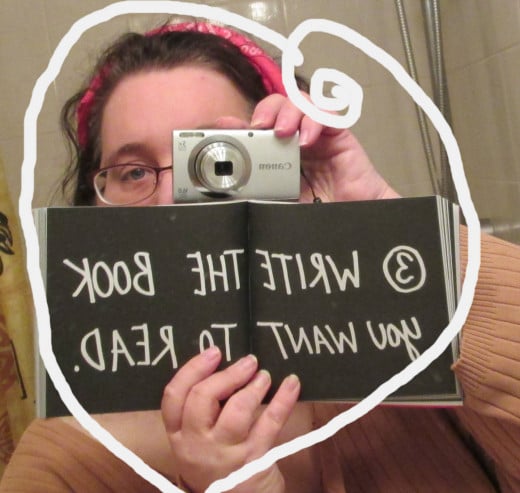
I bought the book because it said #3 Write the book you want to read. I was feeling so burnt out and frustrated with trying to write and not getting anywhere and not being happy about anything I was doing. I was trying too hard to listen to what everyone said I should do. I forgot myself in my own creativity.

Austin Kleon's book, Steal Like an Artist, is about being creative any way you can and in some ways you hadn't thought you would try. It's about taking your creativity, dusting it off, giving it a shake and actually taking it out of the plastic packaging - even though it won't ever be as pristine and collectible again. Creativity should not be pristine or perfect, or too tidy either. Get messy. Try something adventurous. Don't be afraid to steal something and make it your own, not literally.

Of course there is still a line you do not cross. Anything you take from another artist (of whatever form or genre) has to be your inspiration, not something you duplicate and then stick your own name onto. Taking credit for something you didn't add anything to (other than cut and pasting) is not being creative.

Being creative is about your own vision, your own version and how you see things and put them together in your own way. Each of us has a different way of looking at the same thing. Like the blind men describing an elephant, we all see the whole from our own smaller, focused perception.

You could stand a hundred artists in a row and have them all look at the same city skyline or sunset or forest (etc.) and each of them would create an image of their own. No two people see the same thing, in the same way. Think of playing telephone as a kid. The more people who repeated the message the more garbled and confused it became. Art is like that. Not that it become garbled but it is all filtered through different minds, different experiences and different knowledge and skill.

Art is Everything

Don't think an artist is just someone who works with images either. That is selling short. Art is such a huge area: words, buildings... what noun can you not find an art form for, somehow and in some way?
Posted on . Filed in . Tagged with , .

Photocopy Art

From an original post on Suite101 by Jo Murphy. The post and Jo Murphy's bio link are gone since Suite101 revamped the site.

Copy Art Pioneered in Canada Centre Copie-Art Opened in Montreal in 1982 by Jacques Charbonneau

Although it was an international art movement, Canada is recognised for its major contribution to the art form called Copy Art.

According to the Encyclopaedia of Twentieth Century Photography, Copy Art or Xerography was pioneered in Canada, where it is still popular today. Copy Art, uses the photocopier to create artworks by reproducing and multiplying images. The artists play with the process of transformation of graphic images. They experiment with the metamorphosis brought about by the alchemy of light at the heart of the reproduction technology.

Origins of Copy ArtThe electrography process was developed in the USA and Germany in 1938. But this technology became freely available by the year 1960. Copy Art began to appear as an art form by about 1970, and the first exhibition of this kind of art called "Rochester" was held in 1979. Other exhibitions of this type were held in Canada in the same year.

After making its first appearance in France in 1975, copy art became more accepted. By 1983, an exhibition called "Electra" was held in the Musee d'Art de la Ville de Paris. The gallery devoted considerable space to the art form.

Copy Artist Pati HillArtist Pati Hill exhibited in the "Electra" exhibition, working with shadows, grains, and contrasts of black and white as well as textures and micro textures. To create this work, Hill created imagery from feathers, flowers fabrics and plants, says de Meridieu. In a chapter about innovative pioneers in the book called Digital and Video Art, de Mèredieu goes on to talk about Hill as a contemporary experimentalist and her work as extravagant. An example of Hill's technique, she explains, was to photograph every possible (visible, invisible, obvious and unexpected) of the Palace of Versailles.

Centre Copie-Art of Canada

Copy Art continues to thrive in Canada today. The founder of the Canadian movement was Jacques Charbonneau. After discovering the technique, when he was on holiday, he returned to Canada where he opened Centre Copie-Art in Montreal in 1982.

Body Art and Other Offshoots of Xerography

Practitioners of body art, such as Amal Abdenour and Phillipe Boissonnet, reproduced different parts of the body using photo copiers. They were exploiting variations of colour and the effects of contrast and solarisation. Much of this work was achieved by using overlays of transparencies.

Because it so versatile, there have been many different developments and innovations that have evolved from Copy Art. According to de Mèredieu, magazines and fanzines sprang up around artist centres such as art schools and colleges. A centre recognised as famous for encouraging this type of art form was Ecole des Beaux-Arts in Dijon.

de Mèredieu points to the importance of this movement, when she mentions that Klaus Urbons founded a museum of photocopying in Mulheim an der Ruhr in Germany. Here there are displayed old machines, documentation and artist's work. Another example of the value of the body of work, the style and the method, is the opening in 1990 of a major international museum of electrography in Cuenca in Spain.