Posts tagged with “urban exploration”
Posted on . Filed in . Tagged with , , .

Can you Buy and Live in an Abandoned House?

I've heard and read bout properties in Detroit, Michigan, US, being abandoned and then offered for sale (via foreclosure) by the city for as little as $500 (US dollars of course). It may seem an amazing deal, like winning a lottery, to someone who never thought they could have a home of their own, or for those who think to buy them, fix them up, and then flip/sell them to someone else.

Myself being someone who would love to find a home, a place I could live in and feel I finally have a home... this would sound like a dream come true. But, as so many things are too good to be true, this is yet another of them.

Plus, being Canadian there would be other difficulties and risks involved in buying and owning property in a foreign country. Add to that the tariff thing with the US now. I don't know how that would work. Or the issue of crossing the border multiple times, and immigration to move there from Canada. The list of problems can grow pretty fast.

Demolishing dilapidated properties and building from the ground up can be cheaper than rehabbing. But some buyers choose renovation to save historic architectural details found in much of Detroit’s early 20th-century housing stock: turrets, gingerbread trim, pillars and antique woodwork amid broken windows and sagging rooftops.

Duong bought a house in Detroit for $1,100 and spent $100,000 on roofing, wiring, plumbing, appliances, drywall, flooring, and new bathrooms and kitchens. He speaks reverently of preserving the 100-year-old maple floors, and wanted a quality renovation to attract good tenants. It’s located in a privately patrolled neighbourhood near a hospital, so he sees it as a good investment.

But beware of hidden costs and scams. Properties may come with liens, water bills and back taxes totalling thousands of dollars, in addition to renovation costs. It’s also not unusual to hear of homes sold to buyers in other states and countries, with purchase prices rising with every flip. Check with your accountant or tax lawyer; a Canadian purchase and sale might bring taxes that would cut in to any profit.

Original link to the quoted part of this is broken.

Other issues:

  • Squatters or people who were tenants while the original owner had the property. Squatters and angry or frustrated tenants could not only be a legal hassle but cause a lot of damage just because they don't care and don't have to worry about what shape the house is in.
  • Looting, vandalism and salvagers, or just plain thieves. Salvagers are looking for freebies they can take from old buildings and resell to customers elsewhere. I don't know what percentage of them are all that ethical that they don't remove items (including big things from the structure like fireplaces, staircases, windows, flooring, copper pipes) from a building which hasn't had an owner present for awhile, or even a short enough time to seem like a good risk versus reward. Of course, vandalism and looters are self explanatory.
  • Timing. The city has a time limit set for these houses to be renovated and lived in, or sold to someone who lives in them. The city does not want yet more absentee landlords or owners for a property which has already been vacant and left to deteriorate. A bit more time is given for historical properties but how much benefit is that - an historical property will have more standards set for what is and is not allowed and need more time.
  • City services may be cut off. Not just from your property but the entire street. It helps if you buy in an area where at least most of the other properties are not abandoned. Even so, an area which is in financial hardship may not have the budget to provide stellar services to the city. You could be in for more issues with spotty service which would affect your renovations as well as living there.
  • Having a budget for unexpected expenses. Not just for the renovations, but surprise taxes, or fees, or... well the unexpected.

Overall, I think keeping your $500 US, would be a safer plan. I sometimes look at properties here in Ontario, in small towns and see what comes up in a cost range I can manage, somewhat. Usually these need a lot of renovations. But, now and then they are in good shape, just outdated looking. I can live with an outdated, less trendy or fashionable house. If it is in good shape I can gradually update it cosmetically, or just not worry about it. Cosmetic things would make more difference in reselling the house. If I'm planning to live in it, which I would prefer, then the cosmetic things are secondary.

Posted on . Filed in . Tagged with .

Online and Underground - Janelle Brown

Last time I looked I could not find this post on Salon. I looked again today, and found it. Here is the link, as of today. Online and underground Originally posted January 16, 2001, by Janelle Brown. I think I even found a website for her, I couldn't years ago. I've included the original links but excluded the broken links. This article is about the New York and Detroit area and the explorers around that time. Of course, urban exploration wasn't new then. It was just quieter and didn't have a recognized name.

Thanks to the Web, the sport of infiltration - creeping through abandoned buildings and unused subway tunnels - is thriving as never before.

Julia Solis throws dinner parties in the subway tunnels of New York. Wearing period costumes, her guests dine on vegetarian cuisine while high-speed trains clatter by an arm’s breadth away. She invites friends to join her for games in the dark damp tunnels beneath abandoned lunatic asylums; she browses crumbling shuttered hospitals and reads the patient records that have been moldering there forgotten for decades.

L.B. Deyo likes to climb the Brooklyn Bridge in the middle of the night. He uses the bright wash of floodlights to see as he hauls himself up the support cables, hanging onto the guide wires of the suspension bridge for dear life until he reaches the top of the towers. The cars below pass oblivious to the spectacle above them: In New York, Deyo says, most people simply never look up.

Solis and Deyo are part of a growing movement of urban explorers, adventurers who go where they are not supposed to be and document their experiences online. Call it “off-limits tourism” or “infiltration.” It’s not exactly breaking and entering but, rather, visiting boarded-up ruins and underground steam tunnels and the roofs of forbidden buildings. At Solis’ Dark Passage webzine or Deyo’s Jinx Magazine, and dozens of Web sites such as Infiltration, Urban Explorers Network and Forgotten New York, these explorers are visiting places most of us will never see, and recording it so the future won’t forget.

The term “infiltration” encapsulates a whole range of activities ranging from the merely archaeological to the outright dangerous. Climbing through the broken window of an abandoned orphanage may not seem to have much in common with climbing to the top of the Brooklyn Bridge, but the two activities do share a common ideology. “The whole idea is to look at a sign or an area that’s obviously off-limits, where you’re not supposed to go, and ask, ‘What exactly is it that’s keeping me out?’” explains Deyo. “We don’t break locks or bolts or climb over fences; what we’re really overcoming is imaginary barriers that are just understood but barely questioned.”

Infiltration is in no way a new concept — after all, who hasn’t clambered through an abandoned building, ducked under a fence to explore or slipped behind a barrier to see what’s there? In the ’60s and ’70s groups like the San Francisco Suicide Club began to codify the modern movement with organized guerrilla adventure groups. But in recent years, thanks in part to the community powers of the Web, the infiltration movement has grown in strength. It’s no longer a solitary pursuit; instead, you can join mailing lists, Usenet groups, countless webzines or even the Urban Exploration Web ring to swap tips, scout out good locations and meet fellow explorers. “I don’t think there could have been an urban exploration movement as there is now without the Web,” says Deyo. “It’s a good case study of what the Web can do sociologically; people all over the world send e-mails each and every day. We’ve even heard from someone who explored a nuclear submarine base in Russia.”

Although adventurers hail from any land in which abandoned buildings or underground tunnels can be found, there are particularly strong outposts in France (especially the Paris catacombs), Australia (thanks to its adventurous culture), Detroit (with a crumbling downtown full of abandoned buildings) and the East Coast of the United States. If you live in New York, you can join the Jinx Athenaeum Society, which holds monthly meetings promoting urban adventure, or participate in Solis’ Dark Passage infiltration parties.

Most infiltrators have been lifelong adventurers, but for many the first real step into the explorer underground is by going literally under the earth, into campus steam tunnels. Most campuses have extensive underground routes for Ethernet wiring and steam and water pipes. Despite the heat and cramped quarters, the pipes are big enough to host the curious students who climb through open grates to see what’s inside. On some campuses, such as Cal Tech, exploring the steam tunnels has become such an undergrad tradition that authorities turn a blind eye, also ignoring the poetry and artwork that students leave behind to mark their stays. (Wondering if your campus has steam tunnels and how to go about getting in? The <href="http: www.urbanexplorers.net="" "="" target="new">Urban Explorers Network compiles information about as many campuses as it can.) </href="http:>

“It’s kind of like punk rock — you’re into something not a lot of people are into,” says one student enrolled at Virginia Tech. He was initiated to the steam tunnels by an insider during his freshman year, and has since visited his campus library for maps and historical context; his Web site offers diaries and photos as well as advice to fellow students, although he keeps his name secret to avoid campus authorities. “It’s one of those weird paradoxes,” he says. “We want to be our own underground thing and yet we also want to brag about it and help others so they don’t get hurt or busted.”

Exploration of campus tunnels is a kind of gateway drug that leads infiltrators to more extensive tunnel networks — say, the New York subway system, which boasts level after level of abandoned yet oddly clean tunnels lit by eerie blue lights. Tunnels are probably the most common destination, since nearly every urban area is riddled with them. But Jinx’s Deyo and his co-editor, David Leibowitz, who began their magazine in 1996, pursue more lofty goals: Our “area of specialty among urban explorers is heights — a lot of groups like to go into the sewers and storm drains, but we really like to go onto rooftops and tops of bridges. I’ve always loved heights, getting that vantage point on the city that most people never get, having the whole city at your feet.” He prefers places like the Brooklyn Bridge and the rooftop of Grand Central Station, which have an “aesthetic tug … a certain epic quality.”

Infiltration is undoubtedly dangerous — there are always the very real risks of stumbling onto a live rail in a subway tunnel, falling off the top of a bridge or getting crushed under falling debris in a crumbling building. And there is the risk of getting caught, although most explorers I spoke with seemed relatively unconcerned about authorities. Of those I spoke to, only a few had been caught, and only Deyo had ever gotten in trouble. As a juvenile, he and Liebowitz climbed onto the roof of Grand Central Station and were immediately spied and apprehended — but even then Deyo merely got a ticket. “This is New York City and the cops have other concerns than some people who are basically participating in a minor victimless crime,” he shrugs.

Urban explorers admit that the appeal of infiltration is often about the thrill of being somewhere you are not supposed to be — or, as Solis puts it, of “confronting your fears, going into spaces that are dangerous and very creepy.” But despite the adrenaline rushes, many explorers say that it is also the poetry of this pursuit that draws them in.

Solis, for example, first began adventuring when she was a child in Hamburg, Germany, but it wasn’t until a few years ago that she started feeling compelled to document her explorations. She goes exploring several times a month and throws Dark Passage events — often based on a historical novel or film — in which she guides groups into forbidden places. Solis sees herself as “a little bit of an archaeologist, a little bit of a historian.” She specializes in the numerous abandoned lunatic asylums and hospitals that dot the Northeast, gothic monstrosities still cluttered with abandoned equipment, letters, furniture and records. “You are finding artifacts from a whole different way of life that you never would normally see,” she says. “I find file cabinets full of records and look at documents and try to figure out what went on in a place, reconstruct a story.”

The destinations are often doomed buildings on the brink of being demolished; many infiltrators feel driven to make a written or photographic record of historical places that will soon be lost forever. Photographer Shaun O’Boyle, whose Modern Ruins Web site is full of stunningly evocative images of abandoned hospitals, shipyards and factories, believes that “ruined buildings have an interest that goes beyond any interest that building may have had when it was occupied. It has become abandoned space; it no longer functions as it was designed to. The building is no longer sheltering anyone. The slow crumbling and decay make it less and less like architecture and more and more like shapes and forms, masses and planes for their own sake, much like sculpture.”

The infiltrators are not preservationists, however; rather, they are observers and chroniclers. Kevin Walsh, a 43-year-old copywriter for Macy’s, maintains the Forgotten New York site to document the smaller lost detritus of his lifelong home: lampposts, moldering signs and forgotten alleys that once were thriving roadways. It’s a trove of unnoticed ephemera: doorways in subway stations that lead nowhere, weed-encrusted station houses on the abandoned Rockaway rail line, long-forgotten sidewalk art. “I want to get there before the city notices that they are there and gets rid of them,” he says. “That’s why they’re still there, because people don’t notice them.”

Many infiltrators shy away from press coverage — such as Ninjalicious, the infamous founder of Infiltration.org and one of the movement’s heroes — for fear of trouble with authorities or encouraging too many newbies. But those like Solis and Deyo want to convey the message that the movement isn’t about crazy kids breaking, entering and vandalizing; after all, only a certain kind of person would dare to venture into the blackened basement of an abandoned lunatic asylum and brave the invisible ghosts simply to observe and understand.

Perhaps that person is just a little bit crazy, but the urban explorers have a unique perspective on the places around them. Consider them the secret keepers of the cities, above and below the ground. As Deyo puts it, “People have their own lives to lead and don’t feel much of a need to look up at architecture, which is a shame and is part of the reason why we’re doing it — it forces us, if no one else, to view the city as more than just a milieu for the mundane aspects of our lives, a place to work and live. It’s also an environment, and like any environment it can be explored.”

Janelle Brown is a contributing writer for Salon.
Posted on . Filed in . Tagged with , , , , , , , .

Coalition for Canadian Digital Heritage

CCDH, formerly the National Heritage Digitization Strategy, is a cross-sectoral coalition of memory organizations committed to expanding digital access to Canada’s cultural heritage. We strive to build an inclusive community of practice; enabling and coordinating collaboration, capacity, and resources to advance shared priorities.

I may have posted this link before. It's an interesting find. I will send it to the Ontario Barn Preservation group and... I wonder if it would be a good source/place for my own rural and urban exploration photos. Unbuilt heritage.

Posted on . Filed in . Tagged with , , , , , , , , .

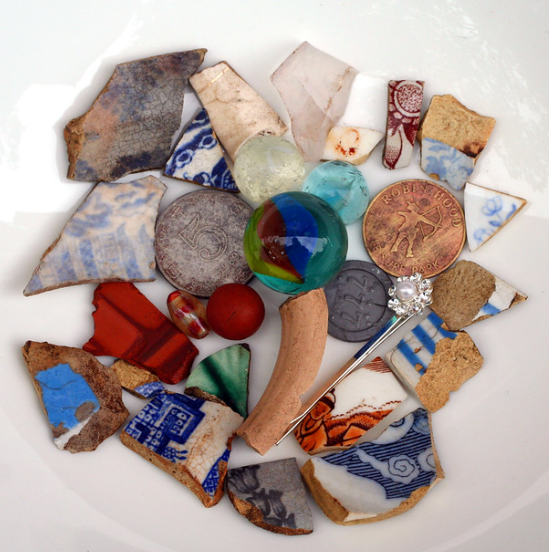
Urban Combing and the Lost Art of Found Objects

The lost art of found objects. (It sounds great as a phrase but I don't think beach-combing (or urban combing) has ever been lost).

Every where you go there are little things to be found. Most people would call it bits of junk. But, its all in the eye of the beholder. An assortment of bits of things found while urban combing can build a whole story, or maybe become part of a creative project.

How to Start Urban Combing

You won't need to buy or carry around a metal detector. Keep something like a spare make up bag, a pencil case, or something smaller you can fit into your pocket or purse and use it to gather what you find. Get home and sort out (was dirt off) your findings. Make notes or start a scrapbook. Photograph the results of each excursion.

Urban combing can be a hobby, free and good for getting exercise strolling around the neighbourhood (or while travelling). Its psychogeography.

You're not walking off with someone's treasures just the little bits of flotsam and jetsam from urban life.

Like beach combing but in an urban setting.

Being a little land-locked, it's not possible to go beach combing in Long Eaton and urban combing is probably the next best thing. Here are lots of bits and pieces I recovered from my garden whilst digging the mud and also a few odds and ends from my walks with the dog.

Source: Urban Combing - Allison Giguere

Posted on . Filed in . Tagged with , , , , , , , , , , , , , , , , , , , , , , , , , , , , , , , .

Create Your Own Backyard Naturalist Notebook

I read the title "3 Ways to Keep a Naturalist's Notebook" and felt that buzz of inspiration. But, reading the post, it was just about other people's projects, people long gone and famous for their other writing. It wasn't what I was hoping for. I wanted something, fresh, something on the scale of in my own backyard versus famous places and perfect settings. So, what was there to do but collect my own ideas for a backyard naturalist, like myself.

First of all, if you don't have a backyard, there is a whole world out there. Take a look at a local public place like a church, cemetery, park, or get creative. Being a naturalist isn't just about walking around in a forested area. Studying urban areas is important too. Even if you walk on paved ground instead of grass, nature can be found. Not even just outdoors!

Make notes about what you see. Including illustrations. Don't try creating masterpieces with your drawings. They can just add to your words as you find more to be curious about, or make note of. If you make a digital notebook you can add digital photos. Later you can look into a magnifying glass and fancier equipment. But, the main thing is to see what you discover while its still out there to be seen. Technology and more equipment can be distracting and time consuming. To start with at least, stick to a pencil and notebook for quick notes.

What can you find in your immediate, local ecosystem? Learn to identify different plants growing in your backyard. What types of grass are in your lawn? What are the "weeds" you see? Watch for animals in your yard, not just birds. What do they find to eat and how do they eat? Do they interact or avoid each other? Add details like the location, season, the weather, time of day, colours, texture, how they move (or blow in the wind), so many details you can think to add once you get started.

Consider all your senses when making observations and notes: sight, sound, smell, hearing and touch. Include your sixth sense, your feelings, too. Avoid touching poisonous plants. Try not to disturb animals and plants in general. That doesn't mean you can't touch things around you, just learn to understand them without endangering or upsetting them. You don't want to harm life while studying life - be responsible for your actions, not a bumbling professor uncaring/ thoughtless about the chaos your actions can create.

How does the environment affect the natural world? The environment can include the location, traffic from vehicles or people, buildings, sidewalks, fences, a river, trees, everything. I think of the odd weed poking up in an otherwise pristine sidewalk. There is the natural world surviving in the environment it finds itself in.

Take time and return. You may see something interesting while busy and make quick notes before moving along. But, plan ahead and choose a time and location where you are not rushed and can return to again and again. Things change in the natural world. You need more than one visit. Try a sunny day and later a rainy day, even in the same week.

You could make a study of just one weed growing where it manages to get a start. What changes day by day? What struggles does that weed have? Does it grow to full height or remain stunted? Does it produce flowers or seeds? If someone pulls it out, does it have enough root to grow back? Endless questions and observations.

Don't forget the motto (used by urban explorers) "take only photographs, leave only footprints". Whatever you bring with you should leave with you, no littering. On the other hand, don't remove things from their environment. Instead hope you will see them/it again next time you visit. I make an exception for seeds and clippings from plants which you could add to your notes. But, don't harm the plants, make sure there is enough of it to keep thriving. In some locations you may need to stay on trails, especially in fragile ecosystems. Think of it as the butterfly effect without the time machine.

Dress appropriately. Think about insects (bees and mosquitos). Think about the weather. Bright colours or anything flashy will make it harder to watch animals, no matter how patiently you wait. Bring everything with you in an easy to haul around backpack or something else that works well for you.

Give yourself credit for what you have learned, progress you have made in understanding the ecosystem and new discoveries you make. Celebrate your discoveries. Add to your research by looking into history and lore about the plants and animals in your own backyard. Which plants are edible? Find out about foraging and cooking/ baking with wild plants. Learn tracking skills for seeing where the animals came from and where they go.

Here are some reflection questions to help you choose your next outdoor adventure: What am I excited to learn outside? What would be easy for me to do in the amount of time I have? What would be easy for me to do in the locations I have nearby? What areas of nature study am I most passionate about? What areas of nature study have I not done in awhile? If you ever get stuck and unable to go deeper in a particular area of naturalist curricullum… simply take a break and go study something else for awhile!

Quoted from Brian Mertins, Nova Scotia.