Posts tagged with “unknown”
Posted on . Filed in . Tagged with , , , , , , , , .

Barrie Ontario Ghost Tour Destinations

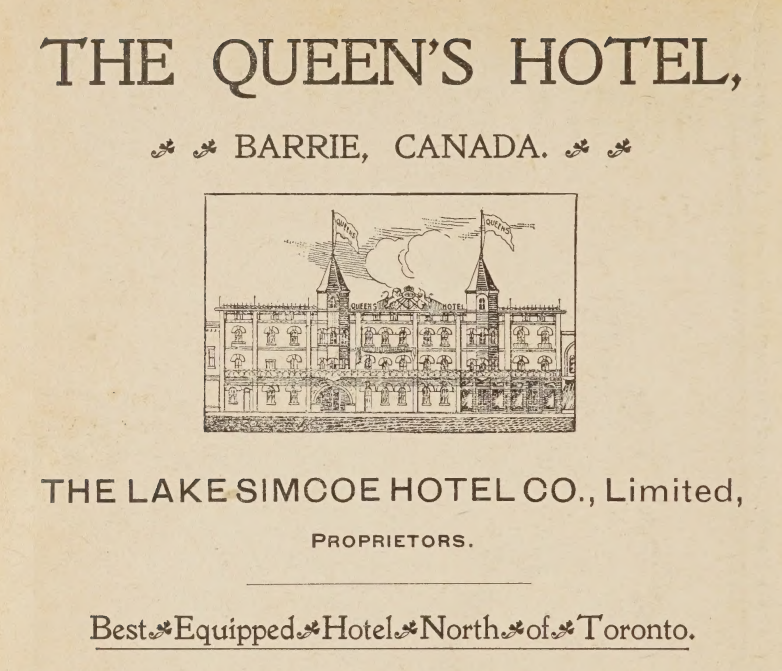
I've got the idea to write a book about places in Barrie, Ontario which are forgotten, lost, unknown, mysterious, "haunted", or otherwise have a good story to be found. I've seen people creating, publishing, and selling books with Amazon. I'm not sure how it works, I have just started with the idea and have a lot to find out. For now, I'm gathering information. I even found an old photo of the Queen's Hotel in Barrie, in an old cookbook from the volunteers at the Victoria Hospital in 1900.
Starting point: The Old Jail (The shadow of Mulcaster Street) Location: 87 Mulcaster St (Site of the former Simcoe County Jail and now a parking lot/site of the new courthouse).

The Story: A classic of Barrie lore. This jail, built in the 1800s. While it was primarily a detention facility, executions were carried out here when Canada still had the death penalty. Security guards who worked at the old jail have reported plenty of unsettling experiences.

What to Look For: The area itself, especially at night, reportedly has an unnerving atmosphere. You're standing where generations of criminals, and some believe, their tormented spirits, spent their final days. The chilling reality of this former institution is often enough to send a shiver down your spine.

Stop two: Barrie Public Library (The Carnegie's quiet guard) Location: 37 Mulcaster St (now the MacLaren Art Centre).

The Story: The original Beaux Arts-style library building was constructed in 1915 with an Andrew Carnegie Foundation grant. Though the current library is elsewhere, the heritage building on Mulcaster is rumored to be home to an elderly ghost. Many say it is a dedicated former staff member or patron. People have reported objects moving on their own and feeling unexplained cold spots. Given its long life as a public building, it's not surprising a few old souls decided to stick around.

What to Look For: Stand outside the old building on Mulcaster (or the new one if you're closer) and think about what kind of person would be so dedicated to books they'd linger after death.

Stop three: Meridian Place and the Lakeshore (The waterside whisper) Location: Meridian Place, at the foot of Dunlop Street.

The Story: This area is the terminus of the historic Nine Mile Portage, a crucial route for Indigenous people and later for fur traders and the military during the War of 1812. The lake itself has a tragic past, with shipwrecks and drownings occuring over the centuries on the icy waters of Kempenfelt Bay. Legend has it that the spirits of those lost to the water, be they soldiers, early settlers, or victims of accidents, can sometimes be heard in the wind coming off the bay, a cold, mournful whisper over the square.

What to Look For: As your walking by this haunted tour stop, feel the wind coming off the water. Consider the hundreds of years of transit, trade, and tragedy that have occurred right where you're standing.

Stop four: The Queen's Hotel (The unfortunate groom) Location: 94 Dunlop Street East (The current site of the Queen's Hotel).

The Story: Legend goes that the Queen's Hotel is forever tied to the sad and mysterious death of Gertrude Small and her husband Warren Bell. Warren was an electrician who had worked at the Queen's Hotel. Just one day after their wedding, both Gertrude and Warren died in a tragic car accident that ended in the Nottawasaga River. Although the official verdict was accidental drowning, there were sensational rumors of a conspiracy surrounding Gertrude’s considerable inheritance.

What to Look For: While the main tragedy didn't happen right here, some say that Warren's ghost has been seen in and around the hotel, perhaps still doing his work or perhaps waiting for his bride.

Stop five: The Collier Street haunting (A stately specter) Location: 58 Collier Street (Site of a former medical office, near Trinity Anglican Church).

The Story: Collier Street is one of the oldest streets in Barrie, running parallel to Dunlop. Many historic homes and early professional offices once lined this road. The old Victorian house at 58 Collier, served as the medical office for Dr. W.A. Lewis (a former associate coroner) for years, residents and staff have reported unusual activity.

The building, now a business, is said to be haunted by a polite, formal specter. Workers in the area have reported seeing an apparition of a gentleman, formally dressed, who simply appears and then vanishes, seemingly just going about his business in the stately old building. This ghost is believed to be the spirit of a former doctor or prominent resident who is simply attached to his professional home. It's less a tale of tragedy and more a classic residual haunting of a person of habit.

What to Look For: Unlike the emotionally charged tales of Elizabeth Meyer (which we talk about soon) or the violent past of the Jail, this is a suspected residual haunting … an imprint of a past routine. Look for any faint, fleeting motion or shadow in the windows, representing a spirit still tied to the place of his daily work, as you check out this haunted walking tour stop.

Stop six: The Five Points (The scarred corner) Location: The intersection of Dunlop St. E/W, Bayfield St., and Clapperton St.

The Story: While not a single haunted building, this historic junction is the scarred heart of Barrie's past. The surrounding buildings, particularly those on the corners, were repeatedly destroyed by devastating fires throughout the 19th and 20th centuries. This corner has been the site of businesses, hotels, and busy human activity for nearly 200 years.

Places that have experienced multiple devastating fires are often associated with residual energy and bad luck. Stand here and imagine the chaos, the heat, and the panic of a city being destroyed by fire. Some say that on a still night, you can faintly hear the muffled screams of warning or the clatter of fire bells from a century ago, echoing the trauma of the area.

What to Look For: Notice the varying ages of the buildings around you … the oldest ones that survived the flames are the most likely to have uninvited guests.

Stop seven: The Simcoe Hotel (Elizabeth's unfinished justice) Location: The corner of Bayfield Street and Dunlop Street East.

The Story: The site of the Simcoe Hotel was a major focal point in the 19th century. This area is strongly connected to the tragic story of Elizabeth Meyer. In January 1872, Elizabeth was found lifeless at the front entrance of the Simcoe Hotel on a brutally cold night. Her death was ruled as accidental, but a lingering mystery remains about the exact circumstances … did she fall? Was she pushed?

The Haunting: Local lore suggests Elizabeth is not resting easily. It is believed her spirit is still attached to the area, seeking justice for her mysterious death. Staff and those who frequent the vicinity have reported a chilling female presence, as if being watched by someone who desperately needs to share a secret.

What to Look For: This stop connects directly to the chaos of the Five Points, so pause here and reflect on the individual human tragedy that occurred amidst the grand history of the hotels. The spot is very close to the newer development, making the old, tragic history all the more unsettling.

Final stop: The Farmhouse (The suicide at the YMCA) Location: The Farmhouse Restaurant, 3480 Yonge St (A short drive south of downtown).

The Story: Originally built in 1890, this building has a rich history as a YMCA and a "gentlemen's club" before becoming the popular restaurant it is today. The most famous piece of folklore centers on a former employee who tragically took his own life in the basement. It's rumored he still lurks, and employees have reported some very weird things. This is a classic local haunting with numerous firsthand accounts.

What to Look For: While you can't go ghost hunting inside (unless you're dining there!), the building's distinctive old architecture and deep history make it a fittingly eerie endpoint to your walk.

Barrie 360 - Barrie After Dark: A self-guided haunted walking tour

Posted on . Filed in . Tagged with , , , , , .

Terry Boyle - Ontario Historian and Author of the Haunted Ontario Series

RIP Terry Boyle 1953-2016

Terry Boyle writes about haunted, forgotten, and historical Ontario. He started writing in 1976, but so far I haven't seen any of the early books. I have several of his books on my shelves. I like reading about old Ontario. When we are out for a road trip I can look for the places he has written about in his books. I don't think I've ever seen a ghost. I'm still on the skeptical side when it comes to haunted places.

Host of Creepy Canada television documentary. I found some episodes on YouTube. But, Wikipedia has a list with 3 seasons and 30 episodes. Not all of them hosted by Terry Boyle. In season 3, half or more of the episodes are not in Canada. That's disappointing, were they running out of Canadian locations or caving to pressure to pacify US viewers? The original Creepy Canada website for the show has more information about each location reported about in the series.

At one point there was a site for Entwood Tours - "...join Canadian author Terry Boyle on Historic and Haunted walks of Bala, Gravenhurst and Parry Sound, Ontario, Canada".

Terry hosted the popular radio show Discover Ontario on Classical 96 and 103.1, Toronto, for 14 years. He has talked and written about Ontario folklore and history for more than 40 years and authored seventeen popular books.

You will hear and see how Parry Sound grew from a native village to a sprawling lumber centre. Perhaps you will hear an eerie wail at the Parry Sound Jail or see the lingering spirit of Belvedere Hill. Terry will highlight the walk with upwards of 300 vintage photographs of the downtown area.

No tours since 2014.

About Terry Boyle - A page from the Entwood Tours site.

Terry Boyle hosted the popular radio show Discover Ontario on Classical 96 and 103.1, Toronto, for 14 years. He has talked and written about Ontario folklore and history for more than 40 years and has authored seventeen popular books.

Do ghosts really exist? Terry Boyle seems to think so. He believes in them so much that he has travelled all across Ontario to research popular hauntings. The outcome of his research was three books: Haunted Ontario and Haunted Ontario 2 and Marilyn at French River and Other Ghostly Sightings.

According to Karen Coyle of The Chronicle, "Some of the more popular stories in the first book are the Donnelly Estate in Lucan and Ghost Road and the Jester’s Court in Port Perry. Boyle does not just write the legends of these ghosts, he researches them. He will travel to the haunted property and speak with the employees or residents of the place as well as other people in the area. He also looks up the history of the area to see if he can find out who the spirits are and why they are still there."

In Port Perry, there are two haunted places - the well-known Ghost Road and the lesser-known Jester’s Court. According to an interview with Boyle, Coyle adds, "The legend of Ghost Road is well-known. Way back when, a man was riding his motorcycle on the road, or in the field (there are several versions). At some point he lost control and was decapitated by the wire fence at the edge of the field. Now, people claim to see a headlight on the road coming towards them, then the red tail light driving away."

Jester’s Court in Port Perry is also documented in Haunted Ontario. The building has a long history. Coyle continues to highlight the interview with Boyle, "It served many purposes, including a hotel for many years, and is currently a restaurant and pub. Many people have had experiences in the restaurant over the years.

Most of the staff have learned to live with them even when dishes are moving around right in front of them and lights turn themselves on and off. The staff simply tells the ghosts to ‘stop playing around, we’re trying to get work done’.

The Donnelly homestead in Lucan , Ontario is also highlighted in Haunted Ontario. A long time ago a terrible tragedy took place there. Boyle states, "Five members of the Donnelly family were murdered in cold blood by people from the town.

Robert Salts and his wife now own the property and firmly believe that the Donnellys are still there. A spirit or spirits haunt the old barn situated on the property as well as the homestead.

In Haunted Ontario 2 Boyle highlights the Ottawa International Hostel and Carleton County Gaol. Boyle states, "Out of the shower and into the change room. The clothes have vanished. In the hallway a sock appears, a shirt...pants...belt...underwear, scattered down the hall like stepping stones. Where is the watch? The search begins in another room or, more accurately put, another cell. No longer ticking, the watch lies upside down on a cold, concrete floor. The searcher flees to his room. What on earth just took place? These are common occurrences for those who stay in the Ottawa International Hostel, once the Carleton County Gaol. Time stops on Death Row."

Marilyn at French River and Other Ghostly Sightings highlights a beautiful, young starlet finds relief from her troubled Hollywood existence at an inn on the French River in the 1950's. After her tragic death the staff, and some visitors, see the ethereal blonde in the room Marilyn once occupied. They are convinced she has returned to stay forever.

This inn is just one of the public places where you may see a spirit yourself. And every place has a fascinating story to tell.

A thwarted love affair led to suicide in the bank building that now houses The Hockey Hall of Fame. A pretty bank teller was driven to despair when her married lover rejected her. Using the bank revolver, she ended it all in the ladies rest room. No one could visit that room without feeling her presence. Visitors today say she still inhabits the building.

Fort George in Niagara-on-the-Lake, a hotel on Lake Huron and even such familiar spots as Prince Edward County and the Gravenhurst Opera House are haunted by spirits people see and hear almost every day.

Take a trip with Terry Boyle, well-known historian and folklorist, who tells the stories behind each place and explains what he and others actually saw and heard.

The possibility of a spiritual world has grown up with the current Burk’s Falls resident. With great-grandparents coming from Ireland, it wasn’t uncommon to tell stories of folklore.

“I grew up with the stories of little people and leprechauns and the like, so I kind of tucked it in the back of my head,” he said. “Then when I started writing books in the 70’s, people kept telling me stories. Sixteen years ago, I thought maybe I should be writing on the subject.”

And so, Boyle began writing the first book to his Haunted Canada series, where various locations are explored by him and documented. He also hosted Creepy Canada, which ran on Discovery Channel from 2002 to 2006.

Boyle said his investigations usually begin with someone telling him of a haunted place.

“I phone the establishment and I see if they’re interested in having a story written about their place in regards to haunting and spirits. If they say yes, then I drive there and arrange an interview with the owners,” he said. “Then I research the history of the property and the building, then I interview possible descendants of the family that built the building. Then I interview the staff that are working in the establishment and I tour the grounds and the building and sometimes stay over night.”

Boyle will take photos of the site and retrieve any archival photos he can find of what the building looked like 50 to 100 years ago.

“It’s really quite intriguing because you meet some incredible people,” he said.

The content of his books make for an interesting read, to say the least.

“There are very unusual experiences that challenge the rational mind,” he said. “It goes a bit beyond our belief system.”

Locally, Boyle said the Gravenhurst Opera House and the Ojibway Hotel in Pointe au Baril have experienced sightings.

“There are doorways, there are other dimensions,” he said. “There’s no question about that.”

Boyle has experienced many things, including two women arguing outside his door at the Beild House Country Inn Spa in Collingwood where he slept in Kind Edward’s bed. He’s also visited opera houses where someone sits in the seat behind him but as soon as the lights go up, they’re gone.

“I’ve never looked back,” he said. “It’s pretty fascinating. It’s a very fascinating field.”

Almaguin News - Haunted Ontario author invites Burk’s Falls on trip to the other side

  • Discover Ontario: Stories of the Province's Unique People and Places (2016)
  • Hidden Ontario: Secrets from Ontario’s Past (2011)
  • Ontario Memories (1998)
  • Ontario Album
  • Memories of Ontario (Western Ontario) (1991)
  • Fit to Be Tied: Ontario's Murderous Past (2001)
  • Teachings from the Longhouse (1994)
  • Marilyn at French River and Other Ghostly Sightings
  • Haunted Ontario (1998)
  • Haunted Ontario Revisited (2007)
  • Haunted Ontario (2): Ghostly Inns, Hotels, and Other Eerie Places (2013)
  • Haunted Ontario 3: Ghostly Historic Sites, Inns, and Miracles (2014)
  • Haunted Ontario 4: Encounters with Ghostly Shadows, Apparitions, and Spirits (2015)
  • Full Moons and Black Cats: Everyday Rules to Guide Your Life! Found after searching eBay. Most of his books can be found here but prices can vary by a lot. Plus shipping.
  • Haunted Mississauga - Found on GoodReads (2006)

by Terry Boyle and Dundurn Press - Terry Boyle

The community has lost its foremost expert on the spirit world.

On Monday, July 11 Muskoka Parry Sound author, historian and teacher Terry Boyle died. His wife and family will fondly remember the Burk’s Falls resident.

Boyle was the author of multiple books including his Haunted Canada series where various locations are explored by him and documented. He also hosted Creepy Canada, which ran on Discovery Channel from 2002 to 2006.

He was a prolific community speaker having given talks over the years at numerous local libraries.

In an interview in late 2015, Boyle told the Almaguin News that he often finds people believe the topic of ghosts to be an uncomfortable thing to talk about.

“There’s a lot of people I think are fairly fear based around it,” Boyle said in 2015. “They just don’t want to know or think about it. And it has a lot to do with death and what’s next.”

Huntsville Forester - Haunted Ontario author Terry Boyle dead at 63

Posted on . Filed in . Tagged with , , , , , , .

Algonquin Rock Worm?

Is this a hoax, or real?

Supposedly written by Roger Fontaine (who doesn't appear to exist) more likely written by David Legros, Algonquin Provincial Park chief park naturalist, who’s originally from Lafontaine, now lives in Huntsville, Ontario.

As far as I know, these holes (tunnels) in the photograph below, were created from blasting through the rocks of the Canadian Shield to make way for building the highways/ byways in Ontario. Other provinces and territories likely have them too. I really doubt the worm story, as far as these photos being any kind of real evidence. But, the whole post shows how something can be turned into a great hoax, or a great story. Is there enough here to make you a believer?

Holes in the shield: the Algonquin Rock Worm

Roger LaFontaine originally came to Algonquin Provincial Park looking for creepy creatures like leeches, snails, crayfish and rotifers in the early 2000s.

During that first season in the park, he became fascinated by the huge and strange marks seen all over Algonquin’s Highway 60 corridor left by a prehistoric worm. Since then, he’s devoted at least a day per year to documenting and studying some of Algonquin’s forgotten creatures.

Many visitors to Algonquin are in awe of the rocky shorelines and exposed rock outcrops throughout the park.

What only keen-eyed visitors may pick up on are the telltale marks left behind by a fantastic creature that sadly isn’t around anymore.

Findings from a lost journal Back in the 1930s, strange marks appearing as vertical tunnels were seen in rocks along what would later become Highway 60.

Naturalist Walter Lepinski working with the road crew would eventually go on to describe the creature that made these precise tunnels: the Algonquin Rock Worm (Petrolumbricus algonquinensis).

This was a species of large burrowing worm that specialized in boring tunnels through rock using hardened mouthparts.

Walter estimated that Algonquin Rock Worms were approximately 10 cm wide by 6 m long, featuring segmented bodies and head-ends covered with scales.

Lepinski’s observations were corroborated by strange notes and illustrations found in the journals of timber cruisers and timber chute operators before the turn of the century (pers comms, Norton Smithers, 2024).

Lepinski’s notes from this time are scant, but he did write in his journal

“Algonquin Rock Worm, Petrolumbricus algonquinensis.

“Fossil burrows found along proposed highway through Algonquin. Only burrows found through Canadian Shield. I estimate the worms to be up to 20 feet in length. It must have hardened mouthparts to bore through rock.”

Evidence of species past Sadly, this species was one of the victims of the last Ice Age – the enormous glacier that covered much of North America in a crushing sheet of ice.

By the start of the last Ice Age 100,000 years ago, the rock worm would be wiped from the landscape.

In fact, following the melt of the glacier about 11,000 years ago, there would be no native earthworms at all in Ontario until they were introduced by humans just a few centuries ago.

Alas, no extant fossils exist of the Algonquin Rock Worm because animals with soft bodies rarely become fossilized. On top of that, that worm-killing glacier also scraped much of Ontario clean of its soil and softer rocks, including most fossil-bearing rocks.

Today, fossils of ancient animal life are found in limestone regions of southern and extreme northern Ontario.

To see these, check out parks like Presqu’ile Provincial Park, Craigleith Provincial Park, Kakabeka Falls Provincial Park – these parks host fossils that are hundreds of millions of years old!

As for the Algonquin Rock Worm, all we have left are the huge and mysterious burrows.

When the track or sign of an animal is fossilized, it is called a “trace fossil” or “ichnofossil.”

Modern effects of the Algonquin Rock Worm

Photographs from modern Highway 60, Algonquin Provincial Park featuring the tunnels of the Algonquin Rock Worm. In many locations, a number of tunnels appear next to each other. It is possible the worms lived in groups or were excavated in similar locations over vast time periods – we won’t be able to know.

While called the Algonquin Rock Worm in tribute to the place where it was first described, this species has since been found across much of eastern Canada and parts of the northern United States, with observations made all over the Canadian Shield.

Coincidentally, this lines up well with some of Ontario’s most iconic parks and drives, such as Frontenac Provincial Park, the eastern shore of Georgian Bay, Lake Superior Provincial Park, and more.

Today, we don’t have much to go on to piece together the life and ecology of the Algonquin Rock Worm.

The vertical burrows that we can see while travelling along the highway suggest they were good at orienting themselves to get to the surface and likely fed here.

Modern worms consume vast quantities of forest debris like dead leaves, and we assume that the Rock Worm did as well.

As modern worms feed, they leave behind poop, called worm castings.

One must imagine the immense heaps left behind by a 6 m worm and the nutrients spread onto the landscape, let alone the piles of pulverized stone at the burrow opening.

While we can’t know for certain, it is thought that Rock Worms were long-lived due to their size and the difficulty of boring through rock.

We have yet to find deep subterranean chambers attributed to the Rock Worm, and we suspect they are deep underground so unlikely to find them.

It is thought that the burrows provided homes for other species of long, narrow animals to use, from smaller worms and insect larvae to snakes and weasels.

In the past, as today, water trickles through these holes, perhaps entering the ground for long-term storage.

In winter, the water may freeze and thaw, and over millennia, this has cracked many rock outcrops, eventually creating mineral soil for plants to grow in.

Become a student of nature You may be wondering, “So what? Why does this matter?”

We think the answer might come from Walter’s journal in 1936:

“Those building the road thought it was a waste of time to even ponder what made these burrows, and they teased me relentlessly for my curiosity in such matters. For the student of nature, everything is interesting and instructive to the eyes that can read it.”

If you happen to be visiting some of our stunning parks on the Canadian Shield this season, take some time to look for the burrows of the ancient Algonquin Rock Worm.

Photograph the tunnels from a safe distance, but don’t touch these sensitive fossils – researchers are still trying to glean what they can from them.

Posted on . Filed in . Tagged with , , , .

CBC Archives - One of Canada’s earliest paranormal sightings

Sightings of Unidentified Flying Objects (UFOs) are hardly a new phenomenon. They have been documented throughout the centuries and all over the globe. Here in Canada, reports CBC Assignment's Rex Lambert, one of the oldest and most curious paranormal events dates back to 1845. One September evening near Cornwall, Ont., a farmer notices brilliant dancing lights surrounding Marsh Point Farm. Soon more and more people witness the spectacular lights accompanied by strange sounds of clanging and explosion. Befuddled neighbours decide to keep an overnight watch but fail to solve the mystery. After a year, the bizarre manifestations slowly disappear without a trace. Despite interviewing numerous witnesses and scientists, no credible explanation is ever offered for the strange activities at Marsh Point Farm.

Did you Know?

Canada has one of the highest rates of UFO landings per capita. According to the most recent survey done by Ufology Research of Manitoba, more than 483 UFOs were reported in 2002. That number represents an increase of 29 per cent over sightings in 2001.. Ufology refers to the study of UFOs.. Ufology Research of Manitoba is a non-profit organization established in 1975. Based in Winnipeg, the organization looks at "rational discourse, investigation and research on UFOs and related phenomena." Other UFO research organizations in Canada include UFO*BC and the Mutual UFO Network of Ontario.

CBC Archives 1962 (Just an audio file now).

Posted on . Filed in . Tagged with , , .

Spontaneous Human Combustion

I found an explanation about spontaneous human combustion which makes some sense.

Most deaths thought to be caused by spontaneous human combustion can be attributed to the "wick effect", whereby a person’s body fat acts like candle wax, causing a person to burn in an intensely hot but extremely well contained fireball. Strangely, all that is left in most cases is the lower part of the victims legs, which contain little fat, and their feet, which are usually found to be still wearing slippers. This would seem to explain how homes are sometimes left undamaged after a victim’s body has been burned to cinders along with their favorite armchair. However, whilst the "wick effect" explains the way in which a human body might burn it offers no explanation for the cause of the fire.

Quoted from Weird Worm