This is a list for all of Canada. Some of the trees are still found in Ontario:
I know Butternut trees grow here too. But maybe its not the same at-risk type.
American chestnut (Castanea dentata)
The American chestnut had been considered endangered even before the Endangered Species Act was introduced in 2008. Now restricted to southwestern Ontario, the American chestnut’s natural range used to be 200 million acres of northeastern forest that stretched from Maine to northern Florida, including the southern part of Lake Ontario and all around Lake Erie. Now, there are only 120 to 150 mature trees left in the wild, along with an estimated 1,000 smaller, less mature trees.
Accidentally introduced from Asia in the early 20th century, a fungal infection called, appropriately, chestnut blight (Cryphonectria parasitica) has been responsible for the tree’s decimation throughout the eastern woodland regions in Canada and the US.
Butternut (Juglans cinerea)
The only walnut tree native to Canada, cold-tolerant butternuts are known for their tasty nuts and beautiful wood, which is highly valued for furniture, paneling, and carving. They grow from eastern Canada south and west to Minnesota, and as far south as Mississippi, contributing to forest biodiversity, especially in the northern part of their range.
Butternuts have become vulnerable to a fungal infection known as the butternut canker (Sirococcus clavigignenti-juglandacearum), which attacks trees through buds and openings in the bark, infecting the lower crown. Pores produced by the infection are carried down the tree by rainwater, at which point cankers start to develop on the trunk, eventually surrounding the trunk and killing the tree. While hybrid butternuts seem more resistant to the canker, true native butternuts are almost uniformly vulnerable, often dying within two years of infection.
Cherry birch (Betula lenta)
While its name calls to mind elegant white-barked birches, the cherry birch looks more like the domestic sweet cherry tree, with smooth, dark bark. Its twigs contain methyl salicylate, which gives off a strong scent of wintergreen. In fact, the tree was used in commercial oil of wintergreen production until a synthetic substitute was developed.
Unlike many other endangered trees, the cherry birch isn’t threatened by a pest or fungus. Instead, habitat destruction due to residential development throughout southern Ontario has significantly reduced its numbers. As well, since the population exists almost exclusively on the shores of Lake Ontario, the tree is particularly vulnerable to erosion. At the moment, cherry birches can only be found in two sites on the Niagara peninsula.
Cucumber tree (Magnolia acuminata)
Canada’s only native magnolia tree, the cucumber tree was Ontario’s first endangered tree species. Its name comes from the shape and colour of its unripe seed pods, and it can often reach up to 30 metres in height.
While more common south of the border, the cucumber tree is endangered in Canada because of deforestation and habitat destruction. At present, 18 populations of cucumber trees exist in the Niagara region and Norfolk county.
Limber pine (Pinus flexilis) and whitebark pine (Pinus albicaulis)
Found in Alberta and British Columbia and extending as far south as Mexico, the limber pine is a slow-growing, long-lived tree species, with the oldest tree recorded in Alberta being approximately 642 years old. (One in Oregon is estimated to be more than 2,000 years old.) When growing in exposed areas, limber pines can take on a characteristic twisted, stunted look.
Limber pine is often found growing with whitebark pine, and, in fact, the two are hard to tell apart. The two species are threatened by the same double whammy: a fungal infection called white pine blister rust (Cronartium ribicola) and outbreaks of the mountain pine beetle (Dendroctonus ponderosae). While whitebark pine seems more vulnerable to white pine blister rust, with higher mortality rates, both are affected enough to now be considered endangered.
Eastern flowering dogwood
Characterized by its small size and white flowers (which are actually tiny yellow flowers surrounded by bright white leaves), the eastern flowering dogwood has brownish-grey bark that looks like alligator scales. While fairly common in the middle and southern United States, it only exists in Canada in the Carolinian Zone, a specialized ecosystem that extends from southwest of Toronto down to Sarnia and along the shores of Lake Erie.
The eastern flowering dogwood has come under attack from the dogwood anthracnose fungus (Discula sp.), which infects the tree’s leaves, then spreads to the twigs and trunk. The tree’s mortality rate with this fungal infection is between 25 and 75 percent, which has had a significant impact on the tree’s population.
Red mulberry
Not to be confused with the white mulberry—the tree that drops a sticky red mess of berries all over the ground and sidewalk—the red mulberry is on the brink of extirpation in Canada precisely because of that other mulberry. While the two species are related, and, in fact, hard to tell apart, the white mulberry is an Asian transplant brought to North America by way of European settlers. Because it has no predators, the white mulberry has become an invasive species, pollinating what few red mulberries are left and creating hybrids—and significantly reducing biodiversity.
Only 200 red mulberries remain in Canada, with 17 in Point Pelee National Park (which, by the way, is home to five dozen species at risk).
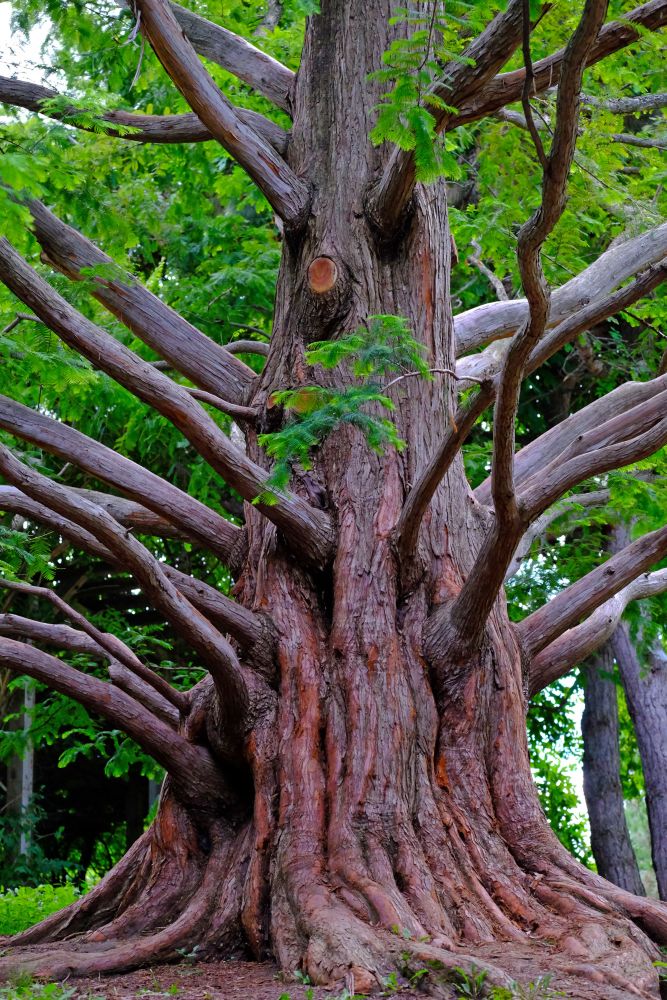 In 2015, it was voted as the most unique tree in the