Posts tagged with “Toronto”
† Posted on . Filed in . Tagged with .

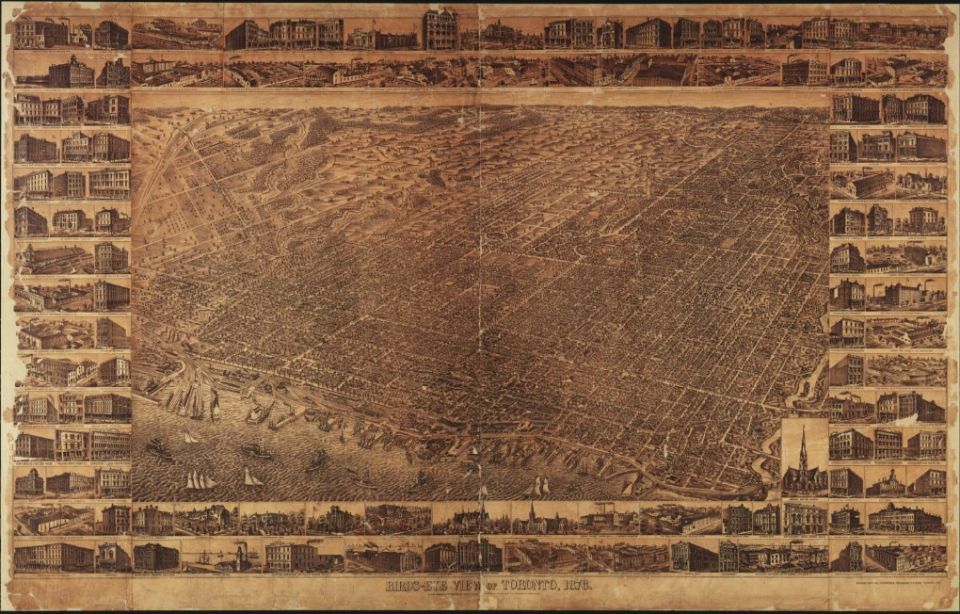
Toronto Map from 1876

I found this map for sale in an Etsy shop, civicatlas. With shipping, it would cost over $50 to have a print copy. Sure, it would be a nice size but more than I can spend. If you have the resources I recommend getting it for any Toronto history explorers. As you can see, there are excellent images of old architecture, likely gone or very different looking now. To see more of it myself, I searched online and found it Historical Maps of Toronto, with a link to the source for the full map at the University of Toronto. Here are screenshots, to give you a preview. I would like to have this covering an entire wall of my house. But, I will settle for keeping it as wallpaper for my desktop computer. Meanwhile, I did download the full file and I can see what it would cost to get it printed. Possibly a local business where the photographer reprints and fixes old photographs, might be just the place. Bird’s Eye View of Toronto, by P.A. Gross, 1876.

† Posted on . Filed in . Tagged with .

A Tribute to Jeff Chapman: RIP Ninjalicious

Jeff Chapman (1973 - 2005) #RIPNinjalicious

Jeff Chapman was a Canadian urban explorer, known as Ninjalicious. Jeff published Access All Areas and the founder of Infiltration, zines and website.

"It's the thrill of discovery that fascinates me. Yes, I know I'm not the first person there, but I can honestly say I found it and I earned the experience for myself. After exploring for a while, you get a wonderful feeling that you're "in on" the secret workings of cities. You know what's under your feet and what's behind the closed doors and what the city looks like from the highest office towers, while almost everyone around you only ever looks at the public areas and never truly pays attention to urban structures unless they've paid admission to take a look." - Jeff Chapman/ Ninjalicious

Source: Interview at Philadelphia City Paper with Neil Gladstone (1998?)

This month, August 2015, marks ten years since Jeff Chapman passed away. I thought someone should post in his honour. I never met him personally. I did email with him, twice. I met his wife, Liz, at a Broken Pencil Zine Festival in Toronto.

I attended the Festival to buy Access All Areas: A User's Guide to the Art of Urban Exploration, see some of Jeff's (and other publishers) zines and take a look at the Gladstone Hotel in Toronto. I was just beginning to explore with a digital camera then. Before that I just didn't know what I was doing had a name (and film was expensive!).

A tribute can still be found at the Toronto Architectural Conservancy 

Jeff Chapman (September 19, 1973 -- August 23, 2005), better known by the pseudonym Ninjalicious, was a Toronto-based urban explorer, fountaineer, writer and founder of the urban exploration zine Infiltration: the zine about going places you're not supposed to go. He was also a prominent author and editor for YIP magazine, as well as its website, Yip.org. Chapman attended York University in the early 1990s and later studied book and magazine publishing at Centennial College. He went on to serve as Editor at History Magazine and as Director of the Toronto Architectural Conservancy board.

Chapman died of cholangiocarcinoma on Tuesday, August 23, 2005 --- three years after a successful liver transplant at Toronto General Hospital (a location he loved to explore). He was 31 years old.

Source: Wikipedia: Ninjalicious

Toronto's own late Jeff Chapman (a.k.a. "Ninjalicious") published his first printed issue of Infiltration, "The zine about going places you're not supposed to go," in 1996. Though Toronto may not live in the imagination of people around the world, Chapman made this city's sewers famous for his global readers. His work lives on in Access all Areas, his book published just before his death to cancer in 2005, and at infiltration.org.

Source: Shawn Micallef: Getting to know Toronto's sewers

Under the alias Ninjalicious is where Jeff made his biggest mark. In his early twenties he spent long periods of time in the hospital battling various diseases. Often bored, he and his IV pole would go exploring the hospital, investigating the basement, peaking behind doors, looking for interesting rooms and equipment. It was here his love for the under explored side of buildings developed, and upon returning to health he created Infiltration -- the zine about going places you're not supposed to go.

Infiltration has had a profound influence on urban exploration in Toronto and around the world, as evidenced by the hundreds of tributes left for him in the Urban Exploration Resource forum. Ninjalicious had a strong code of ethics which he promoted, including no stealing or vandalizing while exploring. Issue 1, all about Ninj's beloved Royal York Hotel, was published in 1996, and the zine was continually published throughout the years ending most recently with Issue 25: Military Leftovers.

Source: Sean Lerner: Torontoist: Death of a Ninja

About ten years ago I was in a Toronto bookshop and found a copy of Infiltration. Subtitled "the zine about going places you're not supposed to go", it was devoted to the escapades of the author, Jeff Chapman or "Ninjalicious", to use his nom de plume as he explored the many off-limits areas in famous Toronto buildings such as the Royal York hotel, CN Tower, or St. Mike's Hospital. In each issue, Chapman would pick a new target and infiltrate it --- roaming curiously around, finding hilarious secrets, then describing it with effervescently witty delight. Chapman had the best prose of any zine author I've read anywhere. Many zinesters are clever, of course, but Chapman wrote with a 19th-century literary journalist's attention to detail; nothing escaped his notice, from the relative fluffiness of the towels in executive lounges to the color of the rust pools in a mysterious, hangar-sized room buried below Toronto's subway system.

Source: Clive Thompson: Collision Detection: R.I.P. "Ninjalicious" --- the founder of urban exploration

infiltration The zine about going places you're not supposed to go, like tunnels, abandoned buildings, rooftops, hotel pools and more.

Source: Infiltration

See also:

cancon
what is it that attracts you to going where you're not supposed to go?

Ninjalicious
Healthy human curiosity about the workings of the world I live in, of course. I mean, it's free, it's fun and it hurts no one. A harder-to-answer question would be: why doesn't everyone?

cancon
what are the tools of your trade?

Ninjalicious
Usually I travel very lightly, with a pen, paper, a Swiss army knife, a camera and a flashlight. That's about all the equipment I need to have a good time in 90% of the places I visit. I take along more specialized equipment, such as rubber boots or various props, for specific targets.

Source: Cancon Interview with James Hörner
† Posted on . Filed in . Tagged with .

What is the GTA (Greater Toronto Area)?

Currently Metropolitan Toronto includes a lot of other small cities and towns. Metropolitan Toronto now reaches out to areas beyond the original borders and far beyond it's own city limits. This large mass of area has become known as The Greater Toronto Area - the GTA for short.

I grew up in a small town which was on the edge of the big city of Toronto. When I was still a kid the town was called Port Union. By the time I was in high school our town of Port Union had become part of Scarborough, absorbed into the suburbs of the city of Toronto. Scarborough is the eastern suburbs of Toronto. People sometimes refer to it as Scarberia because it is over an hour's drive from downtown Toronto to the edges of Scarborough.

I never quite liked the loss of identity from our smaller town, forgotten in history. Port Union lost it's place on the map and become a non-town. If you drive out there you can still find one long street named Port Union Road, but that's all you will find remaining from the early days of the area being independent from the suburbs of Toronto.

However, that's how big cities grow. Toronto has grown a lot from the days of being known as York (Muddy York) over 100 years ago.

The GTA combines the regions of the City of Toronto, York, Durham, Peel and Halton.

I don't live in the GTA now. I moved farther north and I live in Simcoe region, just outside the reaches of the northern part of the GTA. Someday this may become absorbed too, but I'm pretty sure that will be far into the future. Not everyone is eager to move farther north after all. Most of the population density seems to be heading east and west of the Toronto area.

The History of the GTA - The MegaCity of Toronto

In 1998 the sprawling suburbs of Toronto: York, North York, East York, Scarborough and Etobicoke became part of the municipality of the city of Toronto. The megacity, The Greater Toronto Area came into being. Toronto became the largest city in Canada and the fifth largest in North America.

The addition of Halton, Peel, York and Durham is unofficial, as far as I can tell. Sometime after the forming of the megacity people began referring to locations by how far they were from Toronto. For instance, if you were thinking to drive out to Richmond Hill from Toronto you decide it's not too far because it's still in the GTA. But, if someone is thinking to drive out to Barrie, they might rethink it. Barrie is outside the GTA, at least another half hour drive.

The whole GTA thing is usually a way of measuring the distance of any place from Toronto. "How far is it, is it still in the GTA?" When you meet people online and think about getting together there is an imaginary line around the GTA and few people want to cross it. If you are in the GTA you think anything outside of the area is too far. If you are outside of the GTA you think about driving through the GTA traffic and usually look elsewhere to meet people.

† Posted on . Filed in . Tagged with .

Toronto Sites I Found Today

Reading Toronto - Looking at the city through the eyes of the many designers, architects, writers, and artists in the city.

Imagining Toronto - A local exploration of culture and place, a lived geography of the city and region.

Imagining Toronto, the blog. -
Amy Lavender Harris- A geographer and environmental phenomenologist. Occasional rabble rouser. Known to be fiercely independent, curious, principled, persistent.

Jennifer Burns: Local Ruins - Abandoned and reclaimed buildings in Toronto.

Toronto Psychogeography Society - A loose collection of relentless flâneurs, explorers and walkers. Participants step out of their daily routine and explore the city's overlooked corners to imagine the dynamics of a better future urban environment.

Murmur Toronto - An archival audio project that collects and curates stories set in specific Toronto locations, told by Torontonians themselves.

Canadian New Media Awards - To recognize and celebrate the accomplishments of individuals and companies in the Canadian new media industry.

† Posted on . Filed in . Tagged with .

Cryptids of Toronto and Lake Ontario

Nessie of Lake Ontario

Did you know the Loch Ness Monster has a Canadian cousin? Lake Ontario's own Nessie has been sighted for centuries, lurking in the waters. The first known account of this famed giant sea serpent comes from Canada's rich indigenous history. Further, the Seneca First Nations tribe document a mysterious sea monster shaped like a snake and roughly the size of a whale. Later on in the 1880's, several explorers spotted a 50-foot blue-grey serpent basking on the shorts of the lake. While these sightings have never been confirmed or denied, if you're lucky enough to spend the summer in Ontario, you may just spot a Canadian cryptid on your next fishing trip.

Aliens in Cabbagetown

Take a stroll along Parliament Street and you may experience a close encounter of the third kind. Local legends tell of an underground alien base, similar to Area 51, beneath the urban sprawl. The origin of this tale isn't specifically known, but the story originated in the 1970's. A local newspaper published a report from a man who claimed to have followed a three-foot, fuzzy, catlike humanoid into an underground tunnel. He didn't venture far when he was promptly told to "get out", and, wisely, listened. Rumour has it that a magnetic field anomaly in the area may be the cause of heightened paranormal activity. While this part of the legend has been tested and debunked, it's still fun to think that we're not alone.

The Lady in Red

There's something strange in the neighborhood at Lower Bay Station. Mystery and intrigue have swirled around Toronto's underground for years. While we can assure you Canada's transit system is perfectly safe (and efficient!), many stops are no longer in use and therefore do not appear on the TTC map. As you can imagine, this has lead to much speculation about "hidden stations" much like Toronto's version of Platform 9 3/4!One of the most popular legends surrounding the underground is that the abandoned Lower Bay Station is haunted by the ghost of a "lady in red". This seemingly friendly, albeit solemn, spirit appears on the platform when no one else is around. Perhaps she's waiting for her bus or waiting for a true believer to share a few frights with.

Source: Cryptids of Canada and Other Toronto Urban Legends We Bet You Didn't Know About - Mary-am Suites