Posts tagged with “Toronto”
Posted on . Filed in . Tagged with , , , , , , , .

Wild Parrots in Ontario?

Would you support pigeon feeding stations in your city? The idea of pigeon feeders is to move them from areas where they are not welcome and prevent rats/ rodents in general from eating the food intended for wild birds. Also, keeping the birds for those tourists who think feeding pigeons is something to do while visiting cities. (I'd skip it).

I don't think there are parrots and other exotic pet type of birds living in Toronto. I know I haven't seen any in Barrie, where I live now. Could they migrate this north and live through the winters? Winters are milder overall but one good, cold snap could be too much for birds used to a southern climate.

The Parrot Sanctuary (Toronto) From what I read the birds are from people who had them as exotic pets. So, parrots and other exotic birds are still not able to survive winters north of New York.

Brooklyn Parrots - about a non-native species which is surviving and doing well, without causing problems for the native environment. Or at least merging with the existing pigeon population and not causing more trouble than the pigeons.

The site has a wild parrot FAQ, intended for the local, New York area.

The Monk Parakeet, also known as the Quaker Parrot, is an adaptable, hardy bird from South America noted for its intelligence, sociability, creative approach to nest-building, and general resourcefulness. They were first detected in the wild in New York City in the late 1960s, and continue to be seen around Brooklyn, Queens, the Bronx, and occasionally in Manhattan.

For more than 40 years, the birds have survived on New York’s tough streets, weathering tornadoes, hurricanes, and a multitude of predators — both avian and human. Populations have come and gone in New York City, and this will likely recur as urban habitats change.

Monk parakeets are considered by some scientists to be an example of “charismatic megafauna” whose ability to charm humans helps keep them alive and viable as a species.

Posted on . Filed in . Tagged with , , , , , , , .

Save the Railroads, Please

I found a group online about keeping the old railroads running, not just one in particular but all of them around the world. It wasn't a hugely active site but I agreed with the idea. Not only do we already have (or still have some) of the original tracks but railways aren't just an alternative or romantic way to travel. The modern trains are fast and use less fossil fuels.

Today I found an online magazine about graffiti in Eastern Europe with a campaign #SavetheSteel and images of streetcars on coffee mugs. One reminds me of the streetcars as I remember them in Toronto when I was skipping school to go downtown for the day instead. Traveling by TTC bus, subway and sometimes the streetcars too. There were no streetcars in my area, only when I was right downtown in Toronto. #SavetheSteel from Concrete magazine.

I tried to find the railroad group I remember, but I don't know the exact name any more. I hope its in an old post somewhere. I haven't got all of them back online yet. Meanwhile, I did find a few other links worth keeping. I hope the Canadian group is more active than it looks. I'll send them a note.

Posted on . Filed in . Tagged with , , , , .

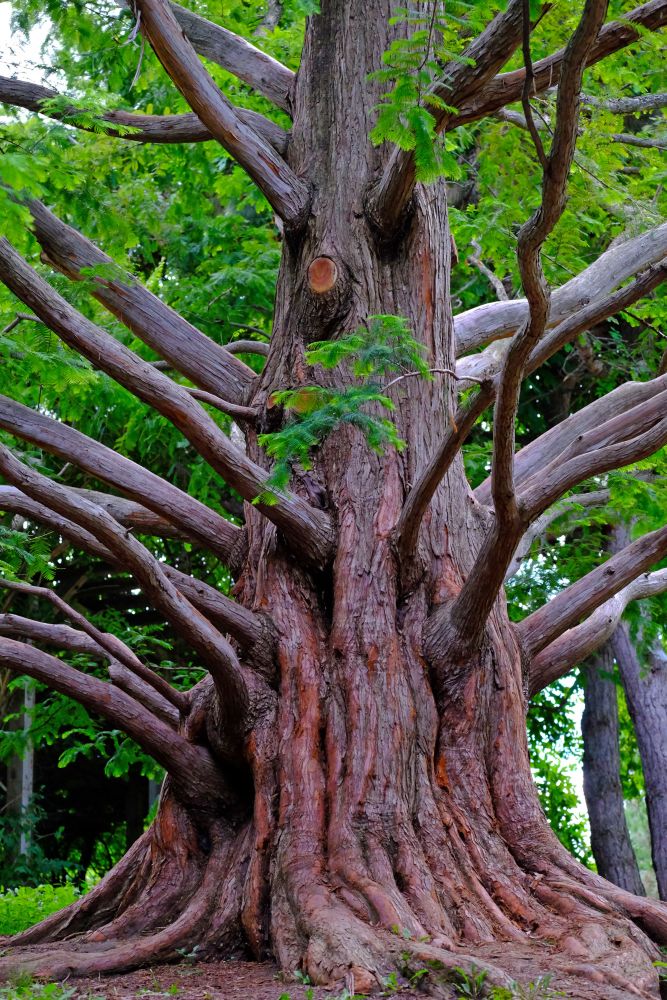
Possibly the Weirdest Looking Tree in Ontario

This is called a dawn redwood tree. In 2015, it was voted as the most unique tree in the Great Toronto Tree Hunt. Unfortunately this is now 404 on the site and I could not find the photographs of the winning, or nominated trees. This is a very strange looking tree. I hope it is still standing and lasts a very long time.

This type of tree has been around from the ages of dinosaurs and it can grow in zone 5 but likes lots of sun and water. I looked for more photographs of this tree. Not all were as red as this. It might depend on the lighting at the time the photograph was taken, or the conditions may have been just right for it where this tree is planted.

Interested in growing one in Ontario? I found a post about growing dawn redwoods, a variety called gold rush, for Ontario gardeners at Canada's Local Gardener magazine: Dawn Redwood.

Near the Children’s Centre and Teaching Garden sits a massive and rare find – a dawn redwood (aka metasequoia), believed to be one of the oldest deciduous conifers in Toronto. It was a winner in the uniqueness category of LEAF’s Great Toronto Tree Hunt, submitted by author Jason Ramsay-Brown. It’s said to have been planted in 1960 on a plot bathed in early-morning sunlight on June 20 each year – the birthday of the wife of the gardener who planted it.

Source: Hidden Toronto: a growing list of the city's best-kept secrets

Posted on . Filed in . Tagged with , , , , .

A Tribute to Jeff Chapman: RIP Ninjalicious

Jeff Chapman (1973 - 2005) #RIPNinjalicious

Jeff Chapman was a Canadian urban explorer, known as Ninjalicious. Jeff published Access All Areas and the founder of Infiltration, zines and website.

"It's the thrill of discovery that fascinates me. Yes, I know I'm not the first person there, but I can honestly say I found it and I earned the experience for myself. After exploring for a while, you get a wonderful feeling that you're "in on" the secret workings of cities. You know what's under your feet and what's behind the closed doors and what the city looks like from the highest office towers, while almost everyone around you only ever looks at the public areas and never truly pays attention to urban structures unless they've paid admission to take a look." - Jeff Chapman/ Ninjalicious

Source: Interview at Philadelphia City Paper with Neil Gladstone (1998?)

This month, August 2015, marks ten years since Jeff Chapman passed away. I thought someone should post in his honour. I never met him personally. I did email with him, twice. I met his wife, Liz, at a Broken Pencil Zine Festival in Toronto.

I attended the Festival to buy Access All Areas: A User's Guide to the Art of Urban Exploration, see some of Jeff's (and other publishers) zines and take a look at the Gladstone Hotel in Toronto. I was just beginning to explore with a digital camera then. Before that I just didn't know what I was doing had a name (and film was expensive!).

A tribute can still be found at the Toronto Architectural Conservancy 

Jeff Chapman (September 19, 1973 -- August 23, 2005), better known by the pseudonym Ninjalicious, was a Toronto-based urban explorer, fountaineer, writer and founder of the urban exploration zine Infiltration: the zine about going places you're not supposed to go. He was also a prominent author and editor for YIP magazine, as well as its website, Yip.org. Chapman attended York University in the early 1990s and later studied book and magazine publishing at Centennial College. He went on to serve as Editor at History Magazine and as Director of the Toronto Architectural Conservancy board.

Chapman died of cholangiocarcinoma on Tuesday, August 23, 2005 --- three years after a successful liver transplant at Toronto General Hospital (a location he loved to explore). He was 31 years old.

Source: Wikipedia: Ninjalicious

Toronto's own late Jeff Chapman (a.k.a. "Ninjalicious") published his first printed issue of Infiltration, "The zine about going places you're not supposed to go," in 1996. Though Toronto may not live in the imagination of people around the world, Chapman made this city's sewers famous for his global readers. His work lives on in Access all Areas, his book published just before his death to cancer in 2005, and at infiltration.org.

Source: Shawn Micallef: Getting to know Toronto's sewers

Under the alias Ninjalicious is where Jeff made his biggest mark. In his early twenties he spent long periods of time in the hospital battling various diseases. Often bored, he and his IV pole would go exploring the hospital, investigating the basement, peaking behind doors, looking for interesting rooms and equipment. It was here his love for the under explored side of buildings developed, and upon returning to health he created Infiltration -- the zine about going places you're not supposed to go.

Infiltration has had a profound influence on urban exploration in Toronto and around the world, as evidenced by the hundreds of tributes left for him in the Urban Exploration Resource forum. Ninjalicious had a strong code of ethics which he promoted, including no stealing or vandalizing while exploring. Issue 1, all about Ninj's beloved Royal York Hotel, was published in 1996, and the zine was continually published throughout the years ending most recently with Issue 25: Military Leftovers.

Source: Sean Lerner: Torontoist: Death of a Ninja

About ten years ago I was in a Toronto bookshop and found a copy of Infiltration. Subtitled "the zine about going places you're not supposed to go", it was devoted to the escapades of the author, Jeff Chapman --- or "Ninjalicious", to use his nom de plume --- as he explored the many off-limits areas in famous Toronto buildings such as the Royal York hotel, CN Tower, or St. Mike's Hospital. In each issue, Chapman would pick a new target and infiltrate it --- roaming curiously around, finding hilarious secrets, then describing it with effervescently witty delight. Chapman had the best prose of any zine author I've read anywhere. Many zinesters are clever, of course, but Chapman wrote with a 19th-century literary journalist's attention to detail; nothing escaped his notice, from the relative fluffiness of the towels in executive lounges to the color of the rust pools in a mysterious, hangar-sized room buried below Toronto's subway system.

Source: Clive Thompson: Collision Detection: R.I.P. "Ninjalicious" --- the founder of urban exploration

infiltration The zine about going places you're not supposed to go, like tunnels, abandoned buildings, rooftops, hotel pools and more.

Source: Infiltration

See also:

cancon
what is it that attracts you to going where you're not supposed to go?

Ninjalicious
Healthy human curiosity about the workings of the world I live in, of course. I mean, it's free, it's fun and it hurts no one. A harder-to-answer question would be: why doesn't everyone?

cancon
what are the tools of your trade?

Ninjalicious
Usually I travel very lightly, with a pen, paper, a Swiss army knife, a camera and a flashlight. That's about all the equipment I need to have a good time in 90% of the places I visit. I take along more specialized equipment, such as rubber boots or various props, for specific targets.

Source: Cancon Interview with James Hörner

Posted on . Filed in . Tagged with , , .

What is the GTA (Greater Toronto Area)?

Currently Metropolitan Toronto includes a lot of other small cities and towns. Metropolitan Toronto now reaches out to areas beyond the original borders and far beyond it's own city limits. This large mass of area has become known as The Greater Toronto Area - the GTA for short.

I grew up in a small town which was on the edge of the big city of Toronto. When I was still a kid the town was called Port Union. By the time I was in high school our town of Port Union had become part of Scarborough, absorbed into the suburbs of the city of Toronto. Scarborough is the eastern suburbs of Toronto. People sometimes refer to it as Scarberia because it is over an hour's drive from downtown Toronto to the edges of Scarborough.

I never quite liked the loss of identity from our smaller town, forgotten in history. Port Union lost it's place on the map and become a non-town. If you drive out there you can still find one long street named Port Union Road, but that's all you will find remaining from the early days of the area being independent from the suburbs of Toronto.

However, that's how big cities grow. Toronto has grown a lot from the days of being known as York (Muddy York) over 100 years ago.

The GTA combines the regions of the City of Toronto, York, Durham, Peel and Halton.

I don't live in the GTA now. I moved farther north and I live in Simcoe region, just outside the reaches of the northern part of the GTA. Someday this may become absorbed too, but I'm pretty sure that will be far into the future. Not everyone is eager to move farther north after all. Most of the population density seems to be heading east and west of the Toronto area.

The History of the GTA - The MegaCity of Toronto

In 1998 the sprawling suburbs of Toronto: York, North York, East York, Scarborough and Etobicoke became part of the municipality of the city of Toronto. The megacity, The Greater Toronto Area came into being. Toronto became the largest city in Canada and the fifth largest in North America.

The addition of Halton, Peel, York and Durham is unofficial, as far as I can tell. Sometime after the forming of the megacity people began referring to locations by how far they were from Toronto. For instance, if you were thinking to drive out to Richmond Hill from Toronto you decide it's not too far because it's still in the GTA. But, if someone is thinking to drive out to Barrie, they might rethink it. Barrie is outside the GTA, at least another half hour drive.

The whole GTA thing is usually a way of measuring the distance of any place from Toronto. "How far is it, is it still in the GTA?" When you meet people online and think about getting together there is an imaginary line around the GTA and few people want to cross it. If you are in the GTA you think anything outside of the area is too far. If you are outside of the GTA you think about driving through the GTA traffic and usually look elsewhere to meet people.