CTV Video -A campfire tale come to life
Author John Warms reveals the real-life encounter that inspired his children’s book The Girl Who Met Sasquatch.
John Warms - YouTube channel
The following is from an interview with John Warms, author of 'Strange Creatures Seldom Seen', featured in the March 2021 issue of Bigfoot Times.
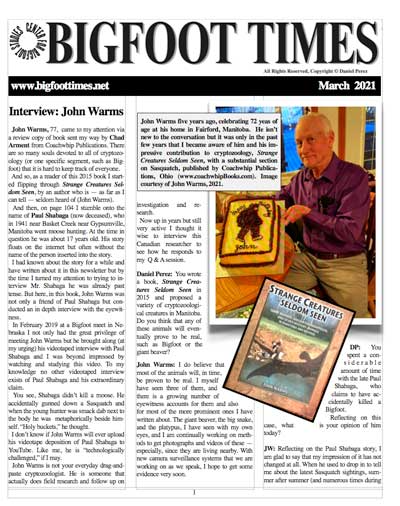
Daniel Perez: You wrote a book, Strange Creatures Seldom Seen in 2015 and proposed a variety of cryptozoological creatures in Manitoba. Do you think that any of these animals will eventually prove to be real, such as Bigfoot or the giant beaver?
John Warms: I do believe that most of the animals will, in time, be proven to be real. I myself have seen three of them, and there is a growing number of eyewitness accounts for them and also for most of the more prominent ones I have written about. The giant beaver, the big snake, and the platypus, I have seen with my own eyes, and I am continually working on methods to get photographs and videos of these — especially, since they are living nearby. With new camera surveillance systems that we are working on as we speak, I hope to get some evidence very soon.
DP: You spent a considerable amount of time with the late Paul Shabaga, who claims to have accidentally killed a Bigfoot. Reflecting on this case, what is your opinion of him today?
JW: Reflecting on the Paul Shabaga story, I am glad to say that my impression of it has not changed at all. When he used to drop in to tell me about the latest Sasquatch sightings, summer after summer (and numerous times during each season, whenever he would spot me working in my yard!), I would offer certain questions to see if his answers might vary from previous years–but there was never any variation in the stories. I always admired his attention to detail, and since those details never wavered, I was confident that he was telling me exactly what he had experienced. His fanaticism about the topic only reinforced the reality that he had inadvertently shot and killed a huge, bipedal, hairy, unknown creature in 1941 when he was seventeen years old. Simply because he expected the patch of fur he saw among the willows to be the wounded moose he was following.
DP: You are of the age where you could have been a contemporary of the likes of René Dahinden and John Green. Early on, did you know of these high profile investigators and did you correspond with them?
JW: It may have been information on the topic of the Sasquatch that came from our West Coast, through people like John Green, that convinced Paul that it was a Sasquatch that he had killed. He told me that it had taken about thirty-five years to come to that conclusion. I’m sure it was from him that I heard of Sasquatch investigators like John Green, John Bindernagel and Curt Nelson. Paul and I met John Bindernagel at a meeting he had convened at a Sasquatch hot spot in Grand Rapids, two hours to the north of us. The next day we met him at Paul’s house again. Some years later I met Curt Nelson briefly when he was visiting Paul Shabaga. [Editor: Dr. John Bindernagel, with whom I had sporadic correspondence, only mentioned Paul Shabaga in passing. Paul was never an exclamation point in his research. By contrast, Curt Nelson was highly impressed with Paul’s testimony. It is report #9552 in the BFRO database. Part of the report, from a taped interview with Paul Shabaga is as follows: “…Sure enough, I did see one in the willows feeding with its head down, and it was a cow moose…”].
DP: What got you started in your search for all these unknown animals?
John Warms: You would think the sightings of a Sasquatch just a few miles away from my home, by a good number of people on a Native reservation, would have captured my interest. I recall taking my young family to the spot where a footprint had been found in a ditch. But it was not until some years later after I met Paul Shabaga that my interest was actually kindled. I enjoyed his stories, some of which were from central Manitoba, but many of them came from in the north as well. One of Paul’s favorite techniques was intercepting truckers and travelers coming from the northern regions, quizzing them on what they knew or had possibly encountered along the way, and in this way garnering a significant repertoire of Sasquatch sightings. I might add that, sadly, his fervor for the topic was too rich in the coffee shops he frequented, or among folks that did not share his passion, so he became widely misunderstood and disliked. Paul had no patience with folks who disagreed with his perspectives.
For me, however, that fervor spoke loudly and honestly of what must have been a traumatic experience for him as a teenager, and I’m sure —now that I think back— he found in me someone who came to believe him–giving him a measure of comfort, assurance, and support in his lonely, alienated existence. The first person he ever shared his experience with had been a brother who had returned from the war, and when his account had brought only laughter and derision, he vowed not to tell anyone else. Not, that is, until in old age. He threw caution to the wind and cared not what people thought of him. He had truth to tell, and he told it to all who would listen. So, he finally divulged his unbelievable experience, come what may, getting it off his chest where it had obviously been a constant burden, a deep secret that he had carried for a lifetime, and was desperate to unload, no matter what the cost.
But I have not yet fully answered your question as to what got me started in the search for all the unknown animals. The above paragraph explains my introduction to the world of Sasquatch. But it was a vague rumor of a big snake sighting on a reservation about sixty miles away that really set me on the road to what has become a continuous search for unusual creatures. A subsequent visit to a professor at the university, a herpetologist, gave me the first indication that our academic community knew virtually nothing about the many elusive creatures that were practically common knowledge among many of the Native peoples— and that realization became, for me, an exciting challenge that I felt I wanted to address.
I decided to check out where the truth lay, suspecting that the scientific community was overlooking some very significant information, either unintentionally or intentionally. [Editor: I suspect it might be the later, that the scientific community has intentionally sidestepped the issues to avoid unwanted ridicule by their colleagues and personal friends. No one wants to be called a “nutcase.”].
DP: Early on, do you think you could have been more effective in your research by focusing on just one animal instead of all the cryptids you research, including the giant beaver, giant snakes, underwater moose and big birds?
JW: Actually, I’m delighted to have a host of unusual animals to pursue. By not being restricted to one particular creature, I can choose which one is the most practical to check out on any given day, or trip, or season. Initially, I found it a real pleasure and even to this day, hearing about a variety of unusual creatures in every community. I consider the northern communities to be like mines that have much more than just one precious metal in them–and I have my favorites, of course, but I value each new animal as a rare and special discovery. But I do look forward to the day–hopefully in my lifetime– when teams of investigators will be able to concentrate on individual creatures, and have the means to do whatever it takes to discover their secrets. One example that excites and dominates my imagination is a concerted effort to locate some remote ‘caves’ that are believed to house airplane-sized ‘bats’ that the Natives know are capable of bringing ‘home’ animals of any size (even moose), since their bones have been spotted in front of their dwellings.
DP: With a population density of about 6 people per square mile in the province of Manitoba and only 1.278 million people in such a large place, do you think the possibility of unknown animals is a real possibility?
JW: Like most Sasquatch enthusiasts, for example, I pursue only what I am fully convinced of. And, the proof of the pudding is in the eating. I hear of a river where huge beavers have been spotted for generations–and I see one for myself. I hear of a lake that is inhabited with big snakes–and with an effective technique, I manage to lure one to the surface. I am shown a small body of water where a beaver-sized animal with a beak lives–and I eventually spot something swimming that matches the description I had been given. As a result of experiences like that, I am convinced, beyond the shadow of a doubt, that most of the dozens of creatures described to me, over the last few decades, are out there, living comfortably where privileged individuals happened to encounter them. In all likelihood, there are many more, some seen by human eyes, and some yet to be discovered.
DP: Is it sometimes difficult interviewing Native Americans as there is seemingly a reluctance to share information beyond their own group?
JW: Actually, when this odd paleface appears in a Native community wanting to talk about unusual animals, he is usually given a pleasant welcome including curious smiles and searching questions. Seems that they would like to know more about the creatures, too. I’ve been cheered on in some cases, and even questioned continually on my return from a particular quest as to the success of each day’s venture. In discussing often-traumatic encounters with individuals who got, for example, too close to a Sasquatch, especially the women, I sense the cathartic effect the sharing provides, since the natural human inclination is to avoid sharing a story that often results in shame and derision. Some women told me that I was the only one they ever shared their experience with apart from their spouse. Furthermore, when I would share similar experiences that other folks had related, I could sense the palpable relief that resulted from knowing that they were not alone in it.
– Daniel Perez