Tunnels in Toronto: Underground Secrets
videos cover a variety of topics, including Toronto, railroads, history, transit, and cats. Anything I find interesting is fair game.
videos cover a variety of topics, including Toronto, railroads, history, transit, and cats. Anything I find interesting is fair game.
an incorporated, non-profit, multi-agency organization founded in April 2007 by a group of individuals and organizational representatives who saw the need for a coordinated provincial response to the growing threat of invasive plants.
Invasives Canada - Canadian Council on Invasive Species
dedicated to safeguarding Canada’s ecosystems, communities, and economies from the growing threat of invasive species. As a national network of chapters, partners, and interested parties, we lead collaborative efforts to prevent and manage invasive species while promoting sustainable land and water management.
Ontario Phragmites Working Group
formed in December 2011 by dedicated professionals concerned about the growing threat posed by the aggressive invasive Phragmites australis to biodiversity, Species At Risk (SAR), recreation, tourism, infrastructure, and property values.
We had tours of Casa Loma with our school, more than once I think. I liked seeing the castle, the furniture, the workmanship, but I wasn't listening carefully, or with full interest, in history then. I didn't know how much Sir Henry had done, how far he went and then how far he fell and was let down by those who profited from him at the time. Its not a happy story but his castle still stands, maintained and visited by the people of Toronto.
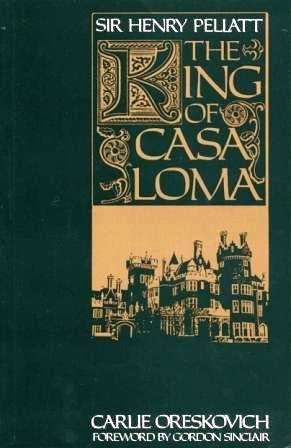 Sir Henry Pellatt: The King of Casa Loma book by Carlie Oreskovich
Postcard views of Casa Loma from 1938 for the Kiwanis Club.
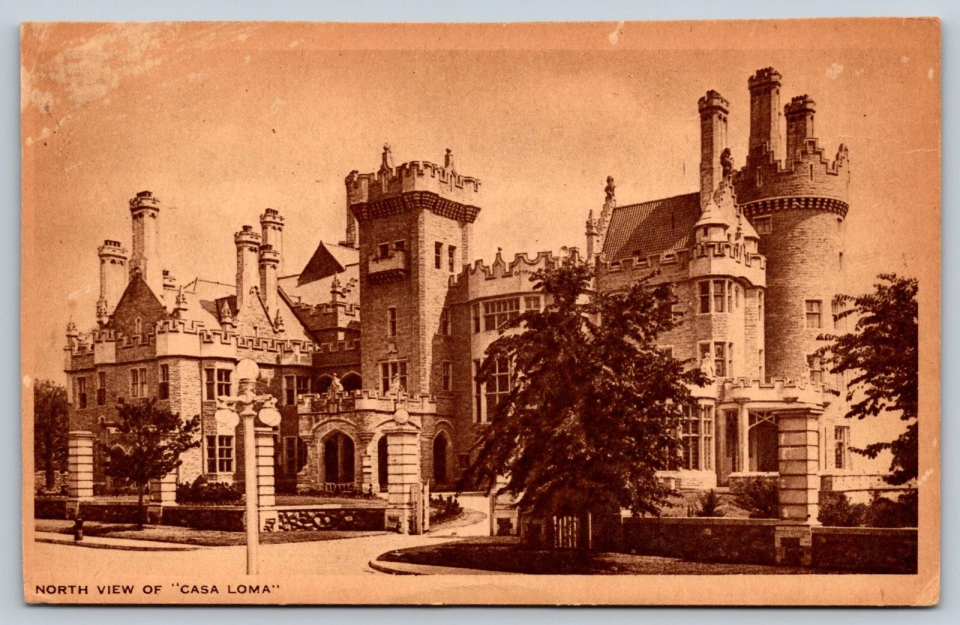
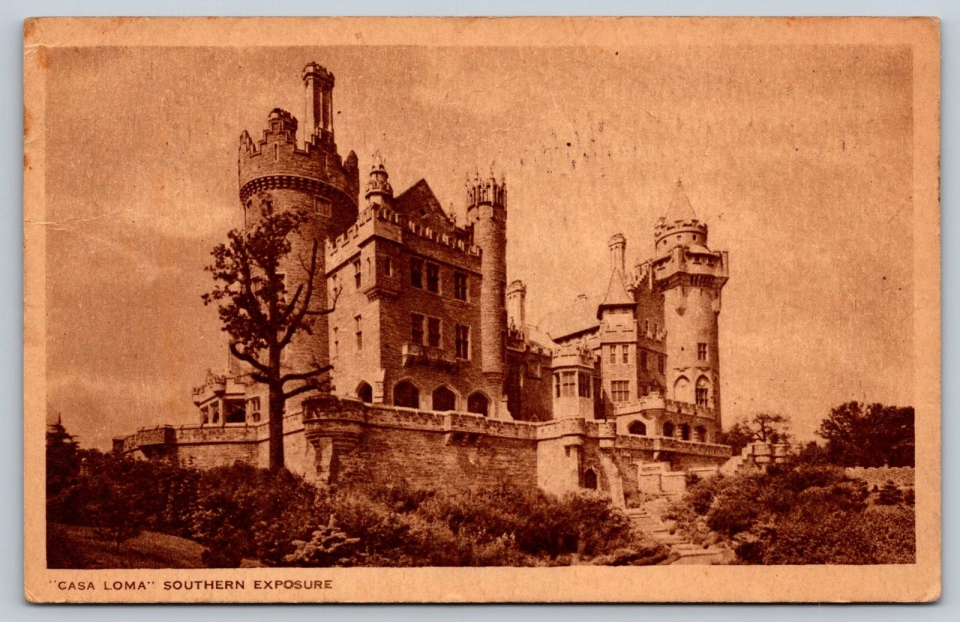
Major-General Sir Henry Mill Pellatt (January 6, 1859 – March 8, 1939)
A Canadian financier and soldier supporting early Canadian industry, particularly in Ontario. In 1879, at the age of 20, Pellatt ran the mile in New York, beating the U.S. champion and setting a world record at 4:42.4. He was involved with hydro-electricity coming to Toronto. Mining in the north. He built Casa Loma (Spanish for “House on the Hill”), the largest private residence ever constructed in Canada. Working with architect Edward James (E. J.) Lennox, the project was begun in 1911, still not finished in 1914 when they moved in. Originally 25 acres of land on the Davenport Hill escarpment at the north end of Spadina Road. It cost Sir Henry over $5,000,000 to construct and furnish his dream castle.
The castle itself boasted the most modern technologies available. The castle was equipped with electric power, it was the first private residence in Toronto to be equipped with an elevator as Mary Pellatt quite often needed a wheelchair to get about, and there was an entire telephone exchange to the castle grounds which accommodated 59 phones. It has been said that on some days, the switchboard operator at Casa Loma was busier than the switchboard operator for the entire city of Toronto! In addition to these new fangled things, the castle had 98 rooms, 30 full bathrooms, 25 large fire places, a 60 foot long indoor swimming pool (though uncompleted), a conservatory that housed exotic and rare tropical plants, a wine cellar that could hold 1,700 bottles, three bowling alleys to entertain guests and an indoor 160 foot long shooting range.
Numerous properties in and around Toronto were built, bought, sold or given by Sir Henry to others, including his son. He also had a summer home and farm built in King City (before Ontario became a province). He and his first wife supported the Boy Scouts and Girl Guides of Canada.
Sir Henry was born in Kingston, Ontario with three sisters and two brothers. His Father, originally from Glasgow (UK), became a stockbroker in Toronto. His great-grandfather was the glassmaker Apsley Pellatt. He attended Upper Canada College then joined his father's stock brokerage company, Pellatt and Osler, later Pellatt and Pellatt as Sir Henry worked his way up and the original partnership changed. Sir Henry enlisted in 1876 and had a notable military career with honours and titles. In 1905, he was created a Knight Bachelor by King Edward VII for his service with The Queen's Own Rifles of Canada. Promoted to the rank of Major-General when he retired from his regiment.
Sir Henry married Mary Dodgson in 1882, she died in 1924. Together they had a son, Reginald (1885–1967). He married Marjorie Carlyle Perry October 14, 1908 and also worked with investments as a stock broker. They had no children so Sir Henry has no direct descendants to make any claims about whatever they might from his estate. In 1927 Sir Henry married Catharine Welland Merritt, he did not remarry after her death in 1929.
He made a fortune investing in hydro-electric industries in Canada, including the founder of the Toronto Electric Light Company (1883 - Sir Henry was 24), the Home Bank of Canada , and the Cobalt Lake Mining Company, mining silver in 1903. Later using his income from silver to invest in the new McIntyre Mines in Timmins, Ontario. Building hydro electric power plants in the Niagara region to supply power to southern Ontario. Investing in ventures like the Canadian Pacific Railroad and the North West Land Company. At the height of his financial success, Pellatt was the Chairman of 21 companies and through his own personal investments, he was in control of 25% of the Canadian economy.
His nickname in the 1880s and 1890s was “The Plunger” because Pellatt seemed to have a knack for diving head first into all his business dealings.
Legislator Adam Beck (a wealthy Canadian politician, horse breeder, and hydroelectricity advocate founded the Hydro-Electric Power Commission of Ontario) set out to ruin Pellatt and others, campaigning against the great industrialists of Canada. Beck was able to successfully use legislature and sway public opinion to appropriate Pellatt's investments, companies, and his properties. Beck had Pellatt's taxes on Casa Loma raised from $600 a year to $12,000.
The government of Ontario took his electrical power generating business. Sir Henry was offered no compensation. With an income of only $66,000 and debts of over 3 million, he transferred his part of the Electricity Company to his business partner. His aircraft manufacturing business was appropriated by Beck and the government, again without compensation, leaving Pellatt near-bankruptcy. Pellatt’s largest financial loss came when the Home Bank of Canada, an institution he co-owned, failed in 1923. Pellatt lost just under $2,000,000. The upkeep of Casa Loma was also becoming a financial burden by the early 1920’s. Maintenance alone was costing $100,000 a year, wages were estimated to be $25,000 a year, heating with coal cost just over $15,000 a year and his property taxes were estimated at about $12,000 a year. Sir Henry and his wife, unable to keep their home, Casa Loma, had to leave it in 1923. They moved to their home/ farm in King City.
Hiking the GTA - Marylake I had imagined Marylake, the home and farm, as a small place, like a cottage with a hobby farm. It wasn't.
When the Home Bank of Canada collapsed in 1923, creditors came knocking on Casa Loma’s door and the one leading the pack was the City of Toronto. Initially the City couldn’t seize the castle because Pellatt had put it into his wife’s name and it was Pellatt himself who was in financial trouble, not Mary technically. However, the City decided to seize the assets of the house in 1924 which meant all the furnishings and moveable chattel was to be sold in a public auction to recover their back taxes owed. What initially coast Pellatt $1,500,000 to furnish Casa Loma was sold at rock-bottom prices where only about $200,000 was made. Jacobean chairs, dating to the reign of King James I (1603-1625) were sold for $30 each. The Grand Pipe Organ, purchased for $75,000 sold for $40, and Lady Mary’s British Regency Period (1795-1837) bedroom set sold for just $45.
Lady Mary Pellatt, already ill for years, died a few months after moving from Casa Loma. Sir Henry built and moved into Bailey House in Mimico, the house is since demolished. I tried to find old photos of it, no luck. At the end of his life he lived in this house with his chauffeur, Thomas Ridgway. He died on March 8, 1939, buried with full military honours at Forest Lawn Mausoleum, north of Toronto. Thousands of people lined Toronto streets to witness his funeral procession.
In the meantime, Casa Loma was turned into a fancy hotel and then a nightclub but neither lasted long. For years Casa Loma was unused, unheated, and vandalized. Local residents wanted the building demolished. In 1937, the Kiwanis Club of West Toronto offered to take it over from the City, fixing it up and turning it into a tourist attraction. In 1939, the Casa Loma stables served as a secret Royal Navy facility, housing secret ASDIC (an early form of sonar) equipment. In 2011, the City of Toronto assumed control due to a contract dispute. It has been operated by Liberty Entertainment Group since January 2014.
Pellatt made one last visit to his beloved castle in 1938 to see the work the Kiwanis Club was doing to turn Casa Loma into a grand destination once again. Pellatt was said to have been impressed by the work and happy this piece architectural history would continue to be a part of the Toronto landscape. As for Pellatt himself, any investments he had left faded with the stock market crash of 1929 and he was left virtually destitute. His former chauffeur, who lived in a modest bungalow on Toronto’s Queen’s Avenue, took his former employer in when he had nowhere else to go. Pellatt died on March 8, 1939, still owing about $6,000 but only had his clothing and $200 left to his name.
Sir Henry Pellatt - Casa Loma, Toronto, Ontario.
Casa Loma Trust - Site by Trelawny Howell Great Grand Niece of Sir Henry Pellatt.
Short reel - Toronto's castle RUINED the richest man in Canada.
Podcast (audio) - The Secrets of Casa Loma | Toronto’s Most Famous Mansion Isn’t What You Think
Designed by E. J. Lennox, the same architect who designed Toronto’s Old City Hall, the Gothic Revival-style “castle” featured 98 rooms, 30 bathrooms, three bowling alleys, an indoor swimming pool, a rifle range within its 64,700 square feet of living space. Casa Loma also had its own internal telephone system and built-in vacuum system for cleaning. It also had the first electric elevator in a Toronto home.
Even an ornate stable was built to house Pellatt’s horses next to his castle.
The floors of the rooms were solid mahogany with bear skin rugs and the 10,000-book library had the Pellatt family coat of arms carved into the ceiling. The doors from the dining room to the conservatory were made of solid bronze and cost $10,000 (equivalent to $215,000 in 2015 dollars) each. Henry’s study contained a replica of Napoleon’s desk and had two secret passages: one leading to the basement vault another to the second floor.
Canadian Military History - The man who built a castle Site by Bruce Forsyth
Spacing.ca - The fall of Sir Henry Pellatt, king of Casa Loma
Dictionary of Canadian Biography - Henry Pellatt
History of the People - Canadian Castles Part V: Casa Loma, Toronto - Site by Laura Waldie.
“I’ve made a mistake,” said Sir Henry. “I should never have built Casa Loma so close to the city. It was in the county when I began it. But it is in the city to-day.
I should have built it at King on my country estate on some oak crowned hill. I can see it then … And it wouldn’t then be swamped with taxes as it is to-day, making it worthless, in the hard times, to live in.
“If I can’t have Casa Loma myself, I would rather see the soldiers in it than anyone else,” he said. “I have a certain value set on the property in my mind. I would be willing, if the soldiers got it, to contribute a million dollars towards it – by taking a million off the value I have in mind.”
Casa Loma was commenced in building in 1911, after a dozen years of preparations. It is not wholly completed yet. The central hall of the castle, a vast chamber ninety feet square and vaulted to the roof, still is filled with the builder’s scaffolding. Many of the hundred rooms are unfurnished. But in 1914, Sir Henry moved into the east wing living quarters, the main rooms of the ground floor, the library, dining room, kitchens, four suites of living quarters and servants’ quarters being furnished to the last degree of completeness.
Not the faintest idea of the richness and magnificence of Casa Loma can be gathered from a single visit. The artist who made the sketches made three visits, and each one found him more helpless to decide which feature of the inexhaustible interests of the castle to select.
For example, the main corridors of all floors of the castle are two hundred feet long, as wide as a city street and high. The walls of corridors and chambers are paneled in great ten-foot squares of the best grained walnut. The borders are deep carving the full richness of which is likely to escape the eye in the lavishness with which wood carving is spread through out the main floor. The ceilings are moulded in splendid patterns after seventeenth century ceilings. The floors are oak planks, a foot wide spaced with teak, studded like ship’s decks, except where a formal chamber demands a fine floor in smaller pattern.
The mantels are genuine seventeenth century marble and inlay pieces, worth about $1.500 apiece. The furniture throughout the down stairs are museum pieces rare, massive antiques, delicate Chippendales and Adams.
There is nothing inside the castle the least bit out of proportion with the outside. The George Second clock which stands just inside the main entrance is the biggest clock imaginable, done in lacquer and rosewood. The beds in the private suites are huge four-posters.
Looking down the main corridor towards the conservatory gives a sense of being back in the days of the Louis. Past dark panelled walls and carven corners, through bronze doors of the most delicate tracery design (modeled after Italian seventeenth century doors) you look into the bright marble conservatory which alone is as big the average house and lot.
Casa Loma is no period. It is a bold combination of the massive Scottish castle and the fine-lined chateau. It grew out of the vision of Sir Henry who visited many splendid mansions in Europe when, as an officer of the Canadian militia, he went to England to Victoria’s jubilee, to the coronations of Edward and of George, and finally when he took his regiment, the Queen’s Own, to England. He admits he saw a bit here, a bit there, a wall, a door, a great room ceiling, and carried the memory of them with him, until as Casa Loma took form in his mind, he began to select deliberately the parts that have been assembled with such genius by E. J. Lennox, the architect who also built the City Hall in Toronto, into this castle which now stands empty.
Romantic Secret Chambers There was romance in the heart of the man who built it, for even in these plain days, there are secret chambers and passages in the castle like those described in Scott’s novels. Just within the main entrance is a sort of reception room which Sir Henry used as his own den. In the carving of one of its panels is a hidden button. Press it and the panel swings out, disclosing a staircase that leads directly to Sir Henry’s own bedroom, where another secret door is concealed as a panel. In his bedroom is a hidden locker operated by pressure on certain spot in the panel.
From the basement of the castle, a wide tunnel, down which a regiment in fours could march, leads over to the stables, back of the castle.
Out of Sir Henry’s bedroom suite (the seventeen suite of Casa Loma each consist of four large chambers and a bathroom) there extends a passage out to a sort of opera box or balcony, which overlooks the great ninety-foot central hall. From here, the host can look down upon his guests, or can sit to listen to the organ in its loft opposite.
It has the grand touch all the way through.
And it could not be duplicated for four times its cost. Carpenters who built Casa Loma got thirty-three cents a hour – and they were master carpenters too, to handle such massive wood. During the building, the masons struck for forty-seven cents an hour – and if you look closely at the walls and battlements and gigantic buttresses of Casa Loma, you will see that a mason had to be a mason to master such monster stones as those.
Greg and Jim - What is to Become of Sir Henry Pellatt’s Castle?
The Greenock Swamp is a large, forested wetland in southern Bruce County. Formerly Greenock Township now the Municipality of Brockton, extending into the municipalities of South Bruce, Huron-Kinloss and Kincardine. It is the largest forested wetland in southern Ontario. Greenock Swamp was designated a provincially significant Area of Natural and Scientific Interest (ANSI) in and classified as a Class 1 wetland, the highest provincial ranking, in 1989.
Cargill and Greenock Swamp Museum and Visitor Centre
Deep in Bruce County, stretching across 20,000 acres of dense, untamed wilderness, lies the Greenock Swamp—Ontario’s largest forested wetland and one of its most legendary places.
For centuries, loggers, settlers, and travelers have shared eerie stories about this land—vanishing men, floating lights, hidden treasures, ghostly figures, and even man-eating plants. Some of these tales are rooted in truth, others in folklore, but all have helped shape the swamp’s reputation as a place full of secrets, danger, and the unexplained.
As someone who has spent a lifetime working in the woods, I know that some forests just feel different—and Greenock Swamp is one of them.
The Vanishing Loggers of Greenock Swamp
During the late 1800s logging boom, Greenock Swamp became a dangerous, grueling workplace for the hundreds of men who tried to harvest its towering white pines. With dense vegetation, hidden bogs, and constant mist, it was easy to get lost---and not everyone made it back out.
The official explanation for these disappearances?
Some drowned in the thick mud and waterways.
Some were crushed by falling trees or runaway logs.
Some simply got lost, and the swamp swallowed them whole.
But the unofficial stories tell a darker tale:
Loggers claimed to hear voices calling their names---but when they turned, no one was there.
Others spoke of floating lights weaving through the trees---too high and too fast to be lanterns.
Some even claimed to see men in old, tattered logging gear watching them from the shadows, only to vanish when approached.
Even today, hunters and hikers who wander too deep into Greenock Swamp report a heavy feeling of being watched---and some never return.
The Lost Treasure of Greenock Swamp
According to local legend, somewhere deep within Greenock Swamp lies a hidden fortune in gold---buried by criminals, fur traders, or bootleggers who never returned to claim it.
Over the years, treasure hunters have searched for it, but the swamp doesn't make things easy.
Some have claimed to find strange markings on trees, possibly left behind as a coded map.
Others have heard digging noises late at night, only to find nothing there.
A few unlucky ones have disappeared while searching, adding to the legend that something in the swamp is guarding the gold.
Nobody knows if the treasure is real or just another tall tale, but one thing is certain---Greenock Swamp doesn't give up its secrets easily.
Phantom Lights and the Green Mist
One of the most frequently reported phenomena in Greenock Swamp is the appearance of ghostly lights---small, glowing orbs that float between the trees.
Some say they're the spirits of loggers who died in the swamp, guiding or warning travelers. Others believe they're something much older---a natural phenomenon, or perhaps even something supernatural.
But the strangest of all is the green mist.
Travelers driving near the swamp have reported thick green fog rolling out of nowhere, sometimes forcing them to stop because visibility drops to zero.
Some claim to have seen figures forming in the mist, almost like shadows moving on their own.
Some old-timers even swear that those who breathe in too much of the mist start seeing things that aren't there.
Scientists say it's just swamp gas, but if you've ever driven past Greenock on a foggy night, you know---it doesn't feel like regular fog.
The Ghostly Lumberjack
Among loggers, there's a legend of a spectral lumberjack who appears on foggy mornings, silently watching crews before vanishing into the mist.
He's always described as a bearded man in tattered logging clothes, standing near the tree line.
He never speaks---just watches.
Some say he's the ghost of a logger who was killed in a tragic accident, still lingering where he fell.
Nobody knows who he is, but even modern-day loggers have reported seeing him.
The Devil's Plants: Are There Man-Eating Plants in Greenock Swamp?
This one is straight out of a horror movie---but some locals insist it's true.
Greenock Swamp is home to rare carnivorous plants like pitcher plants and sundews, which trap insects. But older stories speak of plants big enough to trap small animals---or even people.
Some claim to have seen "devil vines" that tighten around anything that steps too close.
A few loggers and hunters have gone missing near areas where these plants grow in clusters.
Scientists dismiss it, but if you ever find yourself stuck in the swamp and something grabs your leg? Good luck.
The Hidden Moonshine Stills of Prohibition
During Prohibition, the dense, isolated terrain of Greenock Swamp made it the perfect place for bootleggers to hide illegal stills.
Some of the best "swamp whiskey" was rumored to have come from deep in Greenock.
The rough terrain kept the law at bay, allowing operations to flourish.
To this day, people have found old barrels, bottles, and equipment hidden in the muck---left behind by those who once risked it all for a drink.
Final Thoughts: Just Another Swamp... or Something Else?
Greenock Swamp is one of Ontario's most underrated legendary locations. Unlike big-name haunted forests and ghost towns, this place flies under the radar---but talk to anyone who's spent time near it, and you'll hear a story or two that'll keep you up at night.
Zack Weiler, owner of Grey Bruce Tree Workers The Legends and Mysteries of Greenock Swamp
Sources (some quoted by Zack Weiler) and other resources I found:
CBC News reported about Stephan Petar giving tours of ghost signs in Toronto.
CBC News - What's a ghost sign and why are there so many in Toronto? Toronto Society of Architects - Ghost Signs of Toronto Heritage Toronto - Signs That Define Toronto Signs That Define Toronto is a book edited by:
Kurt Kraler is a registered Architect (OAA) and project manager at ERA Architects. He completed his Master of Architecture (MArch) degree at the University of Waterloo where his thesis work was recognized with the AIA Henry Adams Medal for academic excellence.
Matthew Blackett is the publisher, creative director and one of the founders of Spacing magazine. He is the author, editor, and photographer of 11 books. He is also a graphic artist, product designer, and deeply-committed advocate for Toronto.
Philip Evans (OAA, MRAIC, CAHP) is a principal at ERA Architects and the founder of Culture of Outports. Over the course of 17 years, he has led a range of conservation, adaptive reuse, design, and feasibility planning projects.
I also found:
Not Smooth Steve - Tunnels in Toronto: Underground Secrets Mural Routes
Historically Speaking (Facebook)
Join Alex and Leanne on their adventures to historic locations all over Ontario!
Friends of Guild Park, a volunteer-led organization launched in 2013 to support the revitalization and public awareness of historic Guild Park & Gardens.