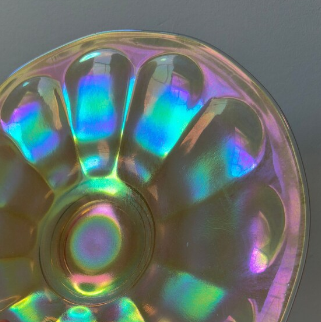
Its so pretty with that rainbow of colours. Like a puddle at the service station (cars) which has had gasoline fall into it. I wondered about it and finally looked it up.
Carnival glass is moulded or pressed glass to which an iridescent surface shimmer has been applied. It has previously been referred to as aurora glass, dope glass, rainbow glass, taffeta glass, and disparagingly as 'poor man's Tiffany'. The name Carnival glass was adopted by collectors in the 1950s as items of it were sometimes given as prizes at carnivals, fetes, and fairgrounds. Purchased by households to brighten homes at a time when only the well-off could afford bright electric lighting, as its finish catches the light even in dark corners. Reached the height of its popularity in the 1920s.
Carnival glass gets its iridescent sheen from the application of metallic salts while the glass is still hot from the pressing. A wide range of colours and colour combinations were produced; scarcely used colours can command very high prices on the collector market.
Carnival glass originated as a glass called 'Iridill', produced beginning in 1908 by the Fenton Art Glass Company (founded in 1905). Inspired by the fine blown art glass of such makers as Tiffany and Steuben, but did not sell at premium prices. Iridill pieces were used as carnival prizes.
Iridill became popular and very profitable for Fenton, which produced many different types of items in this finish, in over 150 patterns. Fenton maintained their position as the largest manufacturer and were one of very few makers to use a red coloured glass base for their carnival glass. After interest waned in the late 1920s, Fenton stopped producing carnival glass for many years. In more recent years, due to a resurgence in interest, Fenton restarted production of carnival glass until its closure in 2007.
Summary from Wikipedia
We have a sundial in the backyard but it's not very functional. Made of cement and no one ever thought to position it in a clearing where it could catch the sun. It's just ornamental. But, it would be interesting to have a shiny, more complicated sundial that could show the time with the passing of the sun. Of course, it might get rusty if it were metal. Maybe something not plastic but not too quick to rust or need a lot of maintenance. I always thought of a sundial as something that can stand the test of time.
The Nocturnal Celestial Stardial! This long-forgotten instrument aided a few lucky navigators and charmed romantics of the Renaissance. Earliest references include Cosmographicus Liber in 1530, Arte de Navegar, in 1551, and Horologiographia, The Art Of Dialling in 1626. 'Twas rare then as now. The Nocturnal Celestial Stardial is also called a stardial, a nocturnal, a "horologium nocturnum" (time instrument for night), or nocturlabe.
The outer disc is marked with the months as well as an indicator for each of the 365 days of the year. The inner disc is marked with hours and 5-minute increments. The pointer rotates on the same center axis as the discs. The center axis has a sight hole through which the North Star Polaris can be aligned.
via - Instructables - 2d Nocturnal Celestial Stardial TJT1/6
It may not be as accurate as modern technology but it is interesting to use historical technology and... you wouldn't have to buy batteries (or recycle batteries).
I can't wear a battery operated watch. For some reason the batteries die within a week or two. I was looking for a mechanical watch. So far I haven't found just the right one. This would be interesting but... the reviews say it isn't very accurate. Still tempting to try it though.
Part of getting old seems to be seeing the things you love become extinct. Tea cups and saucers, clocks, books, hand sewing and embroidery, hand written letters, postcards, birthday cards, silver sets, so many things disappearing or becoming unwanted by the younger generations as they come along with new technology.
But, I notice the old things I love still last longer than the new things coming along. Maybe not in purpose but in strength and durability. New technology is made to break and be replaced. Can it be loved like the old things when it isn't made to last? I don't think there is enough time before a new one is needed and the old hits the landfill.
Galleries and a virtual tour. The museum is located in Deep River, Ontario, if you want to make a road trip and visit them.
"Showcasing the heritage of Canada's many clock manufacturers and sellers from the early 1800s to the present time.
See and hear more than just clocks, because we have lots of period artifacts, including some really old record players that work without electricity! Hear century-old Edison cylinder records on a 1920 floor model player. Be amazed by the incredible sound from our 1927 Victor top-of-the-line CREDENZA Victrola floor model 78s records player that was sold in Ottawa and cost the same as a Ford car back then!"
Horological - means of or relating to devices or sciences of measuring time.
A group for collectors, dealers, and auction houses to further knowledge about antique and modern silver.
This group looks like it needs more members to get it active again. If you found this post while looking for information about siler, in Canada, contact the Society, even just to say hello.
Meanwhile, I have my Great Aunt Alice's tea set really needing a polish. (My Mother's Mother's Sister, Alice).
I don't collect silver, intentionally. It can be beautiful, but it does need maintenance. Not a chore to do but after using the chemicals to shine it I'm not so sure about actually using the tea set. Besides I'm not a tea drinker unless tea is one of few alternatives.