Posts tagged with “jewels”
Posted on . Filed in . Tagged with , , , , , , , .

Kaleidoscope

One of the old, odd and curious devices children had in the 1970's (not just then, but that's when I had one) is the kaleidoscope. I have no idea where mine ended up. It was a cardboard tube with plastic beads inside the end. As you turned the tube the beads rolled around and created different patterns when you looked through the lens at the top. I think it would be related to those keyhole/ pinhole cameras. Do I have that name right? I read about them years ago.

I've seen some variations in kaleidoscope styles. Some have little gems inside, instead of beads, or something else entirely. The one I would have like to buy (and try) was a natural DIY kaleidoscope which you could put anything flat enough to fit in and view it. The ad showed flowers, bits of leaves and other things found outside. Not rocks mostly likely, they would scratch it and be too large to fit. I found several of this kind on Amazon and elsewhere but none were shipped from Canada, or at least from Amazon itself. Also, I thought they should have a nicer wood and finish. They look a bit too cheap, as they are.

Amazon kaleidoscope link.

Vintage kaleidoscopes had interchangeable gears/wheels/discs to switch out. Others I found had a glass marble at the end of the tube, some were able to change those too. Yet more are artsy and individual looking, and even more expensive. What really matters is what you see when you look through.

I want lots of colours and different shapes. A few only had black and white, which was interesting but not as pretty. More colours and, of course, more shapes, will give the kaleidoscope more patterns. If you have one, try to turn the scope just a tiny bit and what the colours and shapes twitch just the least little bit. I would try to keep an eye on one particular bead and follow it.

Life is like a kaleidoscope, a slight change and all patterns alter.

The Brewster Kaleidoscope Society

Kaleidoscope from Wikipedia:

A kaleidoscope (/kəˈlaɪdəskoʊp/) is an optical instrument with two or more reflecting surfaces (or mirrors) tilted to each other at an angle, so that one or more (parts of) objects on one end of these mirrors are shown as a symmetrical pattern when viewed from the other end, due to repeated reflection. These reflectors are often enclosed in a tube, usually containing on one end a cell with loose, colored pieces of glass or other transparent (and/or opaque) materials to be reflected into the viewed pattern. Rotation of the cell causes motion of the materials, resulting in an ever-changing view being presented.

History

Multiple reflection by two or more reflecting surfaces has been known since antiquity and was described as such by Giambattista della Porta in his Magia Naturalis (1558–1589). In 1646, Athanasius Kircher described an experiment with a construction of two mirrors, which could be opened and closed like a book and positioned in various angles, showing regular polygon figures consisting of reflected aliquot sectors of 360°. Richard Bradley's New Improvements in Planting and Gardening (1717) described a similar construction to be placed on geometrical drawings to show an image with multiplied reflection. However, an optimal configuration that produces the full effects of the kaleidoscope was not recorded before 1815.

In 1814, Sir David Brewster conducted experiments on light polarization by successive reflections between plates of glass and first noted "the circular arrangement of the images of a candle round a center, and the multiplication of the sectors formed by the extremities of the plates of glass". He forgot about it, but noticed a more impressive version of the effect during further experiments in February 1815. A while later, he was impressed by the multiplied reflection of a bit of cement that was pressed through at the end of a triangular glass trough, which appeared more regular and almost perfectly symmetrical in comparison to the reflected objects that had been situated further away from the reflecting plates in earlier experiments. This triggered more experiments to find the conditions for the most beautiful and symmetrically perfect conditions. An early version had pieces of colored glass and other irregular objects fixed permanently and was admired by some Members of the Royal Society of Edinburgh, including Sir George Mackenzie who predicted its popularity. A version followed in which some of the objects and pieces of glass could move when the tube was rotated. The last step, regarded as most important by Brewster, was to place the reflecting panes in a draw tube with a concave lens to distinctly introduce surrounding objects into the reflected pattern.

Brewster thought his instrument to be of great value in "all the ornamental arts" as a device that creates an "infinity of patterns". Artists could accurately delineate the produced figures of the kaleidoscope by means of the solar microscope (a type of camera obscura device), magic lantern or camera lucida. Brewster believed it would at the same time become a popular instrument "for the purposes of rational amusement". He decided to apply for a patent. British patent no. 4136 "for a new Optical Instrument called "The Kaleidoscope" for exhibiting and creating beautiful Forms and Patterns of great use in all the ornamental Arts" was granted in July 1817. Unfortunately, the manufacturer originally engaged to produce the product had shown one of the patent instruments to London opticians to see if he could get orders from them. Soon the instrument was copied and marketed before the manufacturer had prepared any number of kaleidoscopes for sale. An estimated two hundred thousand kaleidoscopes sold in London and Paris in just three months. Brewster figured at most a thousand of these were authorized copies that were constructed correctly, while the majority of the others did not give a correct impression of his invention. Because so relatively few people had experienced a proper kaleidoscope or knew how to apply it to ornamental arts, he decided to publicize a treatise on the principles and the correct construction of the kaleidoscope.

More than you wanted to know, but its still interesting to read. The Wikipedia link has more.

Instructables has a fancy kaleidoscope to make. Not one of the simpler cardboard types.

I wonder if there is some kind of digital kaleidoscope? A software program. I didn't look for one, but I'd be surprised not to find something like that.

Posted on . Filed in . Tagged with , , , , .

Wedding Customs are Changing

I've seen a trend for engagement rings to no longer be just diamonds. I know diamonds were not always the stone used in rings for weddings/ engagements. You could choose a stone, or stones, with personal meaning. Like your birthstone, or the birthstone of your groom, family, children.

Also, changes to bridal gowns. Not always so long, luxurious and expensive. I think it is a great idea to choose a dress you can wear again. No point in having something stuck at the back of your closet. Also, more likely the dress could be recycled for someone else to wear, wedding or not. My own wedding dress was red with a black faux fur collar. I loved it for my winter wedding. I did wear the dress again for other occasions too.

If you were planning (for real, or not) a wedding, what would you do to make it a bit greener, or ecologically friendly?

Posted on . Filed in . Tagged with , , .

Vintage Aurora Borealis Glass Beads

I've seen beads like this and did not know they had this name. So, now you know too. They're beautiful. I don't wear jewelry but I like to admire it.

Posted on . Filed in . Tagged with , , , .

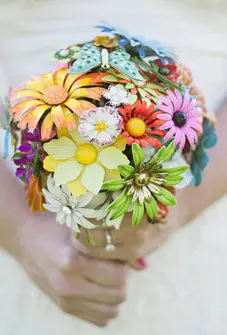
Make your own Brooch Bouquet

I have a little collection of brooches too. When I first noticed this idea I loved it because it would be a great way to bring all my brooches out of hiding and have them displayed so I can see them all again.

Brooch bouquets began as a wedding thing. I've seen them used in for other occasions since then, including a memorial. They are gorgeous, they can be vintage or a great way to repurpose brooches and jewelry you have stashed at the bottom of your jewelry box (or picked out at the local thrift store).

Add your own uniqueness to your own bouquet. Make it yourself, it's a bit time consuming but not difficult. Pick the colours you want, or work with rhinestone, pearl or metallic brooches only. Use other jewelry, broken or out dated necklaces can be wrapped around or clip off the chain and wire them up like another flower in the bouquet.

Some bouquets are made with plastic flowers, or buttons or beads instead of brooches. You can also add silk or other artificial flowers to your bouquet, mix it up.

Finish it off by wrapped florist tape around all the wires to hide them and keep them from poking holes or rips into anything.

Then get ribbon, fabric or whatever you like to wrap around the stems of your bouquet. Add a lace doily or crocheted lace to the top of your bouquet, just as they would have it wrapped up in something extra pretty at the florist shop. I've seen people add tiny brooches to the wrapped up stems too. A little extra pretty touch.

Picking Brooches

Not everyone has a stash of brooches on hand. I have some from my Grandmother and her sisters. They're in my jewellery box, a small collection.

I've seen great brooches in the thrift store. But you should be a little picky, to keep it special. Pick brooches which have some meaning to you. Brooches with a design you especially like. Brooches that aren't just cheap made either. You're going to be handing the brooches you add to your bouquet so they should be able to stand up to being used, poked and prodded around.

If you are using vintage brooches check the settings, see if there are loose stones, beads, etc. Don't use a brooch that is already in need of some repair or too fragile.

Posted on . Filed in . Tagged with , .

Should You Get Her Jewelry for Valentine's Day?

The traditional gifts for your Valentine, on Valentine's Day are chocolates, flowers and jewelry. Then you might take her (or him) out for dinner, dancing, and if all works out well, a romantic night at home. That's the ideal we see in magazines and movies. But, those people have script writers, set designers and wardrobe/ costume artists. Those of us ordinary humans just have out own wits, instincts and whatever romantic notions we have scraped together.

Chocolates and flowers aren't so complicated. The stores have them all lined up in tidy rows for you to pick them up, pay and take them home. There isn't even much guess work any more. Does she like chocolate, likely? From there you have a choice between the standard milk chocolate or the more trendy and intimate, dark chocolate. In the case of flowers, you don't need to worry about those at all if she has allergies. If not, the standard roses are nice. Don't buy them from the grocery store or the gas station - those tend to fade too quickly. Carnations are a safer bet and much less expensive than roses on Valentine's Day.

Now that leaves you at jewelry. You don't have to spend your entire pay cheque to buy jewelry. You do need to know some basics about your Valentine: her style, her ring size and if she actually wears jewelry, for instance.

Picking Out Valentine Jewelry

First of all, does she wear jewelry? Not everyone wears jewelry, man or woman. If you haven't noticed, start looking.

What kind of jewelry does she (or he) wear? Rings, brooches, necklaces, pins, earrings, bracelet, etc.? Then there is a whole category of jewelry for the body piercing types like nose rings. I'm not an expert on that and I don't know all the right names for most of the jewelry worn in belly buttons, on toes and other, more intimate places of the human body.

Next thing you need to know, if she does wear jewelry - is there an allergy or sensitivity to something like silver or gold, or any kind of man made substance? You will probably have to just come out and ask about that. If you get it wrong he or she will never be able to wear something that causes their skin to break out.

You also need to spend time and observe her style of jewelry, fashion in general. Does she like pink, frilly, girlie stuff? Does she prefer a professional image with something not so flashy, pink or trendy? Maybe she loves anything that shines and sparkles in a rainbow of colours. This is important to know when you begin looking at Valentine jewelry. There is no point in spending money on something that doesn't appeal to her sense of style and taste. Also, it will impress her that you were actually paying attention and know her so well.

When you look at the actual jewelry and you are thinking about the financial side of things, also consider how well it is made. There should be a reliable fastening, there should be no rough edges which will catch on clothing and watch for loose stones, or anything that doesn't seem right. Don't waste your money on something that will fall apart. Also, this is the time to know a bit about cheap man made metals which turn green and leave her finger, wrist, whatever green as well. In general, avoid cheap junk and you will be fine. However, back yourself up by making sure the seller offers a decent money back guarantee.

Some jewelry, rings in particular, you will need to know a size for. A necklace has different lengths. Chances are she has pierced ears for earrings, but this is something else you need to be observant about before you buy them. If you want to keep this a surprise you can either stick with something safe like a brooch or get a gift receipt at the store so she can come back and exchange it for the right size. It is better if you can avoid the gift receipt, you want her to think you picked out just the right romantic Valentine jewelry because you know what she likes after all.

Gift Wrapping and a Word of Warning

Gift wrapping counts.

One word of warning first, unless you actually are giving her an engagement ring on Valentine's Day - do not wrap up your gift in a small square shaped box like a ring. Don't raise her expectations, not even because you think it will be funny. This is not a joke that will turn out well for you. Even if she laughs a bit at the time - she isn't laughing on the inside and you have gotten her started thinking about weddings, marriage, and all of that. Was that something you wanted to start? If the answer is no, avoid bringing up the question.

You can easily find a great way to wrap up a Valentine jewelry gift. The store you bought it from should have a service to do this. That is the easiest way.

Use a thick, fabric ribbon and tie the jewelry to an empty box as if it were the garnish. Put a note inside the box with some romantic thoughts and (if you like) an invitation to dinner or a coupon for a hug, kiss, etc. (Make sure the jewelry is securely on the box but don't use glue or anything which you can't easily remove or anything which could damage the jewelry).

You can also buy a gift bag at another store. You can wrap it up in a scarf (one of those silky types). Buy dish drying towels at the Dollar Store and wrap it up in one of those, as a little joke. Tie it up with ribbon to make it pretty and let her think you didn't spend much - until she opens it. Plus, who can't use another dish towel around? You can find endless gift wrapping ideas online.