Fireside Canada
A Podcast about Canadian legends, lies & lore.
A Podcast about Canadian legends, lies & lore.
Human babies can produce “Witch’s Milk” shortly after their birth. It odd, but true, and not something to be alarmed about.
While a baby develops in the womb he/she is exposed to a lot of estrogen. Estrogen causes the Mother's breasts to swell and get ready to produce milk for the baby. The baby, being directly attached to its Mother, also has estrogen in its body. Sometimes this causes the baby's breasts to swell and after birth they can leak what looks like milk. Its just short term, gone in a couple of weeks as the estrogen leaves the baby.
Of course, in the Middle Ages, people did not understand how or why this happened. It seemed to them witches must cause this. Intending to use the milk as a particular treat for their familiars, demons, or anything else that looked a little suspicious. Some parents created baby sized rag dolls to sleep in the crib with the baby, hoping to trick the Witches.
Which makes me wonder... were these the first rag dolls? It seems possible.
I read the title "3 Ways to Keep a Naturalist's Notebook" and felt that buzz of inspiration. But, reading the post, it was just about other people's projects, people long gone and famous for their other writing. It wasn't what I was hoping for. I wanted something, fresh, something on the scale of in my own backyard versus famous places and perfect settings. So, what was there to do but collect my own ideas for a backyard naturalist, like myself.
First of all, if you don't have a backyard, there is a whole world out there. Take a look at a local public place like a church, cemetery, park, or get creative. Being a naturalist isn't just about walking around in a forested area. Studying urban areas is important too. Even if you walk on paved ground instead of grass, nature can be found. Not even just outdoors!
Make notes about what you see. Including illustrations. Don't try creating masterpieces with your drawings. They can just add to your words as you find more to be curious about, or make note of. If you make a digital notebook you can add digital photos. Later you can look into a magnifying glass and fancier equipment. But, the main thing is to see what you discover while its still out there to be seen. Technology and more equipment can be distracting and time consuming. To start with at least, stick to a pencil and notebook for quick notes.
What can you find in your immediate, local ecosystem? Learn to identify different plants growing in your backyard. What types of grass are in your lawn? What are the "weeds" you see? Watch for animals in your yard, not just birds. What do they find to eat and how do they eat? Do they interact or avoid each other? Add details like the location, season, the weather, time of day, colours, texture, how they move (or blow in the wind), so many details you can think to add once you get started.
Consider all your senses when making observations and notes: sight, sound, smell, hearing and touch. Include your sixth sense, your feelings, too. Avoid touching poisonous plants. Try not to disturb animals and plants in general. That doesn't mean you can't touch things around you, just learn to understand them without endangering or upsetting them. You don't want to harm life while studying life - be responsible for your actions, not a bumbling professor uncaring/ thoughtless about the chaos your actions can create.
How does the environment affect the natural world? The environment can include the location, traffic from vehicles or people, buildings, sidewalks, fences, a river, trees, everything. I think of the odd weed poking up in an otherwise pristine sidewalk. There is the natural world surviving in the environment it finds itself in.
Take time and return. You may see something interesting while busy and make quick notes before moving along. But, plan ahead and choose a time and location where you are not rushed and can return to again and again. Things change in the natural world. You need more than one visit. Try a sunny day and later a rainy day, even in the same week.
You could make a study of just one weed growing where it manages to get a start. What changes day by day? What struggles does that weed have? Does it grow to full height or remain stunted? Does it produce flowers or seeds? If someone pulls it out, does it have enough root to grow back? Endless questions and observations.
Don't forget the motto (used by urban explorers) "take only photographs, leave only footprints". Whatever you bring with you should leave with you, no littering. On the other hand, don't remove things from their environment. Instead hope you will see them/it again next time you visit. I make an exception for seeds and clippings from plants which you could add to your notes. But, don't harm the plants, make sure there is enough of it to keep thriving. In some locations you may need to stay on trails, especially in fragile ecosystems. Think of it as the butterfly effect without the time machine.
Dress appropriately. Think about insects (bees and mosquitos). Think about the weather. Bright colours or anything flashy will make it harder to watch animals, no matter how patiently you wait. Bring everything with you in an easy to haul around backpack or something else that works well for you.
Give yourself credit for what you have learned, progress you have made in understanding the ecosystem and new discoveries you make. Celebrate your discoveries. Add to your research by looking into history and lore about the plants and animals in your own backyard. Which plants are edible? Find out about foraging and cooking/ baking with wild plants. Learn tracking skills for seeing where the animals came from and where they go.
Here are some reflection questions to help you choose your next outdoor adventure: What am I excited to learn outside? What would be easy for me to do in the amount of time I have? What would be easy for me to do in the locations I have nearby? What areas of nature study am I most passionate about? What areas of nature study have I not done in awhile? If you ever get stuck and unable to go deeper in a particular area of naturalist curricullum… simply take a break and go study something else for awhile!
Quoted from Brian Mertins, Nova Scotia.
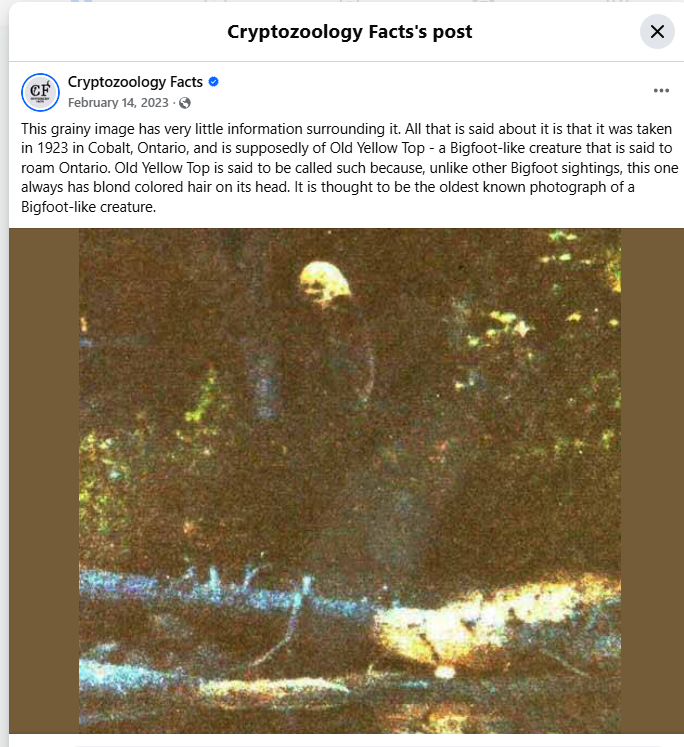
This grainy image has very little information surrounding it. All that is said about it is that it was taken in 1923 in Cobalt, Ontario, and is supposedly of Old Yellow Top - a Bigfoot-like creature that is said to roam Ontario. Old Yellow Top is said to be called such because, unlike other Bigfoot sightings, this one always has blond colored hair on its head. It is thought to be the oldest known photograph of a Bigfoot-like creature.
Also found on Facebook:
“In 1909 a group of miners at the Violet Mine in Cobalt, Ontario, Canada, observed a tall, man-like creature. Its entire body was covered with brown hair, except for the top of its head, which had a thick mane of bright yellow hair. All of the witnesses agreed on the appearance of the creature, but nobody knew exactly what it was.
The account made its way into the local papers, where reporters quickly nicknamed the mysterious creature “Old Yellow Top.”
For a decade and a half, there were no further confirmed sightings. Then, 17 years later, Old Yellow Top made his second major appearance. Again the witnesses were a group of miners working a local mine outside of Cobalt. They observed what they thought was a bear, except it appeared to be picking berries. One of the miners threw a stone at the creature.
Another miner, Mr. Wilson, said, “It kind of stood up and growled at us. Then it ran away. It sure was like no bear that I have ever seen. Its head was kind of yellow, and the rest of it was black like a bear, all covered with hair.”
Following this, Old Yellow Top seemed to disappear, until 23 years later, when he returned. On April 16, 1946, a woman and her son were walking along the railroad tracks that led into Cobalt when she saw a hairy, man-like creature with a head of bright blond hair walk “almost like a man” into the forest.
In 1976, yet another 30 years later, Old Yellow Top made one final appearance. A bus driver and 27 miners on their way to work the Cobalt mine observed Old Yellow Top as the creature crossed the road in front of them.
Says the bus driver, Aimee Latreille, “At first I thought it was a big bear.
But then it turned to face the headlights and I could see some light hair almost down to its shoulders It couldn’t have been a bear ..
The 1976 sighting of Old Yellow Top, if true, would mean that the creature was more than 70 years old...”
Excerpt from the book titled BIGFOOT, YETI, AND OTHER APE-MEN by PRESTON DENNETT
Folklore and legends are essential to cryptozoology, providing the foundational clues for cryptid investigations. They offer the first descriptions and locations of creatures like the Yeti and Bigfoot. These stories act as a starting point, guiding researchers to potential habitats and behaviors. By analyzing these traditional tales, cryptozoologists can bridge cultural beliefs with scientific inquiry, using a blend of anthropology, mythology, and zoology to pinpoint where to begin their search. Ultimately, without folklore, many cryptid hunts wouldn't even exist.