Posts tagged with “flowers”
Posted on . Filed in . Tagged with , , , , , , .

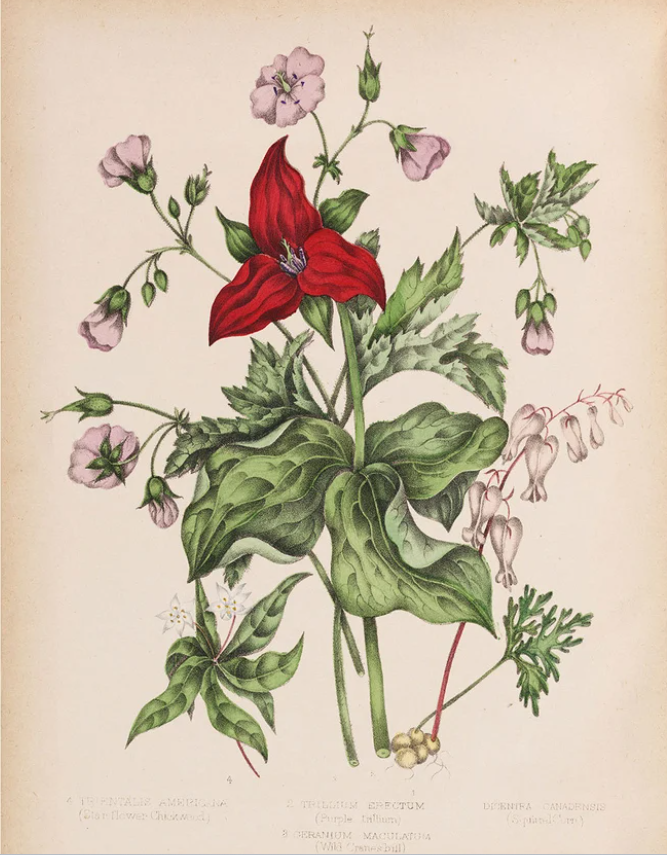
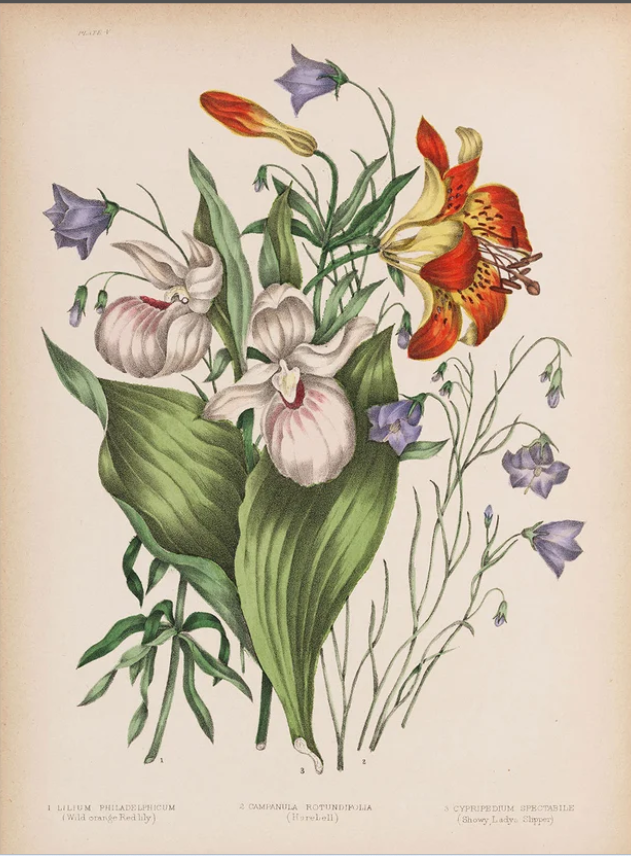
Ontario Wildflower Paintings by Agnes, daughter of Susanna Moodie

I've seen the illustrations here and there growing up in Ontario. I didn't pay attention to who created them. Just enjoyed the detail and the colours, the types of flowers: trilliums, lady's slipper, jack-in-the-pulpit, wildflowers I would look for in woodlands, gardens, anywhere they might turn up. Today I looked up the name and discovered she was the daughter of Susanna Moodie, a well known author here in Ontario.
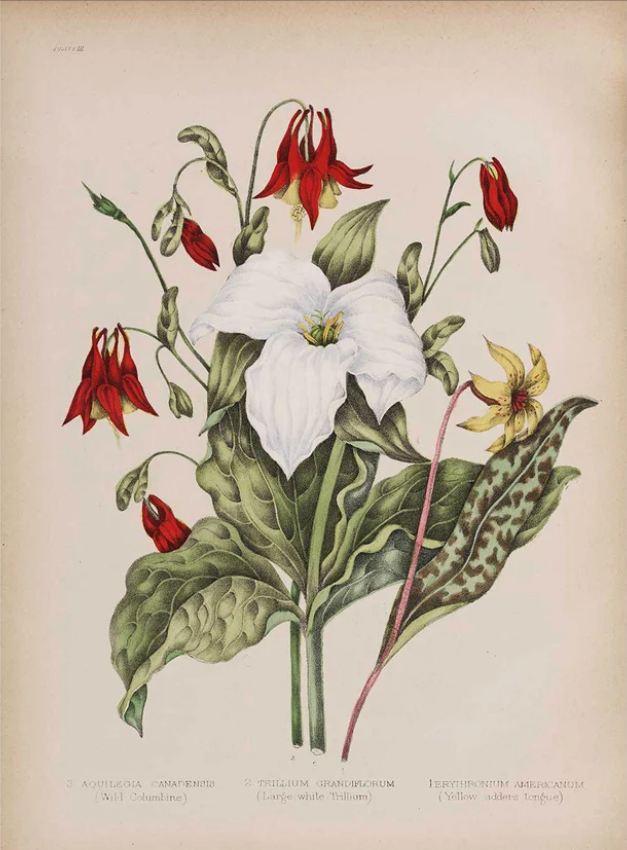
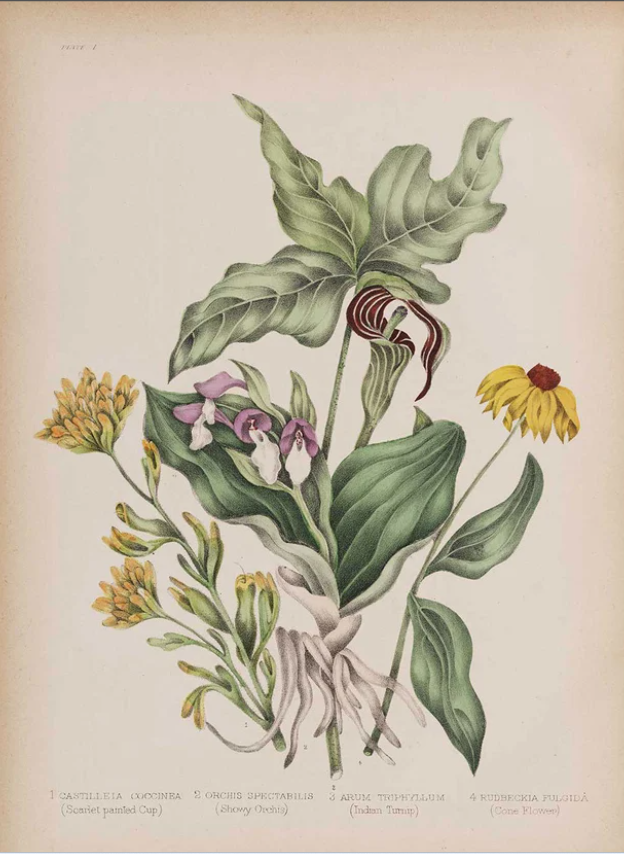
Canadian born, Agnes Dunbar Fitzgibbon Chamberlin (née Moodie; 1833–1913) was an Ontario artist.

She was born Agnes Dunbar Moodie. Her parents were John and Susanna Moodie. Agnes learned how to paint flowers from her mother.

Susana (Strickland) Moodie, sister of Catharine Parr Traill, wrote about life as a New Canadian, 'Roughing it in the Bush' about her experience farming in Ontario during the 1830's. Her sister, Catharine, wrote from a different perspective, about history in Ontario.

In 1868, Canadian Wild Flowers was published, viewed as one of the first serious botanical works published in Canada, which included text by Catharine Parr Traill. The book, very expensive for its time, was sold by subscription, largely through its author's own efforts; as an enterprising widow, she also worked as an illustrator to support her children and herself.

Agnes had 2 husbands (remarried after the first died in 1865) and 9 children.

In 1863, she began her paintings of Canadian flora to illustrate a book by her aunt, Catharine Parr Traill. After the death of her husband, she began work on a book of Canadian wild flowers, with her water-coloured illustrations and Traill's text. The book attracted 500 subscriptions, a significant number at the time.

Her paintings have been presented at exhibitions in Canada, USA, and England since 1886. She died in Toronto in 1913. Her heirs presented her paintings and copies of Canadian Wild Flowers and Studies of Plant Life in Canada to the University of Toronto in 1934–5.

  • Summarized and quoted from Wikipedia.

I think we still have a copy of one of the reprints of the wildflower book. My Mother enjoyed Canadian and Ontario history along with gardening, antique furniture and other hobbies that became popular in the 1970's. That must be where I first saw these illustrations.
Posted on . Filed in . Tagged with , , .

Make your own Crochet Flower Bouquet

Crochet flowers can look delicate and lacy or striking and bold. Use your crocheted flowers to decorate other projects like sweaters, teapot cozies or purses. Crochet flowers are added to so many crafty creations. Sometimes I see them even in the Dollar Store, added to hair accessories. Of course, those are machine made crochet flowers.

You can make your own flowers in crochet. Most of the patterns are simple, especially if you have already mastered the art of the basic granny square.

I like various forms of flowers, other than living flowers, because I have allergies and asthma. I'm not allergic to many plants (luckily). Strong smells like perfume do bother me. Also, once cut flowers are in your home they begin to rot, water goes stagnant and mould grows. That is one of my big allergy and asthma problems. So, I like a variety of other options when it comes to having flowers.

Another plus with making your own flowers is choosing your favourite colours for them. I love red. Blue is not a favourite colour for me but I do love shades of blue with white. There are other colour combinations I really like but would not be able to find exactly as I like them in nature. You can create flowers in every shade of pink, orange or even green if that's what you like. Or, combine pink, purple and green in the exact shades you want. Or, create the flowers to match the room you plan to display them in.

Crochet Flowers as Brooch Bouquets?

I really like the brooch bouquets, created with sparkling jewels and formed into a floral bouquet. So I was really liking the idea of doing the same thing with crocheted flowers. Maybe this will catch on and become more popular than the jewelled bouquets. Or, maybe not. But, they are still very beautiful, if not so glittery.

Posted on . Filed in . Tagged with , , .

Bone China Bouquet: Delicate and Romantic

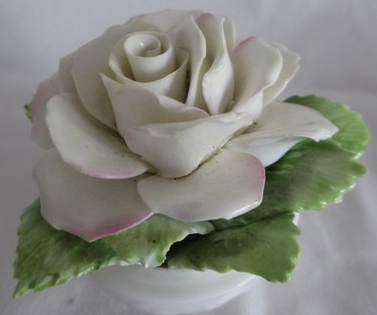
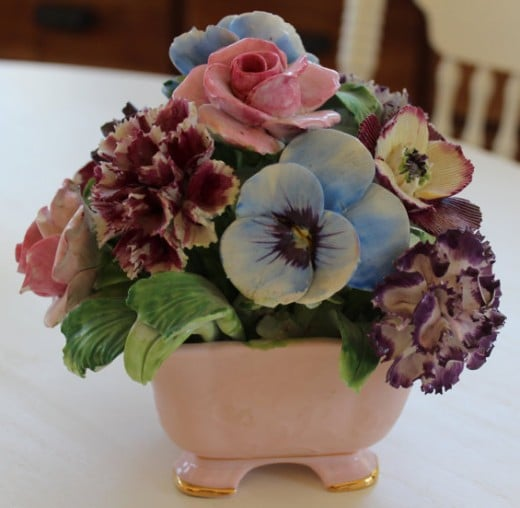
I collect bone China bouquets. They are delicate, fragile and romantic.

I started collecting bone China posies when I inherited a small white bowl with three coloured roses in it. I have always had a romantic side and I like history and anything vintage. I loved the China flowers from my Aunt Sally, my Grandmother's sister. I kept them, just a collection of one, for many years.

Then I noticed one in a thrift store. It was larger than mine at home. It also had a variety of flowers: carnations, a violet and the roses too. It had one flower which was an unusual orange sort of colour. I bought it for a dollar.

It was a bit dirty and had two flower petals chipped off at the tips. I put it in a sink of soapy, warm water. Let it soak awhile. I've heard that's a good thing for any kind of China, otherwise it can dry out, especially if it's not being used and washed regularly.

I set it out to dry out well after the washing. I tipped it on different angles to be sure any water had drained out. Having it tipped lets you make sure it won't have water left inside which could gradually drain out and become mould when it's displayed on a shelf. It's not a bad idea to put something under your knickknacks to be sure it can drain and dry out - when it has a hollow inside.

Hunting for Bone China Posies

This morning we are going to the thrift store, on the hunt. It's a big sale day and there are (or were) two large sized bone China posies in the display cabinet earlier this week. I'll get them, if they are still there and if they are in good shape. Today the thrift store has a 75 percent off sale for it's ten year anniversary. So, if they are there, it will be quite a sale price. If they aren't there, I would have liked to at least see them, but I do have enough of them, realistically.

Posted on . Filed in . Tagged with , .

Preserve Flowers by Pressing or Drying Them

Pressing Plants, Flowers or Leaves the Easy Way

Get a big, thick, heavy book, a dictionary is kind of traditional, but not essential. There are other hefty books you can use to squish your flowers.

You also need wax paper or tissue paper to protect the pages of your book and to keep the flowers from breaking apart and sticking to the pages as they become pressed, dried and flattened in between the pages of your book.

Some people don't put the flowers in the pages of the book, they just put the book on top of the flowers. This is fine of course, but it loses some of the history of the project I think. My Grandmother would press flowers in the pages of her diary. She would have to put something heavy on her diary (it wasn't heavy enough on it's own) but I've always liked the custom and the history to pressing flowers in this traditional, sort of romantic way.

My Grandmother pressed the flowers she was given in the pages of her diary. I've always been fond of vintage romantic notions like this. So, I have to be careful when picking up my own old diaries/ journals lest the old pressed blooms slip out from the hand-written pages.

Why press flowers?

Pressed flowers can't keep all their fresh, original colour. I always feel this is the downside of having pressed flowers versus just taking a photograph. But, if you take the time to arrange all those flowers, leaves and so on for a photograph - why not take the extra step of pressing and preserving the originals.

Of course, this means you have to find room to keep them. You can create them as a framed picture and hang it up on a wall. A smaller project could be a in a frame which you could add a photograph to and give as a gift. You might even add other souvenirs from the day or event and turn the pressed flower project into a scrapbooking sort of arts and craft.

So, why press or dry flowers and keep them?

They are a sort of living art. If you use some plants which smell nice you can also keep that scent around in the display. A nice added bonus.

Most of all, I think flowers and plants in general have a short life, it's nice to preserve a few of them - give them added years rather than becoming compost at the end of each garden season.

My Mother likes it because she spends so much of her time in the garden, working. Then at the end of the season she really just has photos and her own memories left. When we take the time to preserve some of her best blooms she can keep them much longer, the very flower she grew in her own garden.

Some gardeners enter flowers in contests. I wonder if they press them and display them in a frame or just add the winning blossoms to the compost pile, mere worm food.

Drying Plants, Flowers or Leaves the Easy Way

The simplest way to dry flowers is to gather them in a bunch, tie the stem ends together tightly and hang them upside down somewhere for at least a few days. They should be dry right through before you store them.

You can tie the bundle to a wire hanger and easier hang the whole bunch over a door knob or something else do-able. Keep them away from steam and water - hanging them in the bathroom is not the best idea. I put newspaper down under them in case petals or leaves fall off as they dry.

Store dried flowers in a sealed container until you're ready to use them. Some dried flowers can be used to make teas as well as just looking pretty.

Posted on . Filed in . Tagged with , , , , .

Vintage Treasure: Flower Frogs

There are many obsolete technologies since mobile phones began taking over the world. I miss the elegance of watches in particular. However, some vintage technology is just misplaced and not obsolete. Frogs are one of those.

Not frogs of the living kind, but these frogs which were used in floral arrangements. The frogs usually came with a vase (or flower holder of some kind) which they fit inside. So the frogs were made to fit the vase.

Sadly the frogs were easily lost or misplaced. So not every vase still has the frog it came with originally.

We recently lost the frog to one of our own vintage vases. It was a silver frog, one of those which had to be polished. I hope we find it again, before it gets heavily tarnished. I can clean it but I can't do much if the silver gets pits in it from being tarnished. I'm sure this is why silver has lost it's popularity. As lovely as it still looks, stainless steel is much easier to look after.

Have you seen any frogs lately?

Vintage flower frogs...what are they? How many 'frogs' do you have?  How many did your Mom or Grandma have?   Frogs were used in the bottom of vases to hold the flower stems just right. They are usually metal basket weave grid, or fine textured metal spikes or made of clear or colored glass disk with holes....

Source: Flea Market flower frogs