I haven't heard the term commonplace book until today. It sounds like an art journal, a diary which includes drawings, maybe a scrapbook which includes things cut and pasted in from magazines and other sources. It is a curated collection of thoughts, ideas, and interests. The idea isn't so new but the phrase is new to me.
This description comes from a site which hosted commonplace journals. Its gone now.
A commonplace book is a collection of remarkable quotations, reflections, and oddities gathered from one's reading, thoughts, or experience--in short, a reading and writing journal.
A private commonplace book is also a great way to organize your research by author, source, and subject, and gives you the ability to display and search your notes by each category and by keyword.
The original, vintage Love is... drawings were created by a woman to the man she loved. They later married, in May 2011.
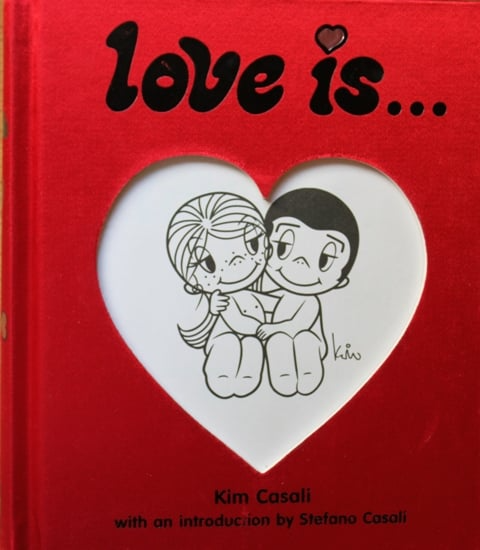
The new Love is... has all the love, happiness and spark of mischief which the old Love is... is missing. This is likely because the original artist hasn't been drawing the cartoons for many years. It was taken over when her husband (the man she loved) died and she stopped drawing the cartoons.
If you loved the old Love is... cartoons in the 1970s take a look at HJ Story, the Love is... cartoons for the new century. He has a Deviant Art page which gives more of his story, their story.
The History to the Vintage Love Is... Couple and Illustrations
The Love Is... drawings were created by New Zealand artist, Kim Grove, as a series of love notes in the late 1960′s for Roberto Casali. They later married but Roberto became ill with terminal cancer and Kim stopped working on the cartoons in 1975. Roberto died in 1976.
Since 1975 the cartoons have been drawn by Bill Asprey.
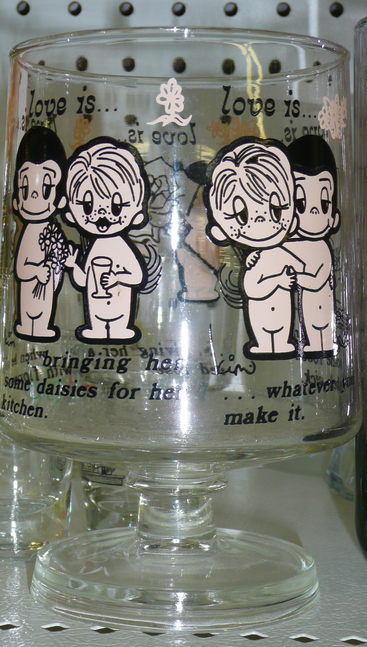 My own photo of a Love Is... glass I found at the local thrift store.
Mainly this is about lettering, how to create fun, fanciful and pretty letters. These can be used to illustrate quotations. Or add a unique touch to other creative work you are doing. Think outside the box. Just get the basics and take off with your own imagination and favourite things.
- Start by drawing your letters as usual, in your own hand drawn print. Use a soft pencil (#2 or mechanical pencil) which you can easily erase if you also use a white eraser. These should be easy to find in any kind of art or craft supply shop.
- Outline your letters with a fine black liner pen. Don't try to make them perfect but do think of your original letter as the centre point so that your new letters will be in the right place while becoming fuller in size. Once you have outlined the letters you will need to carefully erase the original letters you drew with the soft pencil. Use thicker paper if you find the paper you are using is ripping too easily.
- Add life to your letters with crayons, coloured pencils or markers. Draw thick and thin lines, polka dots, diamond shapes, whatever you prefer or get the idea to try. When you colour the letters in pick your favourite colours. Outline some of the shapes you drew inside the letters, give them extra focus and it's a way to get more colour in your design. Experiment and discover what styles and colours you like best.
- Now shadowing... the rule I discovered is "outside right and inside left". So you will be adding shadow to the outside of letters on the right side and to the inside of letters on the left side. Do it for awhile so you get the feel for it. Try different thick and thin shadows, see which you like best for your own style of lettering.
- Decorate your letters with a little extra touch. Add shapes to the whitespace around your letters. Or, draw a frame around some letters and then decorate the frame with more shapes and colours.
- Add a whole illustration around your letters. Maybe a cityscape, a sandcastle, a garden, something that just appeals to you or seems to suit the words you used. Whenever you need some inspiration or a general drawing guide for an object try to search for it on Google. In the Google Images section you will see a setting "Any type" which gives you the choice of clip art and line drawing. Either of those will give you illustrations instead of photographic images. Study how someone else drew the cityscape (for example) and then you will be able to use that as a guide for your own illustration.
Lots of links, not in any real order due to a small mishap with cut and paste somewhere along the way. Most of these are for beginners who draw on pen and paper, but not all. I think everyone will find something to stir their imagination and (I hope) pick up a pen to doodle. Join in for Doodle Week this weekend.
One thing I do know about drawing a comic is that it can't be too detailed if you hope to get them out there on a regular basis. Maybe it's different for those who aren't hand drawing each one.