Posts tagged with “cryptozoology”
Posted on . Filed in . Tagged with , , , , , , .

Algonquin Rock Worm?

Is this a hoax, or real?

Supposedly written by Roger Fontaine (who doesn't appear to exist) more likely written by David Legros, Algonquin Provincial Park chief park naturalist, who’s originally from Lafontaine, now lives in Huntsville, Ontario.

As far as I know, these holes (tunnels) in the photograph below, were created from blasting through the rocks of the Canadian Shield to make way for building the highways/ byways in Ontario. Other provinces and territories likely have them too. I really doubt the worm story, as far as these photos being any kind of real evidence. But, the whole post shows how something can be turned into a great hoax, or a great story. Is there enough here to make you a believer?

Holes in the shield: the Algonquin Rock Worm

Roger LaFontaine originally came to Algonquin Provincial Park looking for creepy creatures like leeches, snails, crayfish and rotifers in the early 2000s.

During that first season in the park, he became fascinated by the huge and strange marks seen all over Algonquin’s Highway 60 corridor left by a prehistoric worm. Since then, he’s devoted at least a day per year to documenting and studying some of Algonquin’s forgotten creatures.

Many visitors to Algonquin are in awe of the rocky shorelines and exposed rock outcrops throughout the park.

What only keen-eyed visitors may pick up on are the telltale marks left behind by a fantastic creature that sadly isn’t around anymore.

Findings from a lost journal Back in the 1930s, strange marks appearing as vertical tunnels were seen in rocks along what would later become Highway 60.

Naturalist Walter Lepinski working with the road crew would eventually go on to describe the creature that made these precise tunnels: the Algonquin Rock Worm (Petrolumbricus algonquinensis).

This was a species of large burrowing worm that specialized in boring tunnels through rock using hardened mouthparts.

Walter estimated that Algonquin Rock Worms were approximately 10 cm wide by 6 m long, featuring segmented bodies and head-ends covered with scales.

Lepinski’s observations were corroborated by strange notes and illustrations found in the journals of timber cruisers and timber chute operators before the turn of the century (pers comms, Norton Smithers, 2024).

Lepinski’s notes from this time are scant, but he did write in his journal

“Algonquin Rock Worm, Petrolumbricus algonquinensis.

“Fossil burrows found along proposed highway through Algonquin. Only burrows found through Canadian Shield. I estimate the worms to be up to 20 feet in length. It must have hardened mouthparts to bore through rock.”

Evidence of species past Sadly, this species was one of the victims of the last Ice Age – the enormous glacier that covered much of North America in a crushing sheet of ice.

By the start of the last Ice Age 100,000 years ago, the rock worm would be wiped from the landscape.

In fact, following the melt of the glacier about 11,000 years ago, there would be no native earthworms at all in Ontario until they were introduced by humans just a few centuries ago.

Alas, no extant fossils exist of the Algonquin Rock Worm because animals with soft bodies rarely become fossilized. On top of that, that worm-killing glacier also scraped much of Ontario clean of its soil and softer rocks, including most fossil-bearing rocks.

Today, fossils of ancient animal life are found in limestone regions of southern and extreme northern Ontario.

To see these, check out parks like Presqu’ile Provincial Park, Craigleith Provincial Park, Kakabeka Falls Provincial Park – these parks host fossils that are hundreds of millions of years old!

As for the Algonquin Rock Worm, all we have left are the huge and mysterious burrows.

When the track or sign of an animal is fossilized, it is called a “trace fossil” or “ichnofossil.”

Modern effects of the Algonquin Rock Worm

Photographs from modern Highway 60, Algonquin Provincial Park featuring the tunnels of the Algonquin Rock Worm. In many locations, a number of tunnels appear next to each other. It is possible the worms lived in groups or were excavated in similar locations over vast time periods – we won’t be able to know.

While called the Algonquin Rock Worm in tribute to the place where it was first described, this species has since been found across much of eastern Canada and parts of the northern United States, with observations made all over the Canadian Shield.

Coincidentally, this lines up well with some of Ontario’s most iconic parks and drives, such as Frontenac Provincial Park, the eastern shore of Georgian Bay, Lake Superior Provincial Park, and more.

Today, we don’t have much to go on to piece together the life and ecology of the Algonquin Rock Worm.

The vertical burrows that we can see while travelling along the highway suggest they were good at orienting themselves to get to the surface and likely fed here.

Modern worms consume vast quantities of forest debris like dead leaves, and we assume that the Rock Worm did as well.

As modern worms feed, they leave behind poop, called worm castings.

One must imagine the immense heaps left behind by a 6 m worm and the nutrients spread onto the landscape, let alone the piles of pulverized stone at the burrow opening.

While we can’t know for certain, it is thought that Rock Worms were long-lived due to their size and the difficulty of boring through rock.

We have yet to find deep subterranean chambers attributed to the Rock Worm, and we suspect they are deep underground so unlikely to find them.

It is thought that the burrows provided homes for other species of long, narrow animals to use, from smaller worms and insect larvae to snakes and weasels.

In the past, as today, water trickles through these holes, perhaps entering the ground for long-term storage.

In winter, the water may freeze and thaw, and over millennia, this has cracked many rock outcrops, eventually creating mineral soil for plants to grow in.

Become a student of nature You may be wondering, “So what? Why does this matter?”

We think the answer might come from Walter’s journal in 1936:

“Those building the road thought it was a waste of time to even ponder what made these burrows, and they teased me relentlessly for my curiosity in such matters. For the student of nature, everything is interesting and instructive to the eyes that can read it.”

If you happen to be visiting some of our stunning parks on the Canadian Shield this season, take some time to look for the burrows of the ancient Algonquin Rock Worm.

Photograph the tunnels from a safe distance, but don’t touch these sensitive fossils – researchers are still trying to glean what they can from them.

Posted on . Filed in . Tagged with , , , , , , , .

Ontario Creatures

I'd like to find out more about some of these mysterious Ontario creatures. Not so much the wendigo. Maybe its just the popularity of the idea in fiction, but it seems less supernatural/ paranormal based than the others.

Some, like crying at the water falls, are common ideas with accompanying legends about romantic tragedy. These likely have an explanation to do with how sound carries and bounces off rocks, etc.

Sure, lake monsters are more likely floating logs or debris, a large fish, or just a wave in the water. But, I do wonder more about the possibility of lake creatures. It does seem there could be species we don't see. Yet, as with Loch Ness, it seems there should be some evidence when they test the water for DNA. It could be I just want to believe in lake monsters/ creatures.

Ontario's mythological creatures and mysterious folklore - Erin Horrocks-Pope

Gaasyendietha: Lake Ontario's Hydra Serpent Lake Ontario, surrounded by the ancient tales of the Iroquois and Algonquin, is said to have been home to a race of giant serpent-dragons.

Among these mythical creatures, Gaasyendietha, a massive hydra snake capable of breathing fire and flying like a bird, was revered by the Seneca people.

In 1805, fishermen near Kingston alleged an encounter of a serpentine creature in Lake Ontario, led to local panic, adding to the legend of the fearsome Gaasyendietha.

Described as a hydra snake with the ability to breathe fire and fly, Gaasyendietha's origins involve being born from serpent eggs or arriving on Earth via a meteor.

Stories of this creature, known by many names, have persisted through generations. While a 1934 hoax cast doubt on sightings, the legend endures to this day.

The Little People of Doghead Mountain Near the town of Nipigon lies Doghead Mountain, resembling the outline of a dog's head. The mountain was once known as Memegwesiwijiw, meaning "mountain of the little people."

According to the legends, the little people reside at the mountain's base, and there's a curiosity to see them firsthand. However, folklore warns about the trickster nature of these elusive beings.

The tricks of the little people involve playful disruptions such as tipping over open and unattended water bottles. Accounts include incidents where the little people interfered with a trap line, releasing the trapped animals.

The story of Memegwesiwijiw weaves a cultural narrative connecting generations and arouses a sense of wonder about the mystical beings that inhabit Doghead Mountain.

Wendigo: Malevolent Spirit of Algonquian Folklore Originating from Algonquin folklore, the Wendigo is an evil spirit or creature believed to possess humans, inducing insatiable hunger, a desire for human flesh, and a tendency towards murder.

"Wendigo psychosis" is a term associated with modern psychiatry that refers to a cultural-bound syndrome among certain Algonquian-speaking indigenous peoples. The condition is characterized by an intense craving for human flesh.

In psychiatric terms, Wendigo psychosis is considered a culture-bound syndrome because it is specific to certain cultural or ethnic groups. It reflects how cultural beliefs and folklore can influence the manifestation of mental health symptoms within a particular community.

The phenomenon is not recognized as a mental disorder in mainstream psychiatric classifications but is acknowledged as a culturally specific expression of distress.

A Reddit post from an Ontario resident depicts a strange encounter in the woods, hearing the poster's name called in a voice resembling their own.

This eerie experience aligns with Wendigo lore, emphasizing the pervasive influence of these ancient myths on contemporary encounters.

The Crying Woman of Manitou Falls The legend of Manitou Falls tells the story of a waterfall named after the Ojibwe word "manitou," meaning spirit. Locals near Manitou Falls reported hearing the inconsolable cries of a woman every night.

However, it was later revealed that the weeping woman was, in fact, the spirit of the falls itself, appearing as a misty shadow within the cascading water.

The reason behind the spirit's perpetual sadness remained a mystery. One day, outsiders constructed a dam where Manitou Falls once existed, causing the falls and its spirit to vanish.

Legend suggests that the dam silenced the cries of Manitou, the spirit of the falls, forever. There's hope that, occasionally, Manitou might return to her waters or the place she once occupied.

Igopogo: The Elusive Lake Simcoe Monster Lake Simcoe, just 80 kilometres north of Toronto, is home to another peculiar water-creature known as Igopogo. Also referred to as "Kempenfelt Kelly" or "Beaverton Bessie," this lake monster has stirred the waters of Southern Ontario for centuries.

Described as having a canine-like head on a neck resembling a "stove-pipe," Igopogo's sightings date back to Indigenous legends.

Despite the controversy surrounding photographic evidence and sonar readings, Igopogo remains a mysterious and rarely seen creature, adding an air of intrigue to Lake Simcoe's waters.

Waheela: The Mysterious White Wolf of the North Venturing into the enchanting landscapes of Ontario, the Waheela, a mystical guardian, emerges as a cryptic figure echoing through the Canadian wilderness.

Tales of this creature, resembling a giant white wolf haunt the far reaches of Canada, with sightings from the woodlands of Simcoe County to the valleys of the Northwest Territories.

Descriptions paint a picture of an enormous, wolf-like being, impervious to gunfire, adding a touch of magic to the folklore that transcends the provincial borders.

The Waheela remains an enigmatic and elusive presence, a guardian spirit woven into the rich tapestry of Canada's vast and mystical wilderness.

The Legend of the Sleeping Giant At the top of Lake Superior, Thunder Bay boasts the captivating sight of the Sleeping Giant, a colossal land formation resembling a reclining giant.

This geological wonder is more than just a symbol for the city; it carries the weight of an ancient Ojibwa legend.

According to the tale, Nanabijou, a benevolent god, revealed the location of a silver mine to the Ojibwa people as a gift, accompanied by a warning that Europeans must remain unaware, or the curse would transform him into stone.

As jealousy brewed among rival tribes, a European scout betrayed the secret, triggering Nanabijou's wrath. In a tempest on Lake Superior, the Europeans met their demise, and Nanabijou turned to stone, safeguarding the silver mine at his feet.

Today, Thunder Bay honours this legend with the "Wake the Giant" festival, fostering inclusivity and paying homage to the guardian of Lake Superior's precious gift.

Posted on . Filed in . Tagged with , , , , , , , .

Hammerson Peters Writes About Mysterious Canada

Hammerson Peters

Hammerson Peters on YouTube

This Cryptozoology Discovery Actually Gave Me Goosebumps

Mystery Cats of the Northern Wilderness

I've bought several of the books in his series. I've read one, so far.

Posted on . Filed in . Tagged with , , , , , .

Strange Creatures Seldom Seen - John Warms

CTV Video -A campfire tale come to life Author John Warms reveals the real-life encounter that inspired his children’s book The Girl Who Met Sasquatch.

John Warms - YouTube channel

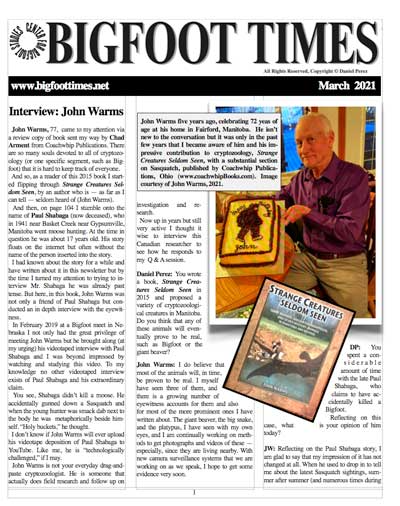
The following is from an interview with John Warms, author of 'Strange Creatures Seldom Seen', featured in the March 2021 issue of Bigfoot Times. John Warms interview

Daniel Perez: You wrote a book, Strange Creatures Seldom Seen in 2015 and proposed a variety of cryptozoological creatures in Manitoba. Do you think that any of these animals will eventually prove to be real, such as Bigfoot or the giant beaver?

John Warms: I do believe that most of the animals will, in time, be proven to be real. I myself have seen three of them, and there is a growing number of eyewitness accounts for them and also for most of the more prominent ones I have written about. The giant beaver, the big snake, and the platypus, I have seen with my own eyes, and I am continually working on methods to get photographs and videos of these — especially, since they are living nearby. With new camera surveillance systems that we are working on as we speak, I hope to get some evidence very soon.

DP: You spent a considerable amount of time with the late Paul Shabaga, who claims to have accidentally killed a Bigfoot. Reflecting on this case, what is your opinion of him today?

JW: Reflecting on the Paul Shabaga story, I am glad to say that my impression of it has not changed at all. When he used to drop in to tell me about the latest Sasquatch sightings, summer after summer (and numerous times during each season, whenever he would spot me working in my yard!), I would offer certain questions to see if his answers might vary from previous years–but there was never any variation in the stories. I always admired his attention to detail, and since those details never wavered, I was confident that he was telling me exactly what he had experienced. His fanaticism about the topic only reinforced the reality that he had inadvertently shot and killed a huge, bipedal, hairy, unknown creature in 1941 when he was seventeen years old. Simply because he expected the patch of fur he saw among the willows to be the wounded moose he was following.

DP: You are of the age where you could have been a contemporary of the likes of René Dahinden and John Green. Early on, did you know of these high profile investigators and did you correspond with them?

JW: It may have been information on the topic of the Sasquatch that came from our West Coast, through people like John Green, that convinced Paul that it was a Sasquatch that he had killed. He told me that it had taken about thirty-five years to come to that conclusion. I’m sure it was from him that I heard of Sasquatch investigators like John Green, John Bindernagel and Curt Nelson. Paul and I met John Bindernagel at a meeting he had convened at a Sasquatch hot spot in Grand Rapids, two hours to the north of us. The next day we met him at Paul’s house again. Some years later I met Curt Nelson briefly when he was visiting Paul Shabaga. [Editor: Dr. John Bindernagel, with whom I had sporadic correspondence, only mentioned Paul Shabaga in passing. Paul was never an exclamation point in his research. By contrast, Curt Nelson was highly impressed with Paul’s testimony. It is report #9552 in the BFRO database. Part of the report, from a taped interview with Paul Shabaga is as follows: “…Sure enough, I did see one in the willows feeding with its head down, and it was a cow moose…”].

DP: What got you started in your search for all these unknown animals?

John Warms: You would think the sightings of a Sasquatch just a few miles away from my home, by a good number of people on a Native reservation, would have captured my interest. I recall taking my young family to the spot where a footprint had been found in a ditch. But it was not until some years later after I met Paul Shabaga that my interest was actually kindled. I enjoyed his stories, some of which were from central Manitoba, but many of them came from in the north as well. One of Paul’s favorite techniques was intercepting truckers and travelers coming from the northern regions, quizzing them on what they knew or had possibly encountered along the way, and in this way garnering a significant repertoire of Sasquatch sightings. I might add that, sadly, his fervor for the topic was too rich in the coffee shops he frequented, or among folks that did not share his passion, so he became widely misunderstood and disliked. Paul had no patience with folks who disagreed with his perspectives. For me, however, that fervor spoke loudly and honestly of what must have been a traumatic experience for him as a teenager, and I’m sure —now that I think back— he found in me someone who came to believe him–giving him a measure of comfort, assurance, and support in his lonely, alienated existence. The first person he ever shared his experience with had been a brother who had returned from the war, and when his account had brought only laughter and derision, he vowed not to tell anyone else. Not, that is, until in old age. He threw caution to the wind and cared not what people thought of him. He had truth to tell, and he told it to all who would listen. So, he finally divulged his unbelievable experience, come what may, getting it off his chest where it had obviously been a constant burden, a deep secret that he had carried for a lifetime, and was desperate to unload, no matter what the cost. But I have not yet fully answered your question as to what got me started in the search for all the unknown animals. The above paragraph explains my introduction to the world of Sasquatch. But it was a vague rumor of a big snake sighting on a reservation about sixty miles away that really set me on the road to what has become a continuous search for unusual creatures. A subsequent visit to a professor at the university, a herpetologist, gave me the first indication that our academic community knew virtually nothing about the many elusive creatures that were practically common knowledge among many of the Native peoples— and that realization became, for me, an exciting challenge that I felt I wanted to address. I decided to check out where the truth lay, suspecting that the scientific community was overlooking some very significant information, either unintentionally or intentionally. [Editor: I suspect it might be the later, that the scientific community has intentionally sidestepped the issues to avoid unwanted ridicule by their colleagues and personal friends. No one wants to be called a “nutcase.”].

DP: Early on, do you think you could have been more effective in your research by focusing on just one animal instead of all the cryptids you research, including the giant beaver, giant snakes, underwater moose and big birds?

JW: Actually, I’m delighted to have a host of unusual animals to pursue. By not being restricted to one particular creature, I can choose which one is the most practical to check out on any given day, or trip, or season. Initially, I found it a real pleasure and even to this day, hearing about a variety of unusual creatures in every community. I consider the northern communities to be like mines that have much more than just one precious metal in them–and I have my favorites, of course, but I value each new animal as a rare and special discovery. But I do look forward to the day–hopefully in my lifetime– when teams of investigators will be able to concentrate on individual creatures, and have the means to do whatever it takes to discover their secrets. One example that excites and dominates my imagination is a concerted effort to locate some remote ‘caves’ that are believed to house airplane-sized ‘bats’ that the Natives know are capable of bringing ‘home’ animals of any size (even moose), since their bones have been spotted in front of their dwellings.

DP: With a population density of about 6 people per square mile in the province of Manitoba and only 1.278 million people in such a large place, do you think the possibility of unknown animals is a real possibility?

JW: Like most Sasquatch enthusiasts, for example, I pursue only what I am fully convinced of. And, the proof of the pudding is in the eating. I hear of a river where huge beavers have been spotted for generations–and I see one for myself. I hear of a lake that is inhabited with big snakes–and with an effective technique, I manage to lure one to the surface. I am shown a small body of water where a beaver-sized animal with a beak lives–and I eventually spot something swimming that matches the description I had been given. As a result of experiences like that, I am convinced, beyond the shadow of a doubt, that most of the dozens of creatures described to me, over the last few decades, are out there, living comfortably where privileged individuals happened to encounter them. In all likelihood, there are many more, some seen by human eyes, and some yet to be discovered.

DP: Is it sometimes difficult interviewing Native Americans as there is seemingly a reluctance to share information beyond their own group?

JW: Actually, when this odd paleface appears in a Native community wanting to talk about unusual animals, he is usually given a pleasant welcome including curious smiles and searching questions. Seems that they would like to know more about the creatures, too. I’ve been cheered on in some cases, and even questioned continually on my return from a particular quest as to the success of each day’s venture. In discussing often-traumatic encounters with individuals who got, for example, too close to a Sasquatch, especially the women, I sense the cathartic effect the sharing provides, since the natural human inclination is to avoid sharing a story that often results in shame and derision. Some women told me that I was the only one they ever shared their experience with apart from their spouse. Furthermore, when I would share similar experiences that other folks had related, I could sense the palpable relief that resulted from knowing that they were not alone in it.

– Daniel Perez

Posted on . Filed in . Tagged with , .

Dearth of Sea Monsters?

Were sea monsters scarce in Ontario that year? An old newspaper post (1961) about the lack of sea monsters in Ontario while Lake Manitoba and lakes in BC, seem to have several sightings.