Posts tagged with “collecting”
Posted on . Filed in . Tagged with , , , .

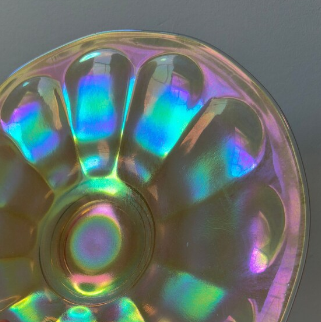
Carnival Glass

Its so pretty with that rainbow of colours. Like a puddle at the service station (cars) which has had gasoline fall into it. I wondered about it and finally looked it up.

Carnival glass is moulded or pressed glass to which an iridescent surface shimmer has been applied. It has previously been referred to as aurora glass, dope glass, rainbow glass, taffeta glass, and disparagingly as 'poor man's Tiffany'. The name Carnival glass was adopted by collectors in the 1950s as items of it were sometimes given as prizes at carnivals, fetes, and fairgrounds. Purchased by households to brighten homes at a time when only the well-off could afford bright electric lighting, as its finish catches the light even in dark corners. Reached the height of its popularity in the 1920s.

Carnival glass gets its iridescent sheen from the application of metallic salts while the glass is still hot from the pressing. A wide range of colours and colour combinations were produced; scarcely used colours can command very high prices on the collector market.

Carnival glass originated as a glass called 'Iridill', produced beginning in 1908 by the Fenton Art Glass Company (founded in 1905). Inspired by the fine blown art glass of such makers as Tiffany and Steuben, but did not sell at premium prices. Iridill pieces were used as carnival prizes.

Iridill became popular and very profitable for Fenton, which produced many different types of items in this finish, in over 150 patterns. Fenton maintained their position as the largest manufacturer and were one of very few makers to use a red coloured glass base for their carnival glass. After interest waned in the late 1920s, Fenton stopped producing carnival glass for many years. In more recent years, due to a resurgence in interest, Fenton restarted production of carnival glass until its closure in 2007.

Summary from Wikipedia

Posted on . Filed in . Tagged with , , .

About Laura Brown from Inherited Values Site

I think I wrote this before 2009. I'm not sure. I looked up the Inherited Values site with the Wayback Machine today. My friend, Deanna, created, ran, everything, the site. I wrote for her for awhile. Mostly posts about hobbies and collectibles.

I try not to gamble or collect things because I know this is a hazardous area for me. I seem to be one of those people who become obsessed with everything, at least for awhile. I also like to try almost everything – everything is fodder for my curiosity. I especially like arts, crafts and history.

On Flickr I have my photos of abandoned farm houses and many other abandoned or just old places. I have two Flickr groups: Ontario Rural Ruins and Canadian Rural Exploration.

Does the house in the photo look haunted to you? To me it has the mystery, romance and bluntness of history and craftsmanship. With a side of weathering and pure determination to survive the elements. I do have some feelings about the paranormal but I don’t look for them in an old house or building. I have yet to feel anything spooky when I explore. Though I did once shriek when I thought I had stepped on a toad in the long grass.

There are some things I collect: bone china posies, postcards and odd other things which aren’t coming to mind right now. I don’t keep them very organized or catalogued and I don’t join groups with other collectors with the idea of trading or buying more. I just like the randomness of a great find. I should have been an archaeologist, except I’m allergic to dust, mold and mildew. To me, the value of a collectible is in the finding of it as much as the beauty of it. I shop at thrift shops but not gift shops.

I love history. History I can reach out and touch is as close to time travel as I may ever get. As a Pagan (Earth Witch) I feel connected to history, it’s traditions and the foundations it has given us. The invention, ingenuity and thriftiness that early people had to develop to survive, that is what I see when I look at old objects and old buildings. I also treasure the art and crafts which have endured into the present. Objects which we no longer use and may not even know how to use any longer. Sometimes I feel a sense of loss for the road not taken and the knowledge lost to us. I like to read about odd crafts, new crafts and hobbies too as these are our own contributions to what will become history in time.

When not out taking photos of derelict farm houses I am writing on the web. My own little monster project is Word Grrls. My main site is ThatGrrl.ca. Most of my other projects link from there.

If you Twitter I am @thatgrrl. If you StumbleUpon I am thatgrrl and if you Tumblr I am also thatgrrl. Nice how that all works out.

Posted on . Filed in . Tagged with , , , , , , , , , , , , .

Mail Art and Mail Artists

Posting and saving information about mail art and artists. It doesn't seem like it will be around in another generation or two. Like so many interesting art forms which evolve or devolve with technology. I used to collect postcards and write letters to pen pals from all over the world. At that time I was making mail art and finding interesting things which could be sent in the mail to friends. I haven't created any mail art in awhile. I liked learning the limitations and finding what could be done to work around them or find a new idea to work with them. Like a puzzle.

MailArt 365 - Twitter - Facebook - Flickr

International Union of Mail Artists

The site for the Envelope Collective is gone and so is a page which had been on Wikipedia.

The Envelope Collective is an ongoing collaborative art project that uses mail as a medium. The Envelope Collective was founded by Garrett Miller and Adam Morse on November 3, 2005. Anyone can send anything to the Envelope Collective; people from all over the world have sent in everything from boxes of Kraft Mac and Cheese to handmade paper envelopes.

Source for the post below: Lisa Vollrath

The Art is in the Mail

The simplest definition of mail art is that it is any art that's created with the intention of sending it through the mail. Mail art can include postcards, faux postage, decorated envelopes, friendship books, and the ever popular naked mail. If you have to mail it to complete the creative experience, it's mail art!

Mail Art Culture

When it comes to the making of mail art, there are very few rules. However, most mail art projects have these similarities:

  • No money exchanges hands. In general, mail art is exchanged between artists, not bought and sold. There aren't usually fees involved to participate in mail art projects.
  • Mail art is given freely, without the expectation of something in return.
  • No judgements are made about the artwork or its quality. You get what you get.
  • Once the envelope has been dropped into the mail, forget about it.

Postcards

Postcards are probably the most popular form of mail art. Handmade, altered, or trash postcards are often exchanged between mail artists, either one on one, or in organized swaps or exchanges. Perhaps postcards are so popular because they are already a type of mail, and are so easily sent, without packaging, and with minimal postage.

Postcards are often used in mail art exhibitions, with are organized through mail art calls. The project organizer puts together a theme and a venue for display, and posts the call to creative groups focused on mail art. Interested artists mail in a postcard, to be included in the exhibition. Sometimes, they receive another postcard in return, or a visual listing of the pieces in the exhibition, known as documentation.

One of the most well-known postcard projects is Post Secret. Since 2005, the project organizer has asked readers to mail him an anonymous postcard with a secret written on it, to be posted on the Post Secret blog. Hundreds of postcards have been sent in and posted, and the project has spawned several books.

Postcrossing is a site designed for those interested in sending and receiving postcards. Rather than matching senders and receivers, the site is set up so that your postcard is assigned a number, and when your card is received and logged by the recipient, your name is put into the queue to receive the next postcard sent.

Artistamps

Artistamps go by several different names: faux postage, postoids, or cinderellas. These terms are used to describe an artist-created stamp that is not used as real postage. In fact, one of the rules of using artistamps is that they must not be substituted for real postage, or used in any way that attempts to defraud the Post Office.

Faux postage stamps are created in a variety of ways, but the most popular method to create them is using a computer for design and layout, and then either printing on paper that is pre-perforated, or perforating the printed sheets afterward. Stamps can be created in sheets or individually, or even to mimic the commemorative issues put out by the Post Office.

Decorated Envelopes

The tradition of sending decorated envelopes has long been practiced by mail artists. The envelopes themselves have evolved into their own form of mail art, often sent through the mail with little or nothing in them. Integrating the sender and recipient addresses, and the postage required to send the envelope, is often an integral part of the envelope's design.

One of the longest running decorated envelope project is The Graceful Envelope, sponsored by the Washington Calligraphers Guild. Each year since 1995, artists have decorated envelopes according to the annual theme. The best envelopes selected in several categories are put on display in Washington, DC.

Naked Mail

Sometimes known as extreme mail art, naked mail is the sending of odd items through the mail without any packaging. In my years as a mail artist, I've received beach balls, flip-flops, a plastic severed hand, a giant plastic crayon bank, a large pink piggy bank, baby bottles, and liter and two-liter bottles filled with all manner of items.

One of the objects of naked mail is to surprise postal employees. Taking the items to the post office window to be weighed and have postage attached, and receiving the naked mail items from your regular postal carrier are part of the naked mail experience.

One of my favorite types of naked mail is the plastic bottle mailgram. A clear plastic bottle is filled with items the recipient might enjoy, and mailed without packaging. Instructions for making plastic bottle mailgrams that fill easily, and will pass through most US post offices are posted here at Go Make Something.

Artist Trading Cards

Artist trading cards, or ATCs, are small-format artworks exchanged between artists. Unlike other types of mail art, artist trading cards do have a few rules. They must be created on a 2-1/2" x 3-1/2" surface, and must fit into a trading card sleeve, which is a clear pocket designed to hold baseball trading cards.

Although artist trading cards originated as a way for artists to meet face-to-face to exchange work, with the rise of the Internet came endless numbers of groups where artists can exchange cards by mail. One of the largest groups online focused on exchanging artist trading cards is ATCsForAll, where you'll find dozens of open swaps at any given time, and thousands of people willing to do a one-on-one exchange.

Trashpo

Trashpo is short for trash poetry, a concept that originated with visual poet Jim Leftwich. In 2005, Leftwich dumped a wastebasket onto a scanner, and posted photos of the random poetry this created. Trashpo is a form of visual poetry, based on random, found arrangements of letters, words, and images. In its very broadest sense, trashpo is art made from garbage.

The trashpo community has its own words to describe the types of work this concept has spawned, and they are as unique as the artists who create them. For example:

  • Cerealism is trashpo made from cereal boxes.
  • Listpo is list poetry made using found lists, like shopping lists.
  • Scannerbed composition is a method of creating trashpo by dumping trash on a scanner and scanning it.

IUOMA

The International Union of Mail Artists (IUOMA) was founded in 1988 by Dutch artist Ruud Janssen. IUOMA has been the center of the online mail art universe for many years, moving from site to site, but keeping many of the same core members and ideals. There are currently over 3,500 members online, and the web site is one of the largest repositories of mail art calls and images of mail art. New members are welcomed heartily, and there is no charge to join or participate in the many projects going at any given time.

Mail Art on the Internet

Examples of various types of mail art are abundant online, but seem to move around and disappear quickly. This collection of sites represents the links I was able to capture the last time this page was updated:

  • Mail Me Art is a mail art documentation project. Viewers send mail art, and the recipient blogs what has been received. The project has spawned several exhibitions.
  • The Mail Art Pool on Flickr has gone silent in recent years, but people are still adding their photos to the pool.
  • The Electronic Museum of Mail Art has several galleries of mail art, including a small collection of artistamps by various artists.
  • Com`post Mail Art displays the work of German artists who have participated in mail art projects for over 20 year. There isn't much text to describe the collections, but there are lots of photos.
  • 1000 Journals was an art journal project that happened by mail. The project's originator sent out 1000 blank journals, and they were passed around using an online queue system. The project is finished, but the photos of journals remain posted.
  • Mail Art Projects is a blog maintained by 100 members of IUOMA. It posts mail art calls from all over the world.
Posted on . Filed in . Tagged with , , , , , , , .

Rocks to Mark the Traveler's Path

I'm interested in rocks and art made with rocks, stones or pebbles: buildings, bridges, cairns, Inukshuks, and rock balancing. The old stone farm houses are my favourite to see and photograph in rural Ontario.

Rocks are used as a way to mark the path of travelers, to tell others they had passed that way. It's not just a romantic notion. There are good, practical reasons for wanting people to know where you have gone and where you might be found. Hikers get lost, have accidents and run ins with wildlife.

I like the custom of putting little pebbles on graves to mark that you were there, still remembering and still visiting.

Posted on . Filed in . Tagged with , , , , , , , .

Kaleidoscope

One of the old, odd and curious devices children had in the 1970's (not just then, but that's when I had one) is the kaleidoscope. I have no idea where mine ended up. It was a cardboard tube with plastic beads inside the end. As you turned the tube the beads rolled around and created different patterns when you looked through the lens at the top. I think it would be related to those keyhole/ pinhole cameras. Do I have that name right? I read about them years ago.

I've seen some variations in kaleidoscope styles. Some have little gems inside, instead of beads, or something else entirely. The one I would have like to buy (and try) was a natural DIY kaleidoscope which you could put anything flat enough to fit in and view it. The ad showed flowers, bits of leaves and other things found outside. Not rocks mostly likely, they would scratch it and be too large to fit. I found several of this kind on Amazon and elsewhere but none were shipped from Canada, or at least from Amazon itself. Also, I thought they should have a nicer wood and finish. They look a bit too cheap, as they are.

Amazon kaleidoscope link.

Vintage kaleidoscopes had interchangeable gears/wheels/discs to switch out. Others I found had a glass marble at the end of the tube, some were able to change those too. Yet more are artsy and individual looking, and even more expensive. What really matters is what you see when you look through.

I want lots of colours and different shapes. A few only had black and white, which was interesting but not as pretty. More colours and, of course, more shapes, will give the kaleidoscope more patterns. If you have one, try to turn the scope just a tiny bit and what the colours and shapes twitch just the least little bit. I would try to keep an eye on one particular bead and follow it.

Life is like a kaleidoscope, a slight change and all patterns alter.

The Brewster Kaleidoscope Society

Kaleidoscope from Wikipedia:

A kaleidoscope (/kəˈlaɪdəskoʊp/) is an optical instrument with two or more reflecting surfaces (or mirrors) tilted to each other at an angle, so that one or more (parts of) objects on one end of these mirrors are shown as a symmetrical pattern when viewed from the other end, due to repeated reflection. These reflectors are often enclosed in a tube, usually containing on one end a cell with loose, colored pieces of glass or other transparent (and/or opaque) materials to be reflected into the viewed pattern. Rotation of the cell causes motion of the materials, resulting in an ever-changing view being presented.

History

Multiple reflection by two or more reflecting surfaces has been known since antiquity and was described as such by Giambattista della Porta in his Magia Naturalis (1558–1589). In 1646, Athanasius Kircher described an experiment with a construction of two mirrors, which could be opened and closed like a book and positioned in various angles, showing regular polygon figures consisting of reflected aliquot sectors of 360°. Richard Bradley's New Improvements in Planting and Gardening (1717) described a similar construction to be placed on geometrical drawings to show an image with multiplied reflection. However, an optimal configuration that produces the full effects of the kaleidoscope was not recorded before 1815.

In 1814, Sir David Brewster conducted experiments on light polarization by successive reflections between plates of glass and first noted "the circular arrangement of the images of a candle round a center, and the multiplication of the sectors formed by the extremities of the plates of glass". He forgot about it, but noticed a more impressive version of the effect during further experiments in February 1815. A while later, he was impressed by the multiplied reflection of a bit of cement that was pressed through at the end of a triangular glass trough, which appeared more regular and almost perfectly symmetrical in comparison to the reflected objects that had been situated further away from the reflecting plates in earlier experiments. This triggered more experiments to find the conditions for the most beautiful and symmetrically perfect conditions. An early version had pieces of colored glass and other irregular objects fixed permanently and was admired by some Members of the Royal Society of Edinburgh, including Sir George Mackenzie who predicted its popularity. A version followed in which some of the objects and pieces of glass could move when the tube was rotated. The last step, regarded as most important by Brewster, was to place the reflecting panes in a draw tube with a concave lens to distinctly introduce surrounding objects into the reflected pattern.

Brewster thought his instrument to be of great value in "all the ornamental arts" as a device that creates an "infinity of patterns". Artists could accurately delineate the produced figures of the kaleidoscope by means of the solar microscope (a type of camera obscura device), magic lantern or camera lucida. Brewster believed it would at the same time become a popular instrument "for the purposes of rational amusement". He decided to apply for a patent. British patent no. 4136 "for a new Optical Instrument called "The Kaleidoscope" for exhibiting and creating beautiful Forms and Patterns of great use in all the ornamental Arts" was granted in July 1817. Unfortunately, the manufacturer originally engaged to produce the product had shown one of the patent instruments to London opticians to see if he could get orders from them. Soon the instrument was copied and marketed before the manufacturer had prepared any number of kaleidoscopes for sale. An estimated two hundred thousand kaleidoscopes sold in London and Paris in just three months. Brewster figured at most a thousand of these were authorized copies that were constructed correctly, while the majority of the others did not give a correct impression of his invention. Because so relatively few people had experienced a proper kaleidoscope or knew how to apply it to ornamental arts, he decided to publicize a treatise on the principles and the correct construction of the kaleidoscope.

More than you wanted to know, but its still interesting to read. The Wikipedia link has more.

Instructables has a fancy kaleidoscope to make. Not one of the simpler cardboard types.

I wonder if there is some kind of digital kaleidoscope? A software program. I didn't look for one, but I'd be surprised not to find something like that.