Posts tagged with “built heritage”
Posted on . Filed in . Tagged with , , .

Vestigial Architecture

I can remember a farm house here in Ontario with a tall light post covering most of the house, sheds, and barn area - still working. Somehow, long after the rest of the property was far into decay and ruin. Were lightbulbs just made so much better long ago? I'd be surprised if the power were still on, but it must have been. I don't think of it as some ghost story, just vestigial architecture. I thought it was a good phrase to remember.

Vestigial architecture works better than Thomassons.

I was fascinated by this recent podcast and article over at 99% Invisible about “Thomassons,” architectural elements on structures or properties that no longer have a function and yet are maintained. These architectural leftovers–stairways leading to nowhere, boarded-up or bricked-up windows, telephone poles that no longer carry lines–are named after Gary Thomasson, an American baseball player who played for the Yomiuri Giants in Tokyo, Japan in the early 1980s. Thomasson was paid exorbitant amount of money for a two year contract, but lost his game in Tokyo and was benched for much of his contract (i.e. he had no function, but was maintained…ouch).

via Rustbelt Anthro. Thomassons: Vestigial Architecture

Posted on . Filed in . Tagged with .

Lighthouses

Note - This was originally posted to a friend's site which has been taken down. The links have not been checked since 2015.

What is it about lighthouses that draws people? People collect lighthouses figurines. People paint and draw lighthouses. People will stop to photograph a lighthouse even when there could be something else more interesting which they did not even notice in the shadow of that mystical, lonely, stark looking building poking the sky.

I think it is the romance, mystery, history and the feeling of adventure -- surviving storms at sea and pounding waves. The idea of steadfast lighthouse keepers, daring rescues and pirates hiding their treasure exposed in the roving splash of a beam of light.

They are kind of fun to draw. Even more fun to be down at the water, hearing it, smelling it.

Photo Galleries of Lighthouses:

Lighthouses as Art:

Lighthouses Visited/ Documented:

Posted on . Filed in . Tagged with , .

Save Our Lighthouses

Marc Seguin has posted lighthouses at risk and lighthouses already lost.

Posted on . Filed in . Tagged with , .

The Challenges of Saving Lighthouses

This is reposted from Swallowtail Keepers Society blog. The blog is abandoned but the post is worth saving. Far more involved with saving lighthouses than I would have thought. (I did think about the weathering).

Lighthouses are usually located in the face of storms, exposed on several sides to strong winds and sea spray, frequently difficult to get to and challenging to maintain. With lighthouses de-staffed or de-commissioned, budget cuts rampant, and maintenance minimal, it is hard to see these once well-maintained structures deteriorate to a point that they begin to crumble but it is becoming all too common. The magnitude of the maintenance or restoration, and the ability to get to the lighthouse is often overwhelming. We have been fortunate with Swallow Tail that ownership has been transferred, access is challenging but better than many, and through the support of the community and access to various sources of funding, restoration work has been possible.

Unfortunately, in five months, three other lighthouses in the Maritimes have disappeared. Two collapsed during storms, the abandoned Fish Fluke Point on Ross Island decommissioned in 1963 but defied gravity for years (November), and Church Point on St. Mary's Bay, NS, decommissioned in 1984 (March), and one burned to the ground, the remote fibreglass lighthouse at Point Aconi on Cape Breton Island (February). Fire was always a worry before lights were electrified. Elodie Foster, one of the light keepers at Swallow Tail, died from her injuries after her clothes caught fire while trying to start the burner for the light. More recently, electrical issues may be the cause of some fires because of the heavy salt presence and corrosion of electrical connections. Two electrical issues at Swallow Tail threatened to cause fires last fall and had no one been working in the lighthouse, the problems would have gone unnoticed until it was too late. Vandalism has also been a cause of some fires and has plagued locations such as Partridge Island in Saint John, and may have been the cause of the grass fire at Swallow Tail in April, 2007, which threatened the lighthouse and keepers house. It has prompted some communities to install security cameras. The ones at Swallow Tail can be viewed on the Village of Grand Manan website (www.villageofgrandmanan.com).
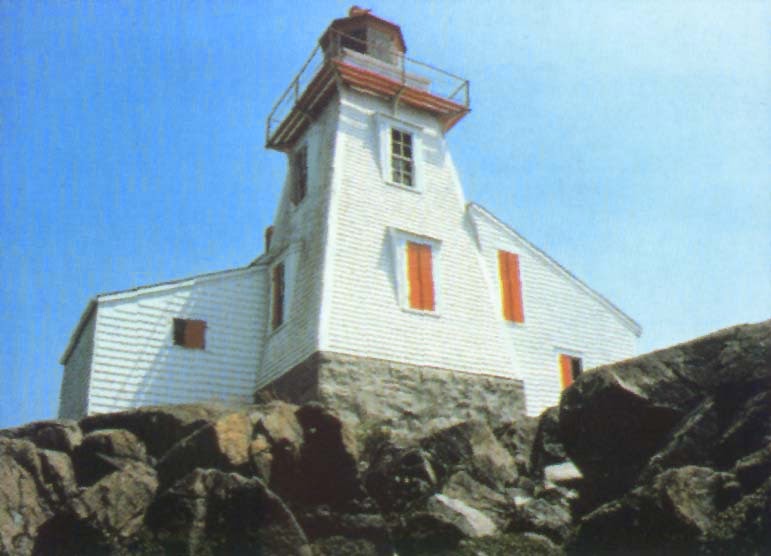
Fish Fluke Point lighthouse in better days.  (unknown origin of photo)

Collapsed Fish Fluke Point lighthouse as seen from the air in November 2013.

Church Point lighthouse before collapse. (from CBC.ca)

??

Church Point lighthouse after collapse, 27 March 2014. (from CBC.ca)

Point Aconi lighthouse before it and the building beside it, burned to the ground in February, 2014. (from Cape Breton Post)

Collapse was not thought to be an issue at Swallow Tail but once work began last fall, it became apparent that it could have been possible. The lime had eroded out of the mortar, making the mortar crumble. The stone foundation was slowly pancaking, with the stones being pushed outward. The eight guy wires and the massive concrete floor in the equipment room were the only things holding the tower upright with probably only five large stones in the foundation carrying weight. Had any of the guy wires failed, the tower would have begun listing or worse. To fix this, all the stones were removed, one side at a time, and then returned with new mortar between the joints. The large corner stones, too heavy to easily lift, were adjusted back into place. The foundation is now functional again and should last for many more years with minimal maintenance.
???

Peter Devine rebuilding stone foundation at Swallow Tail, September 2013.

During this process, it was discovered that the large wooden beam under the front door had completely rotted away. The remains of the beam were removed using a dust pan. Instead of trying to fit a new wooden beam back in a very tight space between the large immovable concrete step, stone foundation and the floor joists, a concrete beam was constructed. One of the 1859 wooden pegs, used to hold the heavy timber structure together, was discovered in the crawl space during the work, looking the same as the day it was made. This was the only spot were the heavy timbers of the lighthouse had completely rotted.

???

Rotted timber beam under front entrance, September 2013

New concrete beam to replace rotted timber, September 2013.

Salt corrosion is another challenge, rusting nails so they no longer do their job. When some shingles were removed on the northern side of the bell house, the boards underneath came off as well. This was also an earlier problem with the boathouse and the entire southern wall began to fall off in large pieces as the nails disappeared and that wall had to be rebuilt. The shingles were stripped off the bellhouse, the boards renailed, and new shingles returned. Shingles on some sides of the tower were also falling out because the nails were gone. Face nailing to hold them in place during previous work only complicated the problem with water getting behind the shingles and rotting the wood. Several places on the tower, notably where the windows had been boarded up, were in worse shape than the rest of the lighthouse, even though the boards were only 40 years old compared to over 150. As the rot continued, longer nails were used to hold the shingles which further exacerbated the problem. It was very noticeable while scraping the sides where the problems were located because of the sponginess. Replacing the rotted wood and shingles where required, caulking the nail heads, plus one to two coats of primer and two coats of finish paint will prevent this for a few years. Because of the extreme weather conditions experienced on the point we hope in the future only the paint will suffer and not the wood behind.

???

Northern wall of the bell house.  The nails had rusted off and the boards had to be nailed back in place before the shingles could be attached.

Areas on the lighthouse that needed repair because of water penetration causing rot.  The area around the fog horn was because of caulking and flashing failures.  The upper area on the tower was probably because of face nailing shingles allowing water to penetrate.

?

Custom blade on paint scraper.

The entire lighthouse and bell house were scraped, primed and received two coats of paint.  The new shingles were primed twice.

Removing the windows in the tower in the 1970s was actually beneficial in many respects since there was little maintenance after the lighthouse was destaffed, but it changed the interior with no natural light or ventilation. Having the opportunity to return the windows to the original locations in the lighthouse was a goal during the restoration but a challenge since everything had to be built from scratch. One window could not be returned because the current fog equipment is located in that spot on the first floor. Windows from an 1849 house in Ontario were donated by the owners, who had once worked at a lighthouse in British Columbia. They were honoured to have them reused at Swallow Tail. The storms and gablets (or dormers) were new construction from mahogany with copper flashing and sills in an attempt to resist the harsh climate. The interior has been completely changed with the additional of natural light and makes it a very pleasant inside.

??

Reglazing 1849 windows donated for the lighthouse.  The bottoms had to be cut down to 8 from 12 panes.  New glass was installed in each window.

Window unit - gablet with storm, all new construction.

?

Windows restored on the southern side of the lighthouse.

The harsh winter weather stopped work in mid-December at the lighthouse. Work will begin again sometime in April. The windows and interior will be completed including repairing the lathe and plaster and painting, the boardwalk from the keepers house (cabled in place to protect it from the strong winds) will be built, and museum displays installed. We are hoping to have the lighthouse open again this summer. Restoration work could not have been possible without the financial assistance of the Atlantic Canada Opportunities Agency, Regional Development Corporation, New Brunswick Built Heritage, Village of Grand Manan, Grand Manan Rotary Club, and generous donations.

Posted on . Filed in . Tagged with , , , , .

A Tribute to Jeff Chapman: RIP Ninjalicious

Jeff Chapman (1973 - 2005) #RIPNinjalicious

Jeff Chapman was a Canadian urban explorer, known as Ninjalicious. Jeff published Access All Areas and the founder of Infiltration, zines and website.

"It's the thrill of discovery that fascinates me. Yes, I know I'm not the first person there, but I can honestly say I found it and I earned the experience for myself. After exploring for a while, you get a wonderful feeling that you're "in on" the secret workings of cities. You know what's under your feet and what's behind the closed doors and what the city looks like from the highest office towers, while almost everyone around you only ever looks at the public areas and never truly pays attention to urban structures unless they've paid admission to take a look." - Jeff Chapman/ Ninjalicious

Source: Interview at Philadelphia City Paper with Neil Gladstone (1998?)

This month, August 2015, marks ten years since Jeff Chapman passed away. I thought someone should post in his honour. I never met him personally. I did email with him, twice. I met his wife, Liz, at a Broken Pencil Zine Festival in Toronto.

I attended the Festival to buy Access All Areas: A User's Guide to the Art of Urban Exploration, see some of Jeff's (and other publishers) zines and take a look at the Gladstone Hotel in Toronto. I was just beginning to explore with a digital camera then. Before that I just didn't know what I was doing had a name (and film was expensive!).

A tribute can still be found at the Toronto Architectural Conservancy 

Jeff Chapman (September 19, 1973 -- August 23, 2005), better known by the pseudonym Ninjalicious, was a Toronto-based urban explorer, fountaineer, writer and founder of the urban exploration zine Infiltration: the zine about going places you're not supposed to go. He was also a prominent author and editor for YIP magazine, as well as its website, Yip.org. Chapman attended York University in the early 1990s and later studied book and magazine publishing at Centennial College. He went on to serve as Editor at History Magazine and as Director of the Toronto Architectural Conservancy board.

Chapman died of cholangiocarcinoma on Tuesday, August 23, 2005 --- three years after a successful liver transplant at Toronto General Hospital (a location he loved to explore). He was 31 years old.

Source: Wikipedia: Ninjalicious

Toronto's own late Jeff Chapman (a.k.a. "Ninjalicious") published his first printed issue of Infiltration, "The zine about going places you're not supposed to go," in 1996. Though Toronto may not live in the imagination of people around the world, Chapman made this city's sewers famous for his global readers. His work lives on in Access all Areas, his book published just before his death to cancer in 2005, and at infiltration.org.

Source: Shawn Micallef: Getting to know Toronto's sewers

Under the alias Ninjalicious is where Jeff made his biggest mark. In his early twenties he spent long periods of time in the hospital battling various diseases. Often bored, he and his IV pole would go exploring the hospital, investigating the basement, peaking behind doors, looking for interesting rooms and equipment. It was here his love for the under explored side of buildings developed, and upon returning to health he created Infiltration -- the zine about going places you're not supposed to go.

Infiltration has had a profound influence on urban exploration in Toronto and around the world, as evidenced by the hundreds of tributes left for him in the Urban Exploration Resource forum. Ninjalicious had a strong code of ethics which he promoted, including no stealing or vandalizing while exploring. Issue 1, all about Ninj's beloved Royal York Hotel, was published in 1996, and the zine was continually published throughout the years ending most recently with Issue 25: Military Leftovers.

Source: Sean Lerner: Torontoist: Death of a Ninja

About ten years ago I was in a Toronto bookshop and found a copy of Infiltration. Subtitled "the zine about going places you're not supposed to go", it was devoted to the escapades of the author, Jeff Chapman --- or "Ninjalicious", to use his nom de plume --- as he explored the many off-limits areas in famous Toronto buildings such as the Royal York hotel, CN Tower, or St. Mike's Hospital. In each issue, Chapman would pick a new target and infiltrate it --- roaming curiously around, finding hilarious secrets, then describing it with effervescently witty delight. Chapman had the best prose of any zine author I've read anywhere. Many zinesters are clever, of course, but Chapman wrote with a 19th-century literary journalist's attention to detail; nothing escaped his notice, from the relative fluffiness of the towels in executive lounges to the color of the rust pools in a mysterious, hangar-sized room buried below Toronto's subway system.

Source: Clive Thompson: Collision Detection: R.I.P. "Ninjalicious" --- the founder of urban exploration

infiltration The zine about going places you're not supposed to go, like tunnels, abandoned buildings, rooftops, hotel pools and more.

Source: Infiltration

See also:

cancon
what is it that attracts you to going where you're not supposed to go?

Ninjalicious
Healthy human curiosity about the workings of the world I live in, of course. I mean, it's free, it's fun and it hurts no one. A harder-to-answer question would be: why doesn't everyone?

cancon
what are the tools of your trade?

Ninjalicious
Usually I travel very lightly, with a pen, paper, a Swiss army knife, a camera and a flashlight. That's about all the equipment I need to have a good time in 90% of the places I visit. I take along more specialized equipment, such as rubber boots or various props, for specific targets.

Source: Cancon Interview with James Hörner