Posts tagged with “Barrie”
Barrie Ontario Ghost Tour Destinations
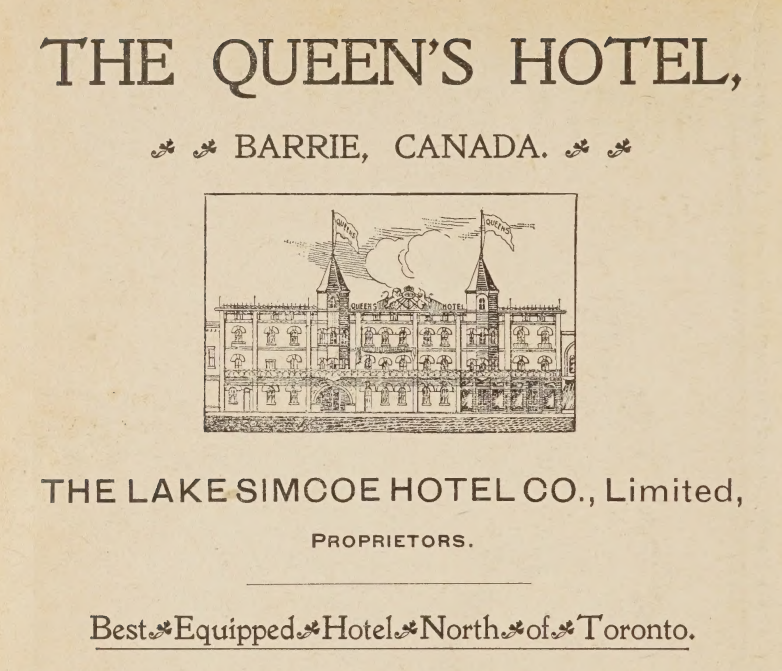
I've got the idea to write a book about places in Barrie, Ontario which are forgotten, lost, unknown, mysterious, "haunted", or otherwise have a good story to be found. I've seen people creating, publishing, and selling books with Amazon. I'm not sure how it works, I have just started with the idea and have a lot to find out. For now, I'm gathering information. I even found an old photo of the Queen's Hotel in Barrie, in an old cookbook from the volunteers at the Victoria Hospital in 1900.
Starting point: The Old Jail (The shadow of Mulcaster Street) Location: 87 Mulcaster St (Site of the former Simcoe County Jail and now a parking lot/site of the new courthouse).
The Story: A classic of Barrie lore. This jail, built in the 1800s. While it was primarily a detention facility, executions were carried out here when Canada still had the death penalty. Security guards who worked at the old jail have reported plenty of unsettling experiences.
What to Look For: The area itself, especially at night, reportedly has an unnerving atmosphere. You're standing where generations of criminals, and some believe, their tormented spirits, spent their final days. The chilling reality of this former institution is often enough to send a shiver down your spine.
Stop two: Barrie Public Library (The Carnegie's quiet guard) Location: 37 Mulcaster St (now the MacLaren Art Centre).
The Story: The original Beaux Arts-style library building was constructed in 1915 with an Andrew Carnegie Foundation grant. Though the current library is elsewhere, the heritage building on Mulcaster is rumored to be home to an elderly ghost. Many say it is a dedicated former staff member or patron. People have reported objects moving on their own and feeling unexplained cold spots. Given its long life as a public building, it's not surprising a few old souls decided to stick around.
What to Look For: Stand outside the old building on Mulcaster (or the new one if you're closer) and think about what kind of person would be so dedicated to books they'd linger after death.
Stop three: Meridian Place and the Lakeshore (The waterside whisper) Location: Meridian Place, at the foot of Dunlop Street.
The Story: This area is the terminus of the historic Nine Mile Portage, a crucial route for Indigenous people and later for fur traders and the military during the War of 1812. The lake itself has a tragic past, with shipwrecks and drownings occuring over the centuries on the icy waters of Kempenfelt Bay. Legend has it that the spirits of those lost to the water, be they soldiers, early settlers, or victims of accidents, can sometimes be heard in the wind coming off the bay, a cold, mournful whisper over the square.
What to Look For: As your walking by this haunted tour stop, feel the wind coming off the water. Consider the hundreds of years of transit, trade, and tragedy that have occurred right where you're standing.
Stop four: The Queen's Hotel (The unfortunate groom) Location: 94 Dunlop Street East (The current site of the Queen's Hotel).
The Story: Legend goes that the Queen's Hotel is forever tied to the sad and mysterious death of Gertrude Small and her husband Warren Bell. Warren was an electrician who had worked at the Queen's Hotel. Just one day after their wedding, both Gertrude and Warren died in a tragic car accident that ended in the Nottawasaga River. Although the official verdict was accidental drowning, there were sensational rumors of a conspiracy surrounding Gertrude’s considerable inheritance.
What to Look For: While the main tragedy didn't happen right here, some say that Warren's ghost has been seen in and around the hotel, perhaps still doing his work or perhaps waiting for his bride.
Stop five: The Collier Street haunting (A stately specter) Location: 58 Collier Street (Site of a former medical office, near Trinity Anglican Church).
The Story: Collier Street is one of the oldest streets in Barrie, running parallel to Dunlop. Many historic homes and early professional offices once lined this road. The old Victorian house at 58 Collier, served as the medical office for Dr. W.A. Lewis (a former associate coroner) for years, residents and staff have reported unusual activity.
The building, now a business, is said to be haunted by a polite, formal specter. Workers in the area have reported seeing an apparition of a gentleman, formally dressed, who simply appears and then vanishes, seemingly just going about his business in the stately old building. This ghost is believed to be the spirit of a former doctor or prominent resident who is simply attached to his professional home. It's less a tale of tragedy and more a classic residual haunting of a person of habit.
What to Look For: Unlike the emotionally charged tales of Elizabeth Meyer (which we talk about soon) or the violent past of the Jail, this is a suspected residual haunting … an imprint of a past routine. Look for any faint, fleeting motion or shadow in the windows, representing a spirit still tied to the place of his daily work, as you check out this haunted walking tour stop.
Stop six: The Five Points (The scarred corner) Location: The intersection of Dunlop St. E/W, Bayfield St., and Clapperton St.
The Story: While not a single haunted building, this historic junction is the scarred heart of Barrie's past. The surrounding buildings, particularly those on the corners, were repeatedly destroyed by devastating fires throughout the 19th and 20th centuries. This corner has been the site of businesses, hotels, and busy human activity for nearly 200 years.
Places that have experienced multiple devastating fires are often associated with residual energy and bad luck. Stand here and imagine the chaos, the heat, and the panic of a city being destroyed by fire. Some say that on a still night, you can faintly hear the muffled screams of warning or the clatter of fire bells from a century ago, echoing the trauma of the area.
What to Look For: Notice the varying ages of the buildings around you … the oldest ones that survived the flames are the most likely to have uninvited guests.
Stop seven: The Simcoe Hotel (Elizabeth's unfinished justice) Location: The corner of Bayfield Street and Dunlop Street East.
The Story: The site of the Simcoe Hotel was a major focal point in the 19th century. This area is strongly connected to the tragic story of Elizabeth Meyer. In January 1872, Elizabeth was found lifeless at the front entrance of the Simcoe Hotel on a brutally cold night. Her death was ruled as accidental, but a lingering mystery remains about the exact circumstances … did she fall? Was she pushed?
The Haunting: Local lore suggests Elizabeth is not resting easily. It is believed her spirit is still attached to the area, seeking justice for her mysterious death. Staff and those who frequent the vicinity have reported a chilling female presence, as if being watched by someone who desperately needs to share a secret.
What to Look For: This stop connects directly to the chaos of the Five Points, so pause here and reflect on the individual human tragedy that occurred amidst the grand history of the hotels. The spot is very close to the newer development, making the old, tragic history all the more unsettling.
Final stop: The Farmhouse (The suicide at the YMCA) Location: The Farmhouse Restaurant, 3480 Yonge St (A short drive south of downtown).
The Story: Originally built in 1890, this building has a rich history as a YMCA and a "gentlemen's club" before becoming the popular restaurant it is today. The most famous piece of folklore centers on a former employee who tragically took his own life in the basement. It's rumored he still lurks, and employees have reported some very weird things. This is a classic local haunting with numerous firsthand accounts.
What to Look For: While you can't go ghost hunting inside (unless you're dining there!), the building's distinctive old architecture and deep history make it a fittingly eerie endpoint to your walk.
Barrie 360 - Barrie After Dark: A self-guided haunted walking tour
Working With the Barrie Historical Society
Barrie is a small city in Ontario, Canada. I'm the webmaster for the Barrie Historical Society. (The Barrie Society has closed/merged with Simcoe County Historical Society). I've just taken on the job, as a volunteer so the site is not quite ready for prime time yet. But, I wanted to share the historical photos/ postcards I have found of Barrie, so far. (It's also a good way to keep another back up copy of the images as I do find more to add).
The Barrie motto is on the coat of arms: People are the City.
A Bit About the City of Barrie's History
Barrie is a city on Kempenfelt Bay in Simcoe County, Ontario. Former and merged community names include Nine Mile Portage and Kempenfeldt. Allandale and Innisfil are not officially merged with Barrie but they share some resources and public services.
First Nations People used the western shores of Kempenfelt Bay to rest and stop over before continuing on the portage which linked Kempenfelt Bay through Willow Creek, connecting Lake Simcoe to the Nottawasaga River which flows (eventually) to Lake Huron.
Barrie's Military and Industrial Heritage
Barrie became a settlement with houses and warehouses in 1812. Barrie was a military outpost, an important supply depot for the British forces. The old portage route was used for communication, military personal, supplies and equipment to and from Fort Willow and Georgian Bay / Lake Huron.
In 1833 the community was named for British Admiral Sir Robert Barrie, in command of the naval forces in Canada and a frequent traveler along the portage route.
After the war Barrie thrived on industry. Huge trees were logged and shipped out to become masts for British ships and railway ties across Canada. During the winters massive blocks of ice were cut from Kempenfelt Bay then shipped down to Toronto, Buffalo and New York for refrigeration use. There were three warehouses to store the ice so it could continued to be kept and shipped out during the rest of the year.
In 1865 the railway connected Barrie to the City of York and all the growing industry the young Toronto.
The Barrie Tanning Company was the oldest industry and stood until being demolished in 1979.
Modern Barrie History
In the 19th century Barrie was a final stop in the underground railway, allowing slaves from the US to build new lives in Canada. Shanty Bay was named and developed from this.
In 1950 Highway 400 became an express route for commercial, business and personal travel between Barrie and the rest of central Ontario.
Minets Point (a popular beach and picnic area in the 1950's) had a dance hall which burned to the ground in the 1960's.
On 31 May 1985, one of the most violent and deadliest tornadoes in Canadian history, an F4, struck Barrie.
In June 1987 the sculpture, Spirit Catcher by Ron Baird, came to Barrie from Vancouver, B.C. where it had been part of Expo '86.
Barrie hosted Live 8 Canada in July 2005 at what was Molson Park and is now known as Park Place. Most of the site (stage, buildings and trees) has since been destroyed for commercial development.
Well-known residents have included Jeff Buttle, Olympics bronze medal winner for men's figure skating in 2006.
Fire has been a problem for Barrie's historical buildings in the past and has still been the cause of loss as recently as 2007 when the Wellington Hotel was lost due to arson. (The case is still ongoing).
In 2011, Barrie was the 34th largest city in Canada.
Barrie Places and People
I've Been Tagged!
 I am away in Newmarket. Lots sort of going on out here. My Mom bought a house in Barrie on Friday/ Saturday. I have only seen it from the street so far. Kind of having a bad/ interesting day today. Soon we are leaving to talk to the siblings (mine), have spaghetti dinner and play canasta. More going on than I want to talk about even inside my own head. Family can really kill you, suck you dry and make you feel it's all your fault. I'm not on the sunny side of optimism right now. You couldn't guess though, right? :)
I think I will be back on my own computer at some point over the weekend. I have some of my tax refunds back and am already looking at the computer bundles for sale. I really want a bundle as I am looking forward to a new thin monitor rather than the big clunker hoarding my desk space now. August is the best time to get a deal but I don't know if I can hold out that long. Silly not to and yet, when you really are looking forward to something this much, it's hard to wait.
Leigh has tagged me as a thinking blogger. Thanks Leigh. I will pull together a list of five blogs too. Blogs that make you come back to see if what they wrote the first time was who they really are. I know which blogs make me laugh but they aren't the same as those which make me think. Though smart humour is the best of all kinds. Sometimes it's great to find a site that stirs around the much just lurking in your brain. I really like a blog that gives me ideas.
So that is how things are going, pretty much sideways. It is possible I will be moving as soon as June. Not a lot of time left for Toronto. I'd stay if I could find something that would pay rent, groceries and bus fare with a bit left over for spending on non-essentials to prevent cabin fever and insanity in general. Sometimes retail therapy is needed even though I scoff at being a shopping grrl. I shop for new bed linens, books and other good things. I need more of those things about as much as I need a huge zit on the end of my nose. (I just got rid of one).