Posts tagged with “art”
Posted on . Filed in . Tagged with , , , , , , , .

Rocks to Mark the Traveler's Path

I'm interested in rocks and art made with rocks, stones or pebbles: buildings, bridges, cairns, Inukshuks, and rock balancing. The old stone farm houses are my favourite to see and photograph in rural Ontario.

Rocks are used as a way to mark the path of travelers, to tell others they had passed that way. It's not just a romantic notion. There are good, practical reasons for wanting people to know where you have gone and where you might be found. Hikers get lost, have accidents and run ins with wildlife.

I like the custom of putting little pebbles on graves to mark that you were there, still remembering and still visiting.

Posted on . Filed in . Tagged with , , , , , , , , .

Urban Combing and the Lost Art of Found Objects

The lost art of found objects. (It sounds great as a phrase but I don't think beach-combing (or urban combing) has ever been lost).

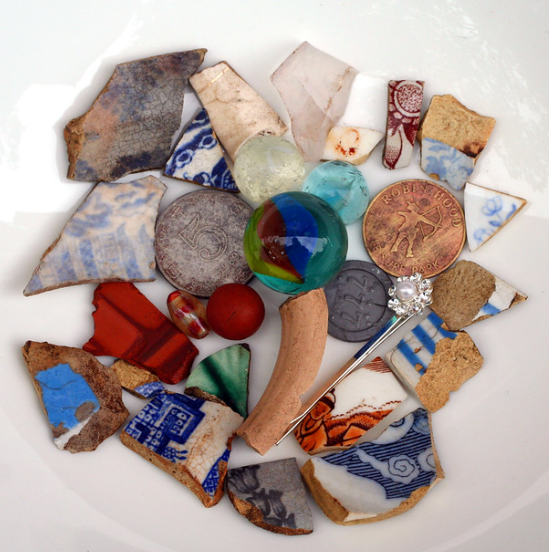
Every where you go there are little things to be found. Most people would call it bits of junk. But, its all in the eye of the beholder. An assortment of bits of things found while urban combing can build a whole story, or maybe become part of a creative project.

How to Start Urban Combing

You won't need to buy or carry around a metal detector. Keep something like a spare make up bag, a pencil case, or something smaller you can fit into your pocket or purse and use it to gather what you find. Get home and sort out (was dirt off) your findings. Make notes or start a scrapbook. Photograph the results of each excursion.

Urban combing can be a hobby, free and good for getting exercise strolling around the neighbourhood (or while travelling). Its psychogeography.

You're not walking off with someone's treasures just the little bits of flotsam and jetsam from urban life.

Like beach combing but in an urban setting.

Being a little land-locked, it's not possible to go beach combing in Long Eaton and urban combing is probably the next best thing. Here are lots of bits and pieces I recovered from my garden whilst digging the mud and also a few odds and ends from my walks with the dog.

Source: Urban Combing - Allison Giguere

Posted on . Filed in . Tagged with , , , .

Pixel Art and 8-Bit Artists

Pixel artists work with tiny dots, pixels. Created with the use of raster graphics software, images are edited on the pixel level. Pixel art is a style of digital art,

A pixel is one tiny dot of colour in an image. Pixel art then, is an image created with tiny dots. It is also known as low resolution art and 8-bit art.

An image created in the pixel art style is not usually smooth, like a photographed image. If you look, you can see the dots, especially around the edges. Comic books were created with pixel images so you could see the dots if you looked closely at those too.

Once an image is evolved past the pixel art level it gets that polished, finished look and (to me) it isn't really pixel art any more. It becomes computer generated or digital art. The main difference between pixel art and any other computer or digitally created art is that the artist works with the pixels, the actual dots which make up the image.

The word pixelated, in reference to an image, means the image is blurry - the pixels have too much space between them and have likely been stretched out due to the image being enlarged past the point it was meant to be shown.

Pixel art is coming back into use because it isn't a bandwidth hog the way a photograph or an image with higher resolution would be. So, for mobile technology, pixel art allows more images to be used because they take up less space in the memory and can be sent much faster too.

Pixel Art is Used for...

  • favicons
  • avatars
  • video games
  • low res images
  • dollz (pixel dolls)
  • and various other new, retro and developing places

Techniques for Making Pixel Art Pixelating, making pixel art, starts with a simple line drawing, sketch or outline. Colours are added to give the image shape, shading and definition.

Start with the basic lines of the image you want to create, this is called the line art. Line art can be original or created from a scan of another drawing. The artist creates their own version of the original drawing, with their own vision and concept.

Dithering and hand-made anti-aliasing are used to bring different shades and colours into the art. Dithering basically uses two colours and by varying the density you can get different tones of colour. Anti-aliasing will smooth curves and changes between colours.

Saving the finished art

Pixel art is saved to either a PNG file or a GIF. JPG images files will make the pixel art appear mussed or messy.

Pixel Art is also Useful for Creating FavIcons You have likely noticed a favicon before, maybe you didn't know it had an official name. A favicon is the short form of, favourite icon. Favicons are used as tiny images which your web browser picks up and shows on the address bar next to the URL for the site you are visiting.

You may even have created your own favicon at one time. I have. The trick is creating something which will still look like something recognizable within the limits of the size the image has to be.

Pixel Dolls. net
Posted on . Filed in . Tagged with , , , , , .

Graffiti Metamorphosis of Buildings

I've seen a few buildings, usually abandoned or derelict, decorated with graffiti in a way that really works. Like this one. It's not randomly spray painted with personal tags or art. It was intentionally painted with a plan, and its beautiful. I've been reading a little about graffiti. Originally connected with hip hop music, now its standing on its own as an art form. Sometimes political, some still about music, and some just completely eye catching and turning plain into magical.

Posted on . Filed in . Tagged with , , .

Red and White Rural Winter Scene

Found on Pinterest, then a web wallpaper site with a broken link to the source. So, I don't know who the artist is. But, I like the colours and theme.