Posts in category “WordGrrls”
† Posted on . Filed in . Tagged with .

What is an Online Editorial Assistant?

This is an actual job post for an Online Editorial Assistant:

The ideal candidate will have consumer writing and web experience, as well as a background or educated interest in interior design. A post-secondary education is also required. Experience with a content management system (CMS) such as Drupal, WordPress, Joomla or Moveable Type are also assets. Proficiency in Microsoft Excel, Word and Power Point for Mac computers is a must. The online editorial assistant will report directly to the Online Director, and liaise with the web team, iPad, Sales, Video and Creative Services Team and other departments of House & Home Media.

Job Responsibilities

  • Research and write photo galleries, articles, blogs and other online content
  • Reception relief duties
  • Assist with research and production for iPad issues
  • Contribute to online promotional materials as needed
  • Assist with content creation and uploads for digital partners and initiatives
  • Conduct photo research and crop images
  • Assist with updating the online editorial calendar
  • Contribute to online forums and social media communities
  • Monitor site traffic, content performance and user experience
  • Grab screenshots for results reports
  • Review press releases/product info directed to houseandhome.com and, on occasion, attend/blog about events
  • Develop content ideas and opportunities
  • Other tasks as instructed by Online Director.
† Posted on . Filed in . Tagged with .

How to Achieve Word Impact

How to Achieve Word Impact - Karen Newcomb

Another post among many which Suite101 has deleted from their content. I had linked to this on Creative Writing Inspiration and decided to save it on my own site when I found it among the carnage.

Three word power secrets that add impact in communication
Writing too often simply sits on the printed page and does nothing. This is because there is a tremendous difference between the potential impact words have and the actual impact they create in a piece of writing.

How many times have you received something written from another person which you had trouble understanding and which you finally stopped reading because you just lost interest? In addition, how many times have you written a letter expecting immediate action and received almost no response. The fact is that written communication often falls flat. This applies to articles, books, query letters, right down to memos in an office. Think about how advertisers use this formula to grab your attention.

The basic word power formula consists of three things:

Keep it simple
Get your reader's attention
Talk directly to your reader
Keep It Simple

This is a basic rule that should be applied at all times. One of the main problems is that people often use too many words to say what they're trying to say, and the writing itself is too complicated.

You can greatly improve your writing if you look at everything you write and ask: Is this the simplest way I can say it and still include everything I want to say? If it isn't, rewrite it.

Here are some examples of complicated sentences and how they can be made simple.

Complicated

We would be very happy if after thinking it over you would reply.

Simple

Please reply.

Complicated

I got the right address when my first letter was returned with another address which I see is correct.

Simple

I got the right address from the envelope when my first letter was returned.

Complicated

Your suggestions will indeed be discussed during the next Publications Committee meeting.

Simple

We will discuss your suggestions at the next Publications committee meeting.

Get Your Reader's Attention

Much writing simply starts without giving the reader any reason to read on. As a result, the first couple of sentences get read then the writing is put down. You should always do something at the beginning of each piece of writing to attract attention. In the beginning, you can improve your writing tremendously if you remember that reader will always read on if you offer him some future promise. How? By changing the sentence around so the reader feels you are offering him something he can use.

Here are a couple of examples:

Poor Beginning

This summer at King Memorial Library we had a Creative Writer's Workshop.

Attention Getting Beginning

Let me tell you about the Creative Writer's Workshop we had at King Memorial Library.

Poor Beginning

Paris is lovely in the spring.

Attention Getting Beginning

I'd like to share Paris in the spring with you.

Poor Beginning

The high school carnival was a success and we got marvelous response in our call for donations and help for the Country Store...and a lot of people helped in phoning and in putting in a lot of long hours...thanks a lot.

Attention Getting Beginning

Thank you very much for helping to make our school carnival a tremendous success. This was due to...

Talk Directly to Your Reader
Of course not every type of writing will allow you to talk directly to your reader, but where you can, you'll increase your written effectiveness 100 percent. In fiction writing you talk directly to your reader through viewpoint, in non-fiction and article writing you simply insert the word "you."

Some examples:

Indirect

Special thanks to those people who helped us.

Talking to Your Reader

A special thank you for helping us.

Indirect

Those who use this method will find out how to lose five pounds easily.

Talking to Your Reader

Using this method you can easily lose five pounds.

Indirect

There are probably many people who would like girls chasing them.

Talking to Your Reader

Would you like girls chasing you?

There are many types of writing in which you can't talk to your reader. But when you can it will improve both the communication and response many times.
† Posted on . Filed in . Tagged with .

Microwriting: Copywriting for Microblogging

Really glad to see someone else thinking of Twitter as a social network rather than a marketing platform.

Copywriting.com: Copywriting for Twitter

Twitter has a strict limit of just 140 characters and that requires you to be concise… there’s no room for fluff or hype! So the real question should be: How do you use copywriting in a way that works for microblogs?

Microwriting 101 Learning to write in a sort of web-shorthand can be a challenge for those of us born to be verbose. Cramming all of my thoughts on a subject sometimes requires multiple postings, chunks of a virtual conversation, so to speak. But this type of writing can lend itself to opening up yourself to allow others a glimpse at your personality, which is ultimately what they will follow. This type of writing obviously can be very informal, but the goal here is to get across your ideas in a few words as possible, and spark reciprocal conversation.

Use Twitter to announce what you’re doing, share your trials and tribulations, seek answers or just about anything else you can imagine. The one thing you DON’T want to do is try and sell anything off Twitter. Work around it; the sales will come, when you’ve put in the time to build relationships.

† Posted on . Filed in . Tagged with .

30 Day Challenge

This is a 30 day blogging challenge. Mainly for personal bloggers as the questions are all about you - who you are, what you like and what you are like.

Here is the list of the each day if you'd like to try it yourself!

  • Day 1-Introduce yourself and give 15 interesting facts
  • Day 2-Meaning behind your blog name
  • Day 3-Your first love
  • Day 4-Your parents
  • Day 5-Your siblings
  • Day 6-A picture of something that makes you happy
  • Day 7-Favorite movies
  • Day 8-A place you've traveled to
  • Day 9-A picture of your friends
  • Day 10-Something you're afraid of
  • Day 11-Favorite TV shows
  • Day 12-What you believe
  • Day 13-Goals
  • Day 14-A picture you love
  • Day 15-Bible verse
  • Day 16-Dream house
  • Day 17-Something you're looking forward to
  • Day 18-Something you regret
  • Day 19-Something you miss
  • Day 20-Nicknames
  • Day 21-Picture of yourself
  • Day 22-Favorite city
  • Day 23-Favorite vacation
  • Day 24-Something you've learned
  • Day 25-Put your iPod on shuffle, first 10 songs
  • Day 26-Picture of your family
  • Day 27-Pets
  • Day 28-Something that stresses you out
  • Day 29-3 Wishes
  • Day 30-A picture

via It's Good to be Queen: 30 Day Challenge.

† Posted on . Filed in . Tagged with .

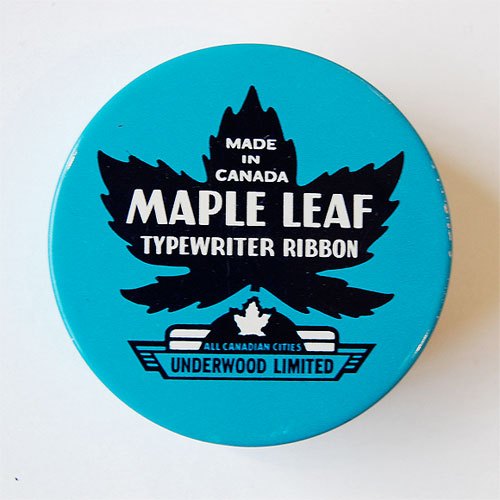
Typewriter Ribbon Tins

I've been reading about dead technology, things like wind-up watches, letter writing and typewriters. Then I found a link to people who collect typewriter ribbon tins. This got me thinking, it's not just the technology or industry itself which dies but all the little things that go along with it.

I had an old typewriter, or my family did anyway. I can remember the smell of the ribbon and the tinny smell of the old typewriter itself. The ribbon was wound around two spools and would gradually wind back and forth between them until someone decided the ink had become too faded and replaced it with a new ribbon. That's where the fancy ribbon case would come in. It would hold the fresh ribbon and spool.

Flickr: Typewriter Ribbon Tin Menagerie

As products go, what could be more banal than the lowly typewriter ribbon? In an effort to stand out from the crowd, ribbon manufacturers covered their products' tins with colorful type and graphic elements. Art Nouveau, Art Deco, and Mid-century Modern graphic design are all well represented. Some tins feature fanciful illustrations having absolutely nothing to do with typewriters, ribbons, writing, business or anything remotely connected with typing. As the industrialized culture of international business spread throughout the 1960s and 70s, soulless, bland graphics and cheap cardboard packaging took over. The tin was no more.

Collecting Typewriter Ribbon Tins -- Site by Darryl C. Rehr

Uppercase Collection of Typewriter Ribbon Tins on Flickr.