Crazy quilting is another way of creating patchwork quilts. Crazy quilts don't use a pattern (traditionally). They are the ultimate in scrap quilting. Crazy quilts are often heavily embellished too. Some use ribbon embroidery.
Crazy Quilting is More than Just Embellished Patchwork
The first crazy quilt I saw was embroidered with delicate stitches, beads and other little things. There were images of birds, spiders and other creatures and things the quilter must have liked or been thinking about. She (I'm assuming it was a woman quilter) had used fabric scraps, fabric and textiles from used clothes, her own wedding gown and her Mother's wedding gown, cigar bands and assorted other textiles which I no longer remember. That quilt was full of local history and her own personal history. All together it was an elaborate masterpiece to keep you warm, snuggled up in your bed each night.
Early crazy quilts were from the 1800's, were made with silk and velvet then heavily embroidered. Often beads, buttons and accessories were added for an extra glamorous touch. Though the idea was to recycle, they were meant to be showy creations. It's a shame to see some modern crazy quilts which have become far more on the practical side versus being gorgeous and decadent looking. But, the concept is still the same.
Vintage Vogue - Crazy Quilt Blocks - https://thatgrrl.com/blog/includes/download.php?file=vintage-vogue-crazy-quilt-blocks.pdf
I taught myself to crochet granny squares. I made lots of them. I used a lot of coloured yarn but then I stopped. I never did start doing anything with them all. I've still got some of them around. So this is my quest to get back to crocheting and to make something with the granny squares I already have.
What I'd really like to find for sewing up all those granny squares is a backpack. The kind I can use as a purse. So it has to be medium sized with enough extra pockets, zipper pockets and fold over pockets, for my keys, the book I'm reading, my digital camera, paper and pens I keep for making notes, my bus pass, my wallet, my mobile pharmacy, and all the other essential stuff I carry around day to day.
So far I can't find anything to suit me. But I have found some very interesting, unique and creative patterns and ideas.
Granny Square History
Crochet itself seems to have been around since the 1350s and likely before. People didn't always make a point to write about the work of women. So there are many things we won't ever know about. Those we have now were likely passed down a long time, though many generations of women.
Granny squares date back to at least Victorian times. They were known as patchwork squares. Most often they were a good way to use up scraps of yarn from other projects. So the patchwork squares were a simple pattern which could be used for everyday stuff rather than the fancy work like crochet lace and doilies.
Granny squares found new popularity in the 1970's when people wanted simple and colourful crafts to make and wear.
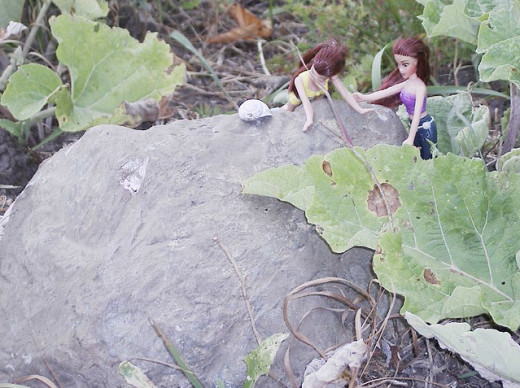
Street art dioramas could be right under your foot and you might not notice. They are tiny, miniature people posed in the great, big, real world. Some are tiny people, some are model trains and some are buildings. All are varied ideas on the same theme of taking miniature art into the street, the outdoors, and posing to interact with the great big world out there.
I'm not a professional photographer. I like creative photography. There are so many things we can create but it's the photograph that keeps them around, remembered and shows them just like new long after the original is gone. Like making a sandcastle on the beach and taking a photo before people walking on the shore and the waves come in to sweep it away. A photograph preserves art and showcases art too.
I photograph old, abandoned and derelict buildings to keep something of them in the world, remembered. However, I love to see other art in photos. I've been watching for different ways to be creative with a camera. There are endless ways and means and styles.
One form of art which is captured by the camera are miniature dioramas created in the street, in public places. Some are in places people walk around all the time, but they might not notice them. Some are outdoors where people might only see them in a photograph.
I wasn't especially interested in art with miniatures. I saw model railways with whole towns and the little people in them. I admired the work, the imagination and creativity. But, I wasn't inspired to try it myself. For one thing, I knew I wouldn't have the patience to assemble an entire miniature village.
Then I found The Little People Project. I loved it. I went out and bought the smallest dolls I could find at the thrift store (2 Bratz Barbie-sized dolls) and started to try the idea of posing little people myself. I did it for awhile but I didn't have the right dolls, the right little people, so I put that project on the back burner. I still have the dolls and the photos I took.
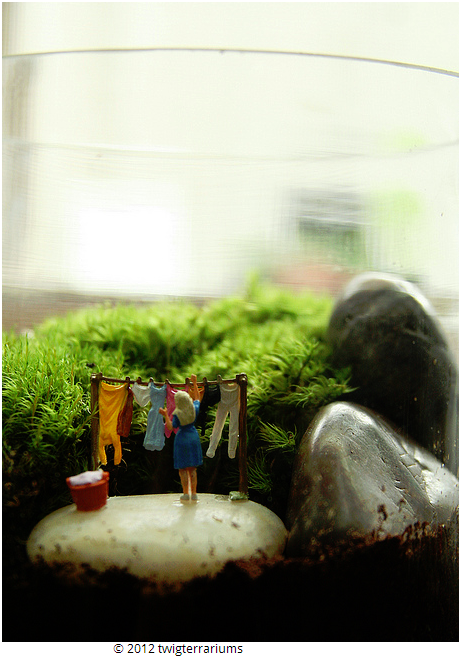
Find Some Little People
I bought myself pot holders from the department store. I loved the colours, that's why I picked them. But, the colours faded after a couple of washings. Disappointing. It would be smarter to just make my own I decided.
I liked the pot holders made with upcycled/ repurposed jeans. Doubled over, they would be nice and thick for picking up hot pots and pans. But, I still think they need a layer in between for keeping out more heat, plus, keeping them dry rather than letting water soak through. If you have ever picked up a hot pan with a wet pot holder you will know why a pot holder must be dry. Fully dry, not even just a bit damp. I feel pain just remembering.
So, when you are making pot holders, be aware of the wet/ dry issue. Consider fabrics or yarn which keeps dry and does not melt in contact with heat. A safer thing would be to have a middle fabric in your pot holder which would prevent both sides getting wet at all.
Of course, you don't want a pot holder made of anything too thin. Another element with crochet or knit pot holders are having gaps in the pattern which you could poke a finger through while picking up a hot pan. If you use a lacey knit or crochet pattern give the pot holder a backing which will keep your hands safe from burns.
Another nice thing about pot holders is how washable they are. It's pretty easy for them to get something slopped on them. My pot holders double as a something I can always sit the hot pan on once I pull it out of the oven. If I don't get something on them from the pan while taking it out of the oven, by the time dinner is done someone else will have dripped and dribbled something on them while serving themselves. This is why I stopped using anything not easily washable as a pot rest (do they have a real name of their own?).
Ribbon embroidery looks complicated when you see some of the wonderfully feminine and romantic looking work done by others. But, if you learn some basic embroidery stitches like the straight stitch, stem stitch and the French knot you can already begin to embroider with ribbons. The trick between regular embroidery and ribbon embroidery is to leave a bit of extra slack in your thread so they are not pulled too tight. You want the ribbon to look placed rather than pulled.
My favourite ribbon embroider work are whole gardens of flowers, especially those I have seen on old, Victorian crazy quilts.
Ribbon Embroidery Resources
Embroidery with Ribbons
I fell in love with ribbon embroidery at least 20 years ago when crazy quilting became popular for awhile. Ribbon embroidery was an extra, an embellishment used on some of the old Victorian crazy quilts.
Ribbon embroidery is mostly about flowers. Now all of it though. It's usually very feminine looking but I've seen some ribbon embroidery used in creative, unusual ways too.
I like hand sewing. Most of the sewing I do is either making Christmas ornaments or mending. I hand sew buttons, hem and mend holes. I don't know how I end up sewing everything by hand. I do have a sewing machine, a very good one which my Mother bought me as a wedding present. It's tucked away in a cabinet. Maybe the idea of taking the time to thread it and set it up keeps me from using it. Meanwhile, you can thread a needle and start sewing by hand right away.
Ribbon embroidery is so romantic and feminine looking. I can't see a machine ever being used for embroidery with ribbons. For one thing, just try running the ribbons through the machine instead of the much thinner thread they are meant to use.

