I Feel Like an Old Shark
Some days I feel like an old shark in a sea of happy dolphins. (Don’t assume too much).
Some days I feel like an old shark in a sea of happy dolphins. (Don’t assume too much).
My Mom and I were talking about leather last week. There are still plenty of animals being butchered for meat but, where do all those hides go now? The post below has it wrong. They are assuming there is a demand for leather. When did you last see or touch anything that was 100% real leather from an animal? Think carefully because a lot can be labelled leather without actually being leather. Of course, its not quite false advertising because there are loopholes to get around almost any and all laws which used to govern marketing. So, it is unlikely anything called leather is actually authentic, real, actual leather from an animal hide.
Leather has always been a byproduct of the meat industry, and as Americans' beef consumption grew over the 20th century, the leather industry grew with it. The past three decades, though, have seen a decline of about 28 percent in Americans' appetite for beef, and the supply of hides has dwindled accordingly. At the same time, drought in the Midwest has pushed up feed prices. The result is that America has fewer and more expensive cows. Meanwhile, the world's consumers still want leather goods.
Source: Your Salad Lunches Are Killing American Leather - Bloomberg Business, 2015.
So, what does happen to all those hides? In Ontario we used to hear advertising (and even visited) the Olde Hide House in Acton, Ontario. Its been closed years ago, not enough business. No shortage of hides. Even though towards the end a lot of them were not coming from Canadian animals. Hides were sent from South America, not in the best of shape, but likely cheaper and maybe more available because it was not a great business for Canadian animal farmers to sell hides. The cost to have the hide processed was not balancing the money made from the sale of the hide.
Too much competition from the fake leather which did not need a lot of processing because it was not taken from any animal. Pleather, plastic leather, did not come from any animal. Carry on with all the other faux leather types, you can see how the business of making leather from animal hides went downhill.
But, we still have all those animals being eaten. So what does happen to all that could-have-been leather? It didn't disappear. Likely a lot of it is included in pet food. That's an easy way to sell parts of animal not sold as steaks, etc. Do you ever wonder what goes into that pet food they sell as pure beef, etc?
This leaves a whole possible business (if someone could come up with an idea) for animal hides to be used again, as something other than pet food, compost, or whatever it currently is going into. Can you think of any ideas? I can't either. The problem is still the cost of processing the hides. Turning hides into leather is not neat and tidy, it stinks, literally. Are there even any places still in Canada that cure hides? Its not something you can just hop into. Think of all the government control there would be for dealing with animal hides. Even before you can think of some new product (that would be cost efficient to make and sell well). Workers would need to be trained and its not a nice job so workers might not be found in Canada.
I don't think the leather industry, as it is, will see a come back. The faux leather is so much easier and cheaper to produce. It sells just as well as the real leather ever did. I doubt people, in general, could tell the difference. Another thing, real leather wears too well. It doesn't rip, fade, or need to be replaced often enough. So once you buy a real leather purse, coat, couch, etc. its not going to need to be replaced for a long time. Meanwhile all that faux leather can generate lots of sales - its not designed to last. Like most of the products made these days. The plan is to sell, sell, sell! Sell junk so you can sell more. Marketing at work!
Lastly, the beef industry and the guilt trip given about eating salad, or meals which do not heavily include beef/ meat. This idea of meat heavy meals is a more modern thing. People long ago did not have the amount of meat in their diet as we do now. Plates at restaurants, on cooking shows, and so on are at least two thirds meat, if not far more. That is not even healthy for people. Long before people could not choose to butcher an animal more than once a year. They were needed to provide milk and eggs, or eat bugs, some kind of service. The plates of pioneers, people from even 50 years ago would not have been meat heavy. It was expensive, not as available and people ate more vegetables. Dishes were more likely to include meat as an ingredient than to be on the plate at all. Soups, stews, all of those would use meat bones boiled down to create flavour. If there was still some meat from those bones it could be added. Meat was not abundant as it is now.
So these meat farmers complaining about salad eaters are basing this on an inflated market. A market created to sell beef/ meat. Like the faux leather, the marketing went wild, with no control over what the market actually could support in sales. Generating sales worked, too well. If you knew how many animals are slaughtered to feed people every day... its a kind of sickening. I'm not a vegetarian, I do eat meat, but I don't take it for granted. I do balance how much meat I eat with more vegetables on my plate. I don't eat out very much because those meals are just too meat heavy, not practical or realistic for what people really need to eat.
Protein is shouted all over the ads for anything edible now. I would not be surprised to see some company marketing ice cream as protein rich. It will have protein. But also a lot of sweetener you don't need. Protein can be found in food other than meat and dairy. How much protein are people eating, being kind of obsessed with it (like a food fad) versus what they really need? Eating too much of anything is not good. That is something you could look into for your own health/ needs.
Anyway, if people could stop eating so much meat they could be healthier and the environment would be better with less production of meat (meat takes far more resources than it does to produce vegetables and fruit). Don't take for granted all those animals which would not be born, live less than a year, and then slaughtered. I'm not expecting, or wanting, to stop eating meat, but there is no need to mass produce it at the current rate. Especially when so much of that animal is not being used but left as byproducts. Have you ever thought about the amount of bacon sold versus the rest of the pig killed to produce bacon? Its not just beef cattle out there being served up on a platter.
Originally the Ontario Barn Preservation newsletter, June 2024.
Dear Members,
I've been thinking about the trees which barns were made from, originally. There were huge trees long ago. I wonder if people now can even imagine the size of the trees in early Ontario history. Jim Campbell and the others at the first Tenon Talks were talking about the size of trees used to make barns a hundred, and more, years ago. Jim said most of the barns in his area were made from pine trees.
Online, I found the Ontario Tree Atlas Project, from the University of Guelph. They created a pdf file, a science survey of Ontario's tree species. Here is a link to read it online, or download it.
Also useful is the Ontario Government's Tree Atlas, online.
Coming up to road trip season you might like to find places to visit from an Ontario travel blog by Stephanie, The World as I See It.
Does your barn have a lightening rod?
I like practical heritage things like lightening rods. But, I wondered how practical they really are. In order to be legitimate, they need to be grounded. This means a copper or aluminum line runs from the lightening rod on the barn roof (house or other building) down the side and is then buried in the ground attached to a metal rod, called a grounding rod. The idea is for lightening to be directed down the the earth to dissipate safely in the ground. A large building, like a barn, may have bonding connectors linking the rods. So, its an old fashioned surge protector.
How many lightening rods still around are actually grounded? Not all of them I'm sure. Nothing wrong with a pretty, decorative lightening rod... except that an insurance company might want a functional lightening rod before insuring a barn.
This question came up in email recently. The contractor said the barn could not be insured without a lightening rod. That brought up the question of how effective a lightening rod is at preventing lightening strikes and possible barn fires. The consensus at OBP was, not much. Some even thought a lightening rod could cause more lightening to hit a barn.
In the end, I think a lightening rod is still pretty decorative and a little touch of history for a barn, but it doesn't have a real, practical use. Which is a little disappointing but, I'll get over it.
Laura
Highlights from the monthly Directors meeting...
New barn related words: silage, hay harpoon, and hay hole. My brother and his friends would have loved to know a phrase like hay hole not so many years ago. Now he's too old and serious for those kind of things. (Most of the time, I know he'll still laugh about it).
At least twice now the subject of heritage designation has been brought up. Some barn owners are concerned that we will be pushing, or are affiliated with, heritage designations for their barns. We are not. It may be useful for some barn owners to look into, but we don't especially support or have influence about heritage designations. If you have concerns please ask us.
Heidi, our Regional Representative for most of Northern Ontario has left. I hope she will come back when she feels she has more time. If you know, or you yourself, would be interested in becoming a Regional Representative please let us know. It'd be glad to find someone else in Northern Ontario because we don't hear very much about barns and rural history from the north.
In case you missed it!
I posted about heritage apple trees in Ontario to our social media accounts. If you missed it, here's the post.
Are you curious about heritage apples in Ontario? I see them growing along the roadside, unpicked or cared for all over Ontario when we go on road trips, visiting and so on. My Mother and Grandparents talk about the apples they used to have for making pies and wonder where they could still find those now. They don't see them sold in farmer's markets and certainly not in stores any more.
I found a few good links and then this book, by Sher Leetooze, "Identifying Heritage Apples Across Ontario".
Orchard People The Kitchen Orchard The Ontario Heritage and Feral Apple Project
Pick some wild apples this year. You could even try planting some of the old trees seldom seen any more. Give them a chance to get a new start and have apples close at hand when you get into pie making mode.
See also, a CBC link: Set in Stone: Ontario man turns the clock back at ancestral farm
I have also posted to our social media about dry stone walling/ fencing. A skill I have admired and even tried a few times in a small way. I'm sure it would be useful if you were making Inukshuks.
Dry Stone Walling Across Canada
Screen capture from https://sdstone.ca/why-drystone
One Last Thing...
I cross posted this wonderful photo from Facebook today.
Originally the Ontario Barn Preservation newsletter, August 2024.
Dear Members,
Thank you to Claudia Smith and Dr. John Carter, we have a new Barn Book Reference List. If you're looking for something to read this summer, especially about Ontario rural history and barns, take a look at our new list.
Hugh Fraser and Randy Bagg have updated the information about 'Your Old Barn Study' on our site. There is a new and improved checklist about how to start the Study and what you might get together before you start.
The next Tenon Talk is scheduled for September, 10th at 8:00 PM. Members will get an email notice with the link.
A FAQ - Frequently Asked Questions
I've been working on a FAQ for the Ontario Barn Preservation website. I hope it will help people looking for barn repairs or information about what to do when their barn isn't in great shape. Most of our emails are asking for help with fixing up an old barn.
I also found a wonderful pdf (free to download) file from the Iowa Barn Foundation: "First Steps in Barn Preservation". I wish we had written this. It includes a checklist at the end.
Your Barn Could be for Dancing!
My Grandparents met at a country dance, in Ontario. I don't know if it was in a barn (a barn dance) but it could have been. In school we were taught how to square dance. Our gym teacher thought it would keep the class busy near the end of the school year when not much was planned.
Now line dancing seems to be the popular country style dance. I guess its simpler for people. But, learning the steps was a lot of fun. Square dancing is one of the things I remember most about any gym class while I was in school.
I found square dancing groups in Ontario, and Canada. So, pull out your dancing shoes. If you have a barn, you might look at local groups and see if they need a place to dance. With a barn full of fiddle music, laughing and dancing it won't be long before you join in yourself.
Canadian Square and Round Dance Society
Ontario Square & Round Dance Federation
Happy Summer,
Laura, Administrative Assistant with Ontario Barn Preservation
In case you missed it!
I posted this YouTube video link to our social media accounts. It's a movie made in 1923, a silent movie, about logging/ lumbering in Ontario.
https://www.youtube.com/watch?v=gn-4HnohRdQ
I've been enjoying the video posts from Hidden Spring Farm in Coldwater, Ontario. https://www.youtube.com/@HiddenSpringFarm
"Hidden Spring Farm is a Homestead in the making. It's also a Farm Stay & Experience startup. Created by Chad & Remy Smith in 2020, Hidden Spring Farm is a super private and tranquil 90 acres and perfect to start an operational farm stay vacation rental. With a little tlc, hard work & creativity, we're hoping to turn this farm into a unique and amazing farm stay experience, while allowing us to share this property's beautiful qualities with others."
Beautiful quilted barn art from Quiltcore. Sold on Etsy as postcards, greeting cards, prints, t-shirts, mugs, and more. Artist from Olds, Alberta.
The Ontario Association of Agricultural Societies - A great source to find Ontario agriculture fairs listed.
Originally posted as a short newsletter for Ontario Barn Preservation, Christmas 2024. The first year I did not send out real (not just email) Christmas cards to the members. Kind of sad. Now they are just sending an email each year. The print card was something I started. I'm not sure why it was discontinued after this year. At this time there was a Canada post strike. The next year there was not. But just an email was sent. Cheaper of course. But, people really noticed getting a print card. It was a much better promotion than just another email, probably not opened.
Dear Members,
Merry Christmas, Happy Holidays, Season's Greetings, and all the other ways to wish you a wonderful winter holiday.
I'm sorry not to send out the printed Christmas cards this year. It just hasn't worked out due to the Canada Post strike.
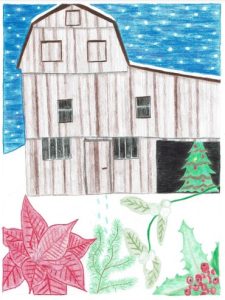
This year I asked my niece, Emma-Jeanne Brown, to create a Christmas card for us. She did! I hope you enjoy it. Emma-Jeanne works as a Pastry Chef, starting a new job at The Watering Can, Vineland, Ontario in January.
Location, location, location... as the real estate people would say. Barns are not usually in areas with a lot of local traffic, but people will come to an event. A location might not be on main street but it could still be a place people can come to for a good evening out. Symphony in the Barn and Ontario Festival of Small Halls have concerts in rural Ontario. Could your old barn be restored and become a host to concerts, weddings, and other private, public, or corporate events?
I thought the idea was interesting. Note, I'm not an architect, city planner, political analyst, or anything with professional knowledge. Just an Electrical Engineer's daughter with an interest in old buildings, art, and history. The following information is what I have found searching online for Ontario based/ relevant resources.
TVO Today - Rescue mission: Fighting to save historical buildings in rural Ontario
Laura