Posts in category “Bewitching Vagabond”
† Posted on . Filed in . Tagged with .

Happy 2018

I have set up new email addresses for some of my domain sites. I'm still going to use my Gmail for almost everything. But, I've been getting attacked by spam emailers, mostly from Subaru USA. So I can use the new addresses for people I actually want to hear from. Which will likely be almost nothing really. Even family email may as well go to the old account. I'm not so likely to check the new accounts often. Unless I set them up to work with something like the email part of SeaMonkey. Tried once and it did not work, but how can you tell when you don't have activity in the account. Yes, I did send myself a test email. Anyway, that is all more to work on.

I'm looking at various ways to keep my niche web resource directories, without WordPress. Everyone seems to suggest WordPress plugins. But they don't understand that all those plugins are dependent on WordPress. WordPress, which says it is standalone software but requires a lot of plugins.

I am trying RSS feeds but, some sites do not use RSS any more. I don't understand why. It is such a simple way to distribute your content and you don't have to do anything. Just put the link up somewhere and forget about it.

Yesterday I was looking at a lot of ways to set up a holiday and event site. Calendar software, address book software, PIM software... No luck so far. Most of the software I find is dated or forgotten/ abandoned. If something isn't popular they don't want to bother with it. Popularity being dictated by Google overall. I am fed up with marketing and that whole mentality. Why do people want to be Google automatons?

I am starting two online shops. One for Ontario Exploration and the other for ASCII Artist. Both of those sites are still on WordPress due to the web resource directory I have built for them. Also, I'm just not feeling the patience to move all the images and figure out this and that to make them work on b2. The image thing on b2 is still bugging me, a lot. Really it shouldn't. It is just a matter of changing the way I create a post, adapting to different software. But, it did seem so much easier to add it while I wrote the post, instead of before or after. I guess I am just letting myself be stubborn about it.

Another change, I allowed Grammarly to attempt to take over my life. It feels that way, even though it just sits in every post window, waiting to boss me around and tell me I should be spelling everything in US spelling, not Canadian. I did not set it all up, registering with the site. If I had it might stop nagging me about every word I spell with Canadian spelling. I don't want to register and give my information to them. So, it will be a battle between trying to catch typos and getting fed up with being corrected.

On the homefront, outside of this computer, I am dealing with hoarding, trying to make myself exercise and other things. Go me.

Happy New Year! Possibly the last time I type that, until the end of this year.
† Posted on . Filed in . Tagged with .

What to Write When Someone has Died

What do you write when someone has died and you want to offer condolences and sympathy? You may not even know the family. It could be someone you worked with and you're expected to sign the card from everyone at work. It could be the family of a close friend and now you need to find something right to say. It's not easy to pick out the right words. We don't want to make a bad impression, say the wrong thing or seem uncaring.

From my Experience

I've been there, as the person writing and the person getting the condolences. From my experience it was best to be kind, keep it short and be honest rather than trying to be nice, polite or neutral.

From my experience, after my Dad died I found many people did not know how to express sympathy or condolences. It's actually not as complicated as they were making it. The best condolences were honest and simple words. One person, in particular, said just the right thing and gave me a new perspective on my own feelings. But, that's not going to happen in most cases.

The friend who had the right words was a good, longtime friend who knew a lot about myself, my life and we had been long time confidants through my divorce too. That kind of friend has a far better chance of knowing the right words.

Here are some ideas, help, and tips to get you through picking the right words to offer your support, sympathy, and encouragement.

When you are sorrowful look again in your heart,
and you shall see that in truth you are weeping
for that which has been your delight.
-Kahil Gibran

Tips for Writing a Sympathy/ Condolence Card

  • Mention the loss in some way. Don't send a note that could sound generic. Mention a name if you know it.
  • Avoid clichés. They make you seem a little uncaring and less than sincere.
  • Keep it short. Unless you are a very close personal friend, stick to just a few words or a couple of sentences.
  • Keep it light, think easy reading. Big, dictionary words will just make you sound smug and superior.
  • Avoid negativity. Don't complain, claim anything owed or air grievances of your own.
  • Be sincere. Don't write anything you don't mean.
  • Offer sympathy or condolences but don't say you're sorry. Unless you are somehow responsible for the death.
  • Keep religion out of it, unless you know they are religious and which traditions they follow.
  • Don't say nothing at all. Even just a simple "thinking of you" is good if you really feel too intimidated, upset or angry.

When it is dark enough, you can see the stars. Then, when it seems we will never smile again... life comes back. - Mark M. Baldwin

† Posted on . Filed in . Tagged with .

Why Am I Here?

I'm not getting far in all my grand plans and schemes for greatness on the web. I wanted to have an amazing site for writers, a huge gallery of ASCII art (my own and all those I have amassed over the years) and I wanted to make a really cute web presence for myself, with lots of red, white and slightly girlish graphics which I would have made myself. I do have some of the graphics. They are sitting on my hard drive or in my desk drawer, as yet unscanned. What keeps you from doing all the things you most want to do?

I don't think it's fear of failure. I have a tendency to jump in and not look back. If I was afraid of failing I'd have to be someone who looks back and second guesses a lot. It's not laziness or a lack of ambition. I have a lot of ambition and so many ideas which keep cramming themselves into my head. I'm not sure what is the problem. Is it possible I just don't want to start, afraid of my own greatness or where it will all end? I know that sounds pompous or slightly mad. But, a life of verbal abuse does strange things to your perception. I grew up that way and I know I'm not over it. I don't even know how to get over it. Talk about forgiving is fine. He's dead, what does it matter how I feel now? There's no going back from dead. Dead is done.

I do wonder why I'm here, what was the point of it all? I'm not likely to have kids now, so what will it matter that I was ever here at all. Who will know in 30 years that I ever thought anything or what I cared about.

† Posted on . Filed in . Tagged with .

How to Make a Gothic Graveyard Garden Indoors

A Gothic garden can be a mix of ghosts, vampires, zombies and haunted houses growing with creepy plants in a terrarium, window box or something more creative.

A creepy, spooky, haunted garden may be part of your dream home or landscape but if you live in a small space you have to go with a smaller garden plot. You might even choose to have an indoor garden so you can enjoy it all year round, no matter what the season is.

A Gothic garden can be a lot of fun and a creative (even green friendly) outlet. Start looking for ideas and decorations right away and use these to plan the type of garden you will make.

A Gothic garden can be a mix of ghosts, tombs, gravestones, wrought iron fences, vampires, zombies and haunted houses growing with creepy plants in a terrarium, window box or something more creative.

Choosing the Container

Will you work with a window box, a standard sort of plant pot, or build a glass terrarium or some other option for your indoor garden?

A container can be concrete or stone or you can get clay pots and decorate them. You will need to have drainage in whatever container you use. Also, something under it to catch the water which drains.

A terrarium does not need drainage, it's enclosed and ideally, it won't need very much watering.

As you pick a container consider other fixtures which can go with it like a plant stand which could be a pillar or column or something wrought iron with a creepy, twisted look. You may choose to have a garden which is small enough to fit in one pot and hang from a chain or a fancy, Gothic plant hanger.

If your garden sits on a table pick out just the right tablecloth or dark lace doily and other pieces which could go along with the theme. Even your watering pot can be set there as part of the creepiness.

Your garden will need natural sunlight at least part of the day so pay attention to which windows get the best light. Not all plants want direct sunlight, some are part shade or shade friendly. If you don't have a great sunny window make sure you keep this in mind as you choose plants for your garden.

Plants to Use for the Gothic Theme

  • opium poppies
  • mimosa
  • ivy
  • mandrake
  • belladonna
  • absinthe
  • monkshood
  • moonflower
  • garlic bulbs
  • evening primrose
  • nicotiana
  • carnations
  • lilies
  • black hollyhock
  • penny black nemohilias
  • Venus flytrap
  • pitcher plants
  • voodoo lily

Choosing the Plants

Seeds or plants for a Gothic garden are those with black flowers or foliage, night bloomers, sensitive to touch or change in the environment and herbs known for their dark, medicinal (poisonous) use in the past.

Some types of plants may not be available due to government regulations. If you do use poisonous plants make sure anyone living with (or visiting) you knows to leave them alone. Keep children and pets safe by making your indoor garden inaccessible to them.

You can plant seeds for some, others will work out better if they are small plants when you start them. However you start your plants, they will need extra care in the beginning. A good soil for indoor plants and extra water while they get roots established.

Don't forget common plants which make a good contrast to the sinister, haunted look like simple daisies, pansies and others known as sweet and romantic flowers.

There are deeply red and even nearly black roses too. Find them in miniatures by contacting nurseries and commercial growers.

Look for very low growing ground cover, like moss, which can spread and grow to appear like grass - especially nice if you are creating a village, cemetery or haunted house where you would usually find grass growing.

Remember or learn about the plants you choose for how they grow. Some will be too tall, some will spread too easily and need to be "weeded", some will grow as hanging plants and need to overlap the container they grow in.

Of course, even indoor plants are still seasonal. Plan your garden around the seasons and don't be surprised to find things become sparse during the off season when some plants are completely dormant and others are just waiting for Spring to give them new energy.

Add Garden Decorations

This is your time to add the flourishes like garden gnomes, gargoyles and haunted houses to your indoor garden. Look for miniatures if you want to build something with huge plants taking over. Or, look for toys to have something on a larger scale. Whatever you start with, nothing is set in stone. Change things, move them around and decorate with seasonal versions of the Gothic theme.

Add small rocks if you don't have anything else at first.

Watch for creative elements to add, like teacups and saucers, chess/ game pieces, miniatures from model train sets or doll houses, beads, gemstones, Pagan gadgets and accessories, Barbie parts, vintage glass jars, bride and groom wedding cake toppers, alchemist and medical gadgets.

See if you can find a vintage store, auction house, or a niche store like a curiosity shop which caters to people with unique interests.

Add tiny lights to your garden with battery operated tea lights. Real tea light candles can be used if you are at home and able to keep an eye on them.

Don't forget the dollar stores and thrift shops for cheapie ideas like plastic mice and spiders. Watch for birds like crows, ravens and owls too.

Place the garden inside another object like an iron bird cage, a large seashell or a temporary container like a jack-o-lantern for more dramatic affect.

† Posted on . Filed in . Tagged with .

The Challenges of Saving Lighthouses

This is reposted from Swallowtail Keepers Society blog. The blog is abandoned but the post is worth saving. Far more involved with saving lighthouses than I would have thought. (I did think about the weathering).

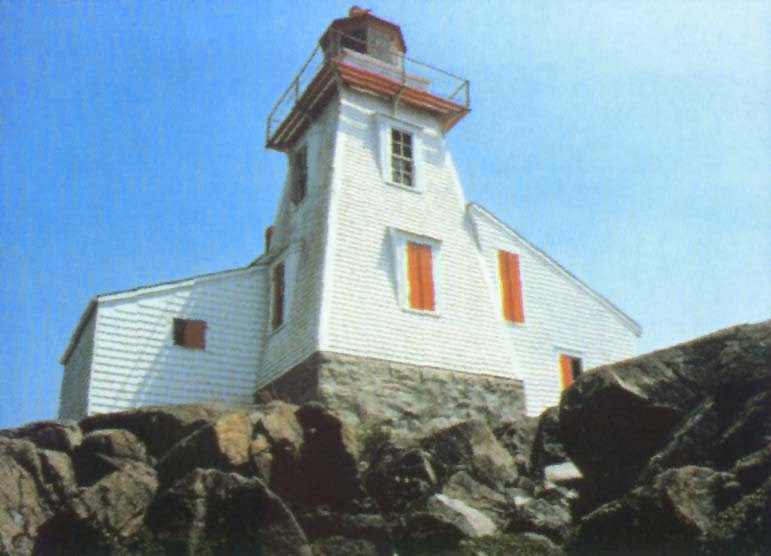
Lighthouses are usually located in the face of storms, exposed on several sides to strong winds and sea spray, frequently difficult to get to and challenging to maintain. With lighthouses de-staffed or de-commissioned, budget cuts rampant, and maintenance minimal, it is hard to see these once well-maintained structures deteriorate to a point that they begin to crumble but it is becoming all too common. The magnitude of the maintenance or restoration, and the ability to get to the lighthouse is often overwhelming. We have been fortunate with Swallow Tail that ownership has been transferred, access is challenging but better than many, and through the support of the community and access to various sources of funding, restoration work has been possible.

Unfortunately, in five months, three other lighthouses in the Maritimes have disappeared. Two collapsed during storms, the abandoned Fish Fluke Point on Ross Island decommissioned in 1963 but defied gravity for years (November), and Church Point on St. Mary's Bay, NS, decommissioned in 1984 (March), and one burned to the ground, the remote fibreglass lighthouse at Point Aconi on Cape Breton Island (February). Fire was always a worry before lights were electrified. Elodie Foster, one of the light keepers at Swallow Tail, died from her injuries after her clothes caught fire while trying to start the burner for the light. More recently, electrical issues may be the cause of some fires because of the heavy salt presence and corrosion of electrical connections. Two electrical issues at Swallow Tail threatened to cause fires last fall and had no one been working in the lighthouse, the problems would have gone unnoticed until it was too late. Vandalism has also been a cause of some fires and has plagued locations such as Partridge Island in Saint John, and may have been the cause of the grass fire at Swallow Tail in April, 2007, which threatened the lighthouse and keepers house. It has prompted some communities to install security cameras. The ones at Swallow Tail can be viewed on the Village of Grand Manan website (www.villageofgrandmanan.com).

Fish Fluke Point lighthouse in better days.  (unknown origin of photo)

Collapsed Fish Fluke Point lighthouse as seen from the air in November 2013.

Church Point lighthouse before collapse. (from CBC.ca)

??

Church Point lighthouse after collapse, 27 March 2014. (from CBC.ca)

Point Aconi lighthouse before it and the building beside it, burned to the ground in February, 2014. (from Cape Breton Post)

Collapse was not thought to be an issue at Swallow Tail but once work began last fall, it became apparent that it could have been possible. The lime had eroded out of the mortar, making the mortar crumble. The stone foundation was slowly pancaking, with the stones being pushed outward. The eight guy wires and the massive concrete floor in the equipment room were the only things holding the tower upright with probably only five large stones in the foundation carrying weight. Had any of the guy wires failed, the tower would have begun listing or worse. To fix this, all the stones were removed, one side at a time, and then returned with new mortar between the joints. The large corner stones, too heavy to easily lift, were adjusted back into place. The foundation is now functional again and should last for many more years with minimal maintenance.
???

Peter Devine rebuilding stone foundation at Swallow Tail, September 2013.

During this process, it was discovered that the large wooden beam under the front door had completely rotted away. The remains of the beam were removed using a dust pan. Instead of trying to fit a new wooden beam back in a very tight space between the large immovable concrete step, stone foundation and the floor joists, a concrete beam was constructed. One of the 1859 wooden pegs, used to hold the heavy timber structure together, was discovered in the crawl space during the work, looking the same as the day it was made. This was the only spot were the heavy timbers of the lighthouse had completely rotted.

???

Rotted timber beam under front entrance, September 2013

New concrete beam to replace rotted timber, September 2013.

Salt corrosion is another challenge, rusting nails so they no longer do their job. When some shingles were removed on the northern side of the bell house, the boards underneath came off as well. This was also an earlier problem with the boathouse and the entire southern wall began to fall off in large pieces as the nails disappeared and that wall had to be rebuilt. The shingles were stripped off the bellhouse, the boards renailed, and new shingles returned. Shingles on some sides of the tower were also falling out because the nails were gone. Face nailing to hold them in place during previous work only complicated the problem with water getting behind the shingles and rotting the wood. Several places on the tower, notably where the windows had been boarded up, were in worse shape than the rest of the lighthouse, even though the boards were only 40 years old compared to over 150. As the rot continued, longer nails were used to hold the shingles which further exacerbated the problem. It was very noticeable while scraping the sides where the problems were located because of the sponginess. Replacing the rotted wood and shingles where required, caulking the nail heads, plus one to two coats of primer and two coats of finish paint will prevent this for a few years. Because of the extreme weather conditions experienced on the point we hope in the future only the paint will suffer and not the wood behind.

???

Northern wall of the bell house.  The nails had rusted off and the boards had to be nailed back in place before the shingles could be attached.

Areas on the lighthouse that needed repair because of water penetration causing rot.  The area around the fog horn was because of caulking and flashing failures.  The upper area on the tower was probably because of face nailing shingles allowing water to penetrate.

?

Custom blade on paint scraper.

The entire lighthouse and bell house were scraped, primed and received two coats of paint.  The new shingles were primed twice.

Removing the windows in the tower in the 1970s was actually beneficial in many respects since there was little maintenance after the lighthouse was destaffed, but it changed the interior with no natural light or ventilation. Having the opportunity to return the windows to the original locations in the lighthouse was a goal during the restoration but a challenge since everything had to be built from scratch. One window could not be returned because the current fog equipment is located in that spot on the first floor. Windows from an 1849 house in Ontario were donated by the owners, who had once worked at a lighthouse in British Columbia. They were honoured to have them reused at Swallow Tail. The storms and gablets (or dormers) were new construction from mahogany with copper flashing and sills in an attempt to resist the harsh climate. The interior has been completely changed with the additional of natural light and makes it a very pleasant inside.

??

Reglazing 1849 windows donated for the lighthouse.  The bottoms had to be cut down to 8 from 12 panes.  New glass was installed in each window.

Window unit - gablet with storm, all new construction.

?

Windows restored on the southern side of the lighthouse.

The harsh winter weather stopped work in mid-December at the lighthouse. Work will begin again sometime in April. The windows and interior will be completed including repairing the lathe and plaster and painting, the boardwalk from the keepers house (cabled in place to protect it from the strong winds) will be built, and museum displays installed. We are hoping to have the lighthouse open again this summer. Restoration work could not have been possible without the financial assistance of the Atlantic Canada Opportunities Agency, Regional Development Corporation, New Brunswick Built Heritage, Village of Grand Manan, Grand Manan Rotary Club, and generous donations.