Archive of
Posted on . Filed in . Tagged with .

Survivorman: Canadian Reality TV Series

Les Stroud is the Canadian Survivorman. An instructor in survival, hiking, whitewater rafting, sea kayaking, dog sledding and winter travel, Les Stroud has more than 20 years of experience as an outdoor adventurer.

The Survivorman series is based on stranding Les Stroud in a remote region of the world without food, water and little more than a pocket knife. His crew drops him off and leaves him alone to face the elements, find food, water and create shelter however he can.

In some episodes he illustrates how to survive scenarios. Such as surviving on an island if you are stranded at sea when your cruise boat leaves without you. Or, how to survive when all you have is a dog sled in the Canadian north. Or, how to survive if your hot air balloon fails in the vast, dry desert somewhere. Each scenario gives Les a few extra tools to use to his advantage. If he can get them to work, there are misfires and mistakes or just bad luck too.

Not only is he alone to struggle for the week, but he is his own film crew too. This means he has to cart around 50 pounds of audio/ video equipment like camera gear, tripods, and batteries. He has to backtrack to pick up the camera once he has used it to film himself walking away. (You can't leave the equipment behind if you hope to use it later). Once in awhile he does leave something behind due to the stress on himself of trying to film when he is suffering from lack of drinking water or sleep and exposure to the elements. At these times he will narrate over the film, letting viewers know the equipment was picked up later by his crew. However, there is no crew there with him at the time.

One Man, Alone, in the Wilderness I have had a debate with a friend about this in the past. Other survivor shows try to appear as if the host is really alone, but if you watch it becomes clear that is not the case. Les Stroud is the only one I have seen who really is alone and in real danger.

The original Survivorman series went for three seasons. At that time Les Stroud needed a break for his health. However, he didn't sit back and put his feet up. There have been documentaries, books, and music performances too.

The Survivorman series is coming back as a new series of specials which will be 10 day long excursions into the wilderness. So far two episodes have been filmed. I couldn't find a lot of detail about this and I haven't seen them appear on TV myself, so far.

Les Stroud, the Music and Survivor Man

However, there's more to Les Stroud than being the creator, writer, cameraman, host, narrator, director, producer, and survivalist on the Canadian reality TV show. Les Stroud is a musician too. You can see albums and tour dates on his website. There are two DVDs available and singles too.

Les Stroud composed the theme to Survivorman.

If you are Canadian you might remember Les Stroud in the 1980s as a music video producer for the Canadian music video channel, MuchMusic. In 1987 he began traveling Canada as a canoe guide and wilderness instructor. Later he started his own outdoor tourism business and studied at Humber College in Ontario and at Prairie Wolf College in Kansas.

So what could be next?

One interesting thing I read in an interview with Les Stroud was his idea to retrace all the world's greatest explorers for a series which may end up as Stroud's Legends. This would be excellent. We hear about the history of exploration in books and classrooms. But these are dry accounts with words and the odd photo taken from modern perspectives or an illustration which can't really capture the isolation, the harshness or the beauty of the wilderness as it was before people came to settle in and take over.

Seeing the routes taken by the early explorers from the perspective of someone who is an explorer and survivalist in our times would be a unique experience. I'm sure it would bring the journey, the history and the explorer himself (most of them were men) into new light. I hope this project turns out to be another one which Les Stroud produces.
Posted on . Filed in . Tagged with .

Why is WordPress Still Free?

WordPress is the Cadillac of CMS for web developers making cookie cutter sites for clients paying thousands of dollars (sometimes). For end users, it is deliberately chopped up and dumbed down. Web developers don’t want clients tinkering, maintaining, changing, or even updating their sites. There are cases where the web developer actually owns the site, the client just has rights to the contents. Clients pay for the site, choose the content, but otherwise get in the way. But, they do pay.

So why is WordPress still free? Why not claim their share of the money being made? Or, will they? It happened with Movable Type.

For those dwindling few who can’t afford/ don’t want a web developer… why are you still using WordPress?

When Gutenberg replaces the current post editor it will take away more functions than it adds, for the end user, the people writing their own sites. WordPress will say it streamlines the editing functions. But, have you taken a look at it? I did. The editor is gone.

Posting to WordPress will become cut and paste with content blocks. This makes it much easier for web developers to configure plugins, themes and other services they can sell to clients who don’t really want to deal with any part of putting up a site themselves. Clients just supply the content, remember. Any editing of the content has already been done before it gets pasted into WordPress.

The new WordPress will be a lot like the old GeoCities. A lot of people won’t know much about GeoCities. It was an online web host, but your sites were on their domain. Sort of like Blogger which gives you the site.blogspot.com domain. I don’t remember if GeoCities let people add their own domain, Blogger does. Anyway, GeoCities made it easy to put up a site. The structure was there, all you really had to do was add your own content. GeoCities was free to use, but they did run a few ads on your site. If GeoCities had not shut down, would they be competing with WordPress now?

Online site building software: Wix, Weebly, SquareSpace, and others, are just competition for WordPress.com because WordPress.org people still make their own sites, right? Yes, if people were making their own sites, but too often sites are made by web developers and people just cut and paste their content into cookie cutter sites built by web developers using WordPress software and assorted plugins the client doesn’t need to know about. How is this really different from an online web site builder? The online website builder is a lot cheaper but does require some hands on work beyond just dumping content into it.

Why not just write for sites like HubPages and at least get paid for your content instead of paying to put it online?

Maybe the only reason WordPress is still free is WordPress.com. If you haven’t taken a look at WordPress.com for awhile, go login and take a look at the features there. Long ago the .com and the self hosted WordPress were not so different. But, that was long ago. WordPress.com is free to sign up for but then it becomes a Facebook game. Features are offered like pretty treats, shiny extras, and premium goodies virtually yours when you pay with real credit cards.

At the end of the day you are paying to use WordPress.

Posted on . Filed in . Tagged with .

What to Write When Someone has Died

What do you write when someone has died and you want to offer condolences and sympathy? You may not even know the family. It could be someone you worked with and you're expected to sign the card from everyone at work. It could be the family of a close friend and now you need to find something right to say. It's not easy to pick out the right words. We don't want to make a bad impression, say the wrong thing or seem uncaring.

From my Experience

I've been there, as the person writing and the person getting the condolences. From my experience it was best to be kind, keep it short and be honest rather than trying to be nice, polite or neutral.

From my experience, after my Dad died I found many people did not know how to express sympathy or condolences. It's actually not as complicated as they were making it. The best condolences were honest and simple words. One person, in particular, said just the right thing and gave me a new perspective on my own feelings. But, that's not going to happen in most cases.

The friend who had the right words was a good, longtime friend who knew a lot about myself, my life and we had been long time confidants through my divorce too. That kind of friend has a far better chance of knowing the right words.

Here are some ideas, help, and tips to get you through picking the right words to offer your support, sympathy, and encouragement.

When you are sorrowful look again in your heart,
and you shall see that in truth you are weeping
for that which has been your delight.
-Kahil Gibran

Tips for Writing a Sympathy/ Condolence Card

  • Mention the loss in some way. Don't send a note that could sound generic. Mention a name if you know it.
  • Avoid clichés. They make you seem a little uncaring and less than sincere.
  • Keep it short. Unless you are a very close personal friend, stick to just a few words or a couple of sentences.
  • Keep it light, think easy reading. Big, dictionary words will just make you sound smug and superior.
  • Avoid negativity. Don't complain, claim anything owed or air grievances of your own.
  • Be sincere. Don't write anything you don't mean.
  • Offer sympathy or condolences but don't say you're sorry. Unless you are somehow responsible for the death.
  • Keep religion out of it, unless you know they are religious and which traditions they follow.
  • Don't say nothing at all. Even just a simple "thinking of you" is good if you really feel too intimidated, upset or angry.

When it is dark enough, you can see the stars. Then, when it seems we will never smile again... life comes back. - Mark M. Baldwin

Posted on . Filed in . Tagged with .

Moving My Sites Out of WordPress

I have moved out of WordPress. I'm using the multi-domain feature of b2evolution. After importing my WordPress content I have found problems with paragraph formatting and missing image files on posts. I will deal with that over time. Today I am just working on today and the post I write next. There is only so much time I want to put into old content when I suspect most of my readers don't have human eyes anyway.

Some of my sites rely on WordPress plugins which will only work with WordPress. I am deciding whether or not to keep the sites fully on WordPress or to move keep them partially on WordPress, in order to use the content I have on the plugin, Link Library.

Meanwhile, I have a lot to do in the admin on b2evolution.

Posted on . Filed in . Tagged with .

A History of the Postcard in Canada

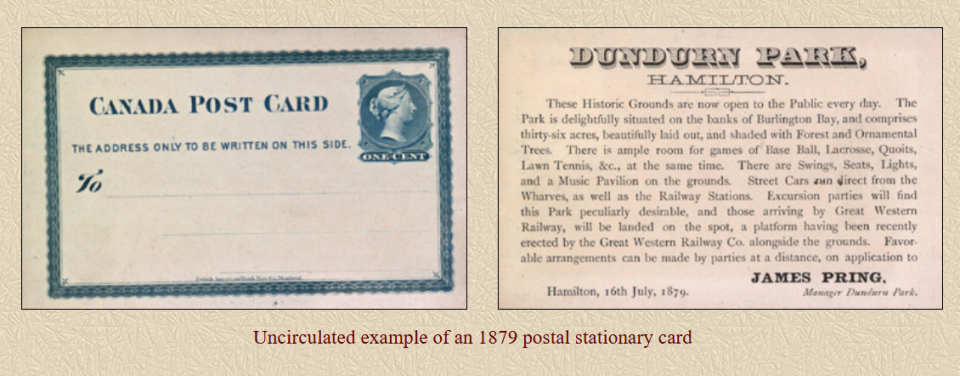
On June 1, 1871, Canada issued a prestamped, pictureless post card. It was called a postal stationery card and was sold for one cent at the post office. The cost included both the card and the delivery to any address within the Dominion. According to the 1871 Department Order No. 7 which authorized the government printed post card "The front or stamped side of the card is to be used for the address only, There must be nothing else either written or printed upon it." and "On the other or reverse side, any communication whether of the nature of a letter or otherwise, may be written or printed."

Postal Stationery Cards were used for business purposes to make appointments, confirm orders and arrange deliveries.

On December 9, 1897 the Post Office announced that "designs, illustrations, portraits, sketches or other forms of advertisement may be engraved, lithographed, printed, etc., on the 'address' side of the one-cent Post Card."

The Private Mailing Card: 1898 marked the end of the Pioneer Era and the beginning of the Private Mailing Card (PMC). Again, only the address was allowed to be written on the stamp side, and space was left around the image for any message from the sender.

Also found on many post cards was "Postal Card - Carte Postale" which indicated it was allowed to enter the international mail system.

The Divided Back: In December 1903 one of the most important changes in Canadian post card history occurred. The Official Postal Guide announced "The department has authorized...that a space may be reserved for communication on the face of the cards to the left of the address.... This space must be marked off from the address section by a vertical line..."

A Brief History of the Post Card