Archive of
Posted on . Filed in . Tagged with .

Another Look at Formatting Code for Posting ASCII Art

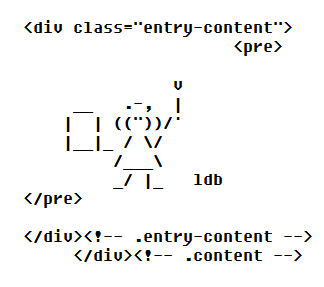
I found a blog posting ASCII art in small text files, cleanly. Quite a nice achievement. I took a look at the code and copied it, but it did not work the same way for me. So, I am looking into it. There may be more to the code than shows on the blog post HTML code. Or, I will see if I can find a way to post a plain text file embedded in the post.

Posted on . Filed in . Tagged with .

Palaeo Art: Prehistory Brought to Life

Palaeo-art is a work of art that brings the prehistoric past to life (as an illustration, this isn't mad science but it may be mad art).

The Online Palaeo Art Community

Posted on . Filed in . Tagged with .

Pretty Much my Final Word on Fetlife

*I'm not looking to meet anyone here just keeping a profile up for the sake of having a login on the site.

For me D/s (domination and submission) are fun. There should be humour, laughter, creativity and exploration. In a Domme/ sub relationship if the woman is playing by his rules, his program, etc then she should at least be getting paid for her time, or allowed to bring along a book to read for the really boring parts.*

Too many times I've given men a chance and ended up with nothing or less than nothing (hope lost). For anyone who is sincere about wanting to meet someone the worst place to spend your time are the very sites which should be your best resource to find someone. The sites are packed with trolls who either want to screw around online only or want to find a woman to screw, physically without actually bothering to know her name or anything else about her.

I don't want to be a woman screwed. If he wants online only he can stay there. If he wants to screw in person he can get a doll at a sex shop. I'm not willing to become a non-person so some walking dickhead can get a screw or screw around.

Yes, I am somewhat bitter. Mostly I'm just annoyed and out of patience with selfish, little men. Sadly, that seems to be pretty much all you find online. I have met very few who could prove to be otherwise).

Posted on . Filed in . Tagged with .

The Most Dangerous Books

Some books, once read, stick with you for the rest of your life whether you like it or not. I can think of a few which won't leave my mind alone. 'The Most Dangerous Game' (written by Richard Connell) is one of them.

Others include 'We Have Always Lived in the Castle' and 'The Lottery', both by Shirley Jackson and 'The Monkey's Paw' (written by W. W. Jacobs) which was a short story I read from a book I found at my Grandparent's house a very long time ago. I still remember the sick feeling of wondering what was at the door. If you have never read it and want a good short story, give it a try.

'The Most Dangerous Game' is about hunters and being hunted. Which do you think is the most dangerous animal to hunt? Lions, tigers and bears... oh my! Not any of those, according to the book. I don't want to give away the story for anyone who doesn't already know it. But, I can say there has never been an adventure quite like the chase which goes on in this book. The ending leaves you guessing, unless you choose to assume things ended in a better way and leave it at that.

You don't need to be into hunting to enjoy this book. If enjoy is quite the right word. It is not a story for children, though it was a story we were required to read when I was a school kid. The story impacted me - I didn't stay up late to sneak downstairs and watch horror on TV as my brother and one of my sisters did. I liked to avoid the gruesome stuff. I still do. But, there are some stories you need to read, some ideas which should be explored, or at least tempted a little. Not that I'm taking up hunting, not as a sport, not after having read 'The Most Dangerous Game' at least once in my life.

Posted on . Filed in . Tagged with .

Photocopy Art

From an original post on Suite101 by Jo Murphy. The post and Jo Murphy's bio link are gone since Suite101 revamped the site.

Copy Art Pioneered in Canada Centre Copie-Art Opened in Montreal in 1982 by Jacques Charbonneau

Although it was an international art movement, Canada is recognised for its major contribution to the art form called Copy Art.

According to the Encyclopaedia of Twentieth Century Photography, Copy Art or Xerography was pioneered in Canada, where it is still popular today. Copy Art, uses the photocopier to create artworks by reproducing and multiplying images. The artists play with the process of transformation of graphic images. They experiment with the metamorphosis brought about by the alchemy of light at the heart of the reproduction technology.

Origins of Copy ArtThe electrography process was developed in the USA and Germany in 1938. But this technology became freely available by the year 1960. Copy Art began to appear as an art form by about 1970, and the first exhibition of this kind of art called "Rochester" was held in 1979. Other exhibitions of this type were held in Canada in the same year.

After making its first appearance in France in 1975, copy art became more accepted. By 1983, an exhibition called "Electra" was held in the Musee d'Art de la Ville de Paris. The gallery devoted considerable space to the art form.

Copy Artist Pati HillArtist Pati Hill exhibited in the "Electra" exhibition, working with shadows, grains, and contrasts of black and white as well as textures and micro textures. To create this work, Hill created imagery from feathers, flowers fabrics and plants, says de Meridieu. In a chapter about innovative pioneers in the book called Digital and Video Art, de Mèredieu goes on to talk about Hill as a contemporary experimentalist and her work as extravagant. An example of Hill's technique, she explains, was to photograph every possible (visible, invisible, obvious and unexpected) of the Palace of Versailles.

Centre Copie-Art of Canada

Copy Art continues to thrive in Canada today. The founder of the Canadian movement was Jacques Charbonneau. After discovering the technique, when he was on holiday, he returned to Canada where he opened Centre Copie-Art in Montreal in 1982.

Body Art and Other Offshoots of Xerography

Practitioners of body art, such as Amal Abdenour and Phillipe Boissonnet, reproduced different parts of the body using photo copiers. They were exploiting variations of colour and the effects of contrast and solarisation. Much of this work was achieved by using overlays of transparencies.

Because it so versatile, there have been many different developments and innovations that have evolved from Copy Art. According to de Mèredieu, magazines and fanzines sprang up around artist centres such as art schools and colleges. A centre recognised as famous for encouraging this type of art form was Ecole des Beaux-Arts in Dijon.

de Mèredieu points to the importance of this movement, when she mentions that Klaus Urbons founded a museum of photocopying in Mulheim an der Ruhr in Germany. Here there are displayed old machines, documentation and artist's work. Another example of the value of the body of work, the style and the method, is the opening in 1990 of a major international museum of electrography in Cuenca in Spain.